
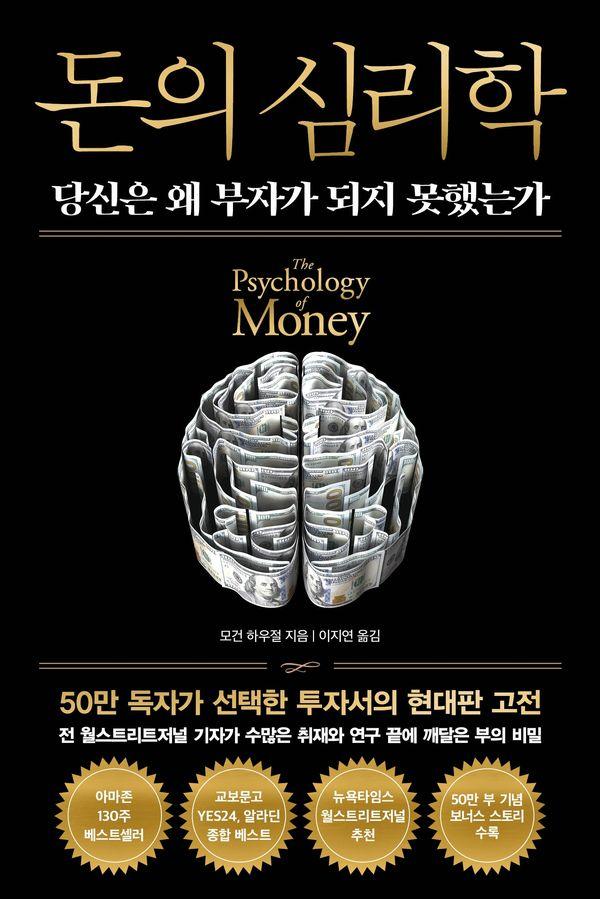
The Psychology of Money: Why You Haven't Become Rich (500,000 Copies Sold New Edition) (Hardcover)
Author Morgan Housel · Publisher Influential · Publication Date 2026-01-14 · ISBN 9791168343443 About the Book★ A modern classic that investors worldwide can't put down★ The #1 must-read investment book chosen by 500,000 readers in Korea★ Amazon 130-week bestseller★ Kyobo Bookstore, YES24, Aladin comprehensive bestseller★ Overwhelming praise from major domestic and international media and world-renowned mastersThe janitor who left behind...
See full description ↓Description
Author Morgan Housel · Publisher Influential · Publication Date 2026-01-14 · ISBN 9791168343443
About the Book
★ A modern classic that investors worldwide can't put down
★ The #1 must-read investment book chosen by 500,000 readers in Korea
★ Amazon 130-week bestseller
★ Kyobo Bookstore, YES24, Aladin comprehensive bestseller
★ Overwhelming praise from major domestic and international media and world-renowned masters
The janitor who left behind 10 billion won vs. the millionaire who went bankrupt overnight
What separated their fates?
In this book, Morgan Housel introduces a fascinating story that made international headlines. Richard Fuscone graduated from Harvard University, earned an MBA, and served as an executive at Merrill Lynch. He was named one of the "40 Under 40 Successful Businessmen" and enjoyed a luxurious life after retiring as a millionaire. He built a mansion with 11 bathrooms, an elevator, and a swimming pool by taking out large loans, and his frequent pool parties became the talk of the town. Then, when the 2008 financial crisis hit, Fuscone went bankrupt overnight. His mansion was foreclosed, and he became penniless.
A few months later, another news story topped the headlines. Ronald Read. With only a high school education, he repaired cars for 25 years, swept department store floors for 17 years, bought a two-bedroom house at age 38, and lived there until his death. The janitor Ronald Read left behind an astonishing 10 billion won in assets after his death. This surprising news topped the headlines.
"Investing is not an IQ test"
The secret to wealth discovered by a Wall Street Journal reporter
Morgan Housel, who has written about finance and investing for over 10 years as a Wall Street Journal columnist, fell into deep contemplation after seeing these two cases. The janitor who left behind 10 billion won and the millionaire investor who went bankrupt overnight. What separated their fates? What was the difference? Morgan Housel says that the simultaneous existence of cases like 'Ronald Read' and 'Richard Fuscone' in our time can be explained in two ways.
First, financial outcomes are not directly related to talent, effort, or education. Second, wealth accumulation is more about psychology than science or numbers. Morgan Housel particularly focused on the second fact and called these soft skills related to money—the psychology of money, one's attitude towards money—"The Psychology of Money."
"The more I studied and wrote about the financial crisis, the more I realized that it was better understood through the lens of psychology and history, rather than finance. To understand why people are burdened by debt, one should study the history of greed, fear, and optimism, not interest rates. To understand why investors sell at the bottom of a bear market, there's no need to study complex calculations of future expected returns. It's quicker to look at your family's faces and recall the painful thought, 'Is my investment jeopardizing our future?'" (p.20)
Becoming rich vs. Staying rich
Warren Buffett stayed rich, while his friend Rick Guerin disappeared
Morgan Housel shares 20 other fascinating stories that vividly illustrate the nature of wealth. A prime example is the story of Rick Guerin. Forty years ago, Rick Guerin was Warren Buffett and Charlie Munger's investing partner. Buffett, Munger, and Guerin invested together and even jointly interviewed managers for their businesses. Then Guerin disappeared. Buffett said:
"Charlie and I always knew that we would become incredibly rich. We were not in a hurry to get rich. We knew it would happen eventually. Rick was just as smart as us, but he was in a hurry." (p.107)
What was different about Rick Guerin compared to Buffett and Munger? During the economic downturn from 1973 to 1974, he used borrowed money to increase his investments. During these two years, the stock market fell by almost 70 percent, and Guerin was required to make additional margin calls. Guerin had to sell his Berkshire Hathaway shares to Buffett for less than $40 per share. Rick Guerin became rich, but he didn't stay rich.
Munger, Buffett, and Guerin were equally skilled at becoming rich. However, Buffett and Munger also had the skill of 'staying rich.' Over time, the most important skill is this: staying rich.
Nassim Taleb, the 'sage of Wall Street,' said this about it: "Being in a favorable position and surviving are completely different issues. The former requires the latter. Catastrophe must be avoided. No matter what."
In the midst of an investment frenzy, what no one has said
"The real reason we should be rich"
Why do you make money? Why do you want to be rich? Why should we be rich? Morgan Housel emphasizes that answering these questions must come before jumping into investing.
Charlie Munger said, "I didn't set out to be rich. I just wanted to be independent." This is the true 'meaning of wealth' in this book. What one seeks through wealth is not a Ferrari. Not a big house. Not wealth itself. It is the power to live as one wishes. This is the true value of wealth.
However, when people think of being rich, they imagine 'spending money.' When they say they want to be a millionaire, they imagine spending a million dollars. They find the meaning of wealth in driving expensive cars, wearing expensive watches, and living in big houses. But such satisfaction is temporary. Shortages return and repeat.
In "The Psychology of Money," Morgan Housel offers a very cautious and thoughtful opinion on the 'meaning of wealth.'
"Wealth is the ability to do what you want, when you want, with whom you want, for as long as you want. This is an invaluable asset, and it is the highest dividend money can pay." In other words, it is the 'power to live as one wishes' that Charlie Munger spoke of.
"Wealth is invisible. Wealth is like a nice car you didn't buy. It's like a diamond you didn't buy. It's a watch you didn't wear, clothes you gave up, and a first-class upgrade you declined. Wealth is financial assets that have not been converted into visible goods." (p.163)
The value of wealth is not in consumption. Wealth is about freedom and independence. The freedom to spend your time as you wish. The freedom not to do things you don't want to do when you don't want to. The freedom not to associate with people you don't want to. This is why we make money and should become rich.
The Rich vs. The Wealthy,
What kind of rich person do you want to be?
"The Psychology of Money" does not teach investment know-how or techniques. Readers expecting such will surely be disappointed. This book makes you think about 'what money and wealth are for.' Through 20 stories, it continuously asks 'what perspective and attitude one should take in pursuing wealth.'
What kind of rich person do you want to be? Are you "the rich" (consumption-rich) who drives a $100,000 car and is faithful to current consumption, or "the wealthy" (asset-rich) who has secured assets for future freedom, even if invisible?
When asked what financial success is, Morgan Housel answers in one word: "Survival, survival, survival." Investing, financial success, is 'survival.' No one always succeeds in investing. There is no natural law that states that if things went well yesterday, they will go well today. But people ignore or disregard this fact.
Buffett's investing partner, Rick Guerin, disappeared. Millionaire Richard Fuscone also went bankrupt overnight. That's capitalism. There is no eternal luck, and the world is not kind. Therefore, whether in investing, career, or business, survival must be the fundamental basis of strategy. No matter how large the profit, it's not worth risking annihilation.
Housel emphasizes the path to wealth that survives without going bankrupt or being annihilated.
From a World War II anecdote to Bill Gates' confession
20 investment stories that will instantly captivate you
True to his nicknames "storytelling genius" and "financial writer with a novelist's skill," the 20 investment stories Morgan Housel tells are immensely captivating. Each is based on real events and evidence, incorporating both engaging narratives and investment lessons. From the story of German tank divisions during World War II, Bill Gates' confession about founding Microsoft, episodes from his time working as a valet in LA, to the secret of Warren Buffett's astonishing returns, he unfolds diverse stories in an intriguing way that instantly captivates readers. Moreover, each story ends with insights that evoke both admiration and reflection.
After its publication, the world's reaction was fervent. The Wall Street Journal and The New York Times showered it with praise, and many professional investors posted glowing reviews on social media, calling it "the best financial book of 2020" and "the most original book I've ever encountered." It rose to #1 in the investment category on Amazon and remains at #1 five years after its release.
Amidst the 2020 bubble debate, referred to as the largest liquidity in history, a fierce investment craze continues. In this context, the message of "The Psychology of Money" might pour cold water on some. However, if one aims for longer-term, less regrettable investments, the message of this book is like a track that must be acknowledged at least once. It doesn't matter whether you invest in stocks or real estate. If you don't first define why you want to make money and where you stand, you might face extreme situations like bankruptcy or ruin when a crisis hits. I will repeat what was said earlier: catastrophe must be avoided. If you go bankrupt due to directionless investments, there will be no second chance. Survive. The first step to survival will be understanding 'The Psychology of Money.'
Table of Contents
Introduction _How much do you know about money?
story 1. No one's crazy
story 2. Where does luck end and risk begin?
story 3. Never enough
story 4. Confounding compounding
story 5. Getting wealthy vs. staying wealthy
story 6. Tails, you win
story 7. The freedom of time
story 8. Man in the car paradox
story 9. Wealth is what you don't see
story 10. Save money
story 11. Reasonable > Rational
story 12. Surprise!
story 13. Margin of safety
story 14. You'll change
story 15. Nothing is free
story 16. You and Me
story 17. The seduction of pessimism
story 18. When you'll believe anything
story 19. All together now
story 20. My own history with money
More Stories _How did these ideas about money form?
bonus story 1. A brief history of why the world is the way it is
bonus story 2. A little bit of everything
Acknowledgments
References
Product Details
Related products




The book is priced at its original Korean retail price (KRW 1,000 = A$1). Air freight is charged separately at checkout.
Orders close every Tuesday, are sent to Korea on Wednesday, and arrive in store one week after dispatch — 8 to 14 days from your order. Order today and pick up from Wed 7 Oct; we'll email you as soon as your books arrive.
Collect at the book corner in our Lidcombe or Eastwood store. No home delivery. Please have your order number and name ready.
First book A$15 + A$6 per extra book — 1 book $15 · 2 books $21 · 3 books $27 · 4 books $33, calculated automatically at checkout. The more books you order together, the lower the cost per book.
Titles temporarily out of stock in Korea may be delayed by about one week. If a title is out of print or unavailable, we refund that book in full and proceed with the rest of your order.
 The Psychology of Money: Why You Haven't Become Rich (500,000 Copies Sold New Edition) (Hardcover)
$24.80
The Psychology of Money: Why You Haven't Become Rich (500,000 Copies Sold New Edition) (Hardcover)
$24.80