
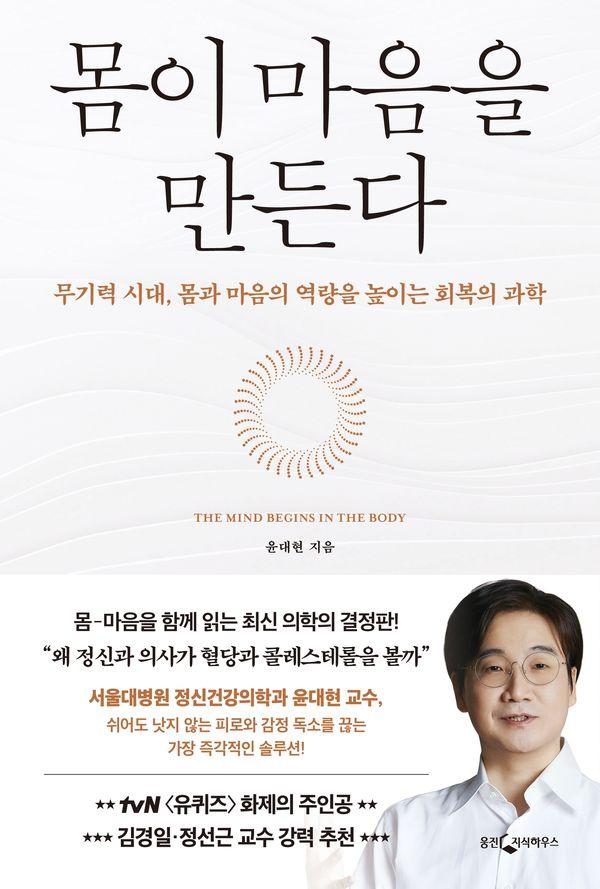
The Body Makes the Mind: The Science of Recovery to Enhance Body and Mind in an Apathetic Age
Author Yoon Dae-hyun · Publisher Woongjin Thinkbig · Published 2026-06-01 · ISBN 9788901299914 About the Bookㆍ“The root cause of recurring lethargy, depression, and anxiety lies in 'bodily metabolism'”Blood sugar, cholesterol, visceral fat… A new approach to mental recovery proposed by Metabolic Psychiatry“Why does a psychiatrist look at blood test results?” This is the most common question Professor Yoon Dae-hyun of...
See full description ↓Description
Author Yoon Dae-hyun · Publisher Woongjin Thinkbig · Published 2026-06-01 · ISBN 9788901299914
About the Book
ㆍ“The root cause of recurring lethargy, depression, and anxiety lies in 'bodily metabolism'”
Blood sugar, cholesterol, visceral fat… A new approach to mental recovery proposed by Metabolic Psychiatry
“Why does a psychiatrist look at blood test results?” This is the most common question Professor Yoon Dae-hyun of the Seoul National University Hospital Department of Psychiatry and Mental Health hears in his clinic. For over 20 years, the author has treated patients in a mental clinic connected to internal medicine outpatient services and a health promotion center, examining both their mental state and blood test results. What he confirmed through this process is that the body and mind never move separately. Behind symptoms that outwardly appear to be psychological problems, such as depression, anxiety, and panic attacks, were underlying bodily changes like unstable blood sugar, hyperlipidemia, visceral fat, and inflammatory responses.
These changes are also becoming a significant trend in the medical field recently. ‘Metabolic Psychiatry,’ which seeks to understand mental problems in conjunction with overall bodily changes such as blood sugar, inflammation, hormones, gut health, and metabolic status, is gaining attention. Major medical institutions worldwide, including Stanford Medical School and McLean Hospital, affiliated with Harvard Medical School, are operating related clinical and research programs, signifying a global movement towards a holistic understanding of the body and mind.
Professor Yoon Dae-hyun's new book, 『The Body Creates the Mind』, based on this trend, proposes a new perspective: the ‘body-mind integrated system’ for those who repeatedly fail at managing their minds. If lethargy, anxiety, and depression are recurring, it's time to listen to the signals the body sends, rather than just focusing on the mind.
ㆍ“In an era of energy depletion, willpower alone is no longer enough to endure”
A warm bowl of ‘seaweed soup’ can change your life more than efforts to steady your mind
Many people, amidst lethargy and burnout, try various methods such as meditation and mindfulness. However, there are times when trying to steady the mind only leads to collapse. Feeling anxious in an anxious situation is natural, and if one forcibly pushes for positive thoughts, it can create ‘cognitive dissonance’ due to the widening gap between actual feelings and ideal feelings.
In an era where AI is rapidly shaking up jobs and lifestyles, and extreme change has become daily life, we are in an environment where it is difficult to endure with mental strength alone. Mind management methods like ‘think positively’ or ‘love yourself’ have their limitations. In such times, the author offers an unexpected prescription: eat a warm bowl of seaweed soup. This implies that comforting the stomach with nutritious meals can be a more realistic form of mind management than forcibly steeling one's will when the mind feels like it's collapsing. The author emphasizes that immediate ‘physical intervention’ helps, such as reducing cortisol by walking for 20 minutes in a forest or park when the mind is cluttered, or supplementing protein with a bowl of oxtail soup on lethargic days.
The brain is the organ that consumes the most energy in the body. When blood sugar is unstable, inflammation levels rise, and mitochondrial function declines, the brain does not receive enough necessary energy. This results in symptoms such as fatigue, decreased concentration, lethargy, and mood swings. Therefore, when one feels ‘mentally weak,’ restoring energy metabolism becomes the most fundamental solution. This book provides specific guidance on what to eat, what signals to observe, and what actions to start with when the mind is struggling, offering ways to reset the body-mind metabolic system.
“If we continue to rely only on past methods of changing our thoughts and steeling our minds, the burden due to the resulting gap will only increase. We need to change the question. It should not be ‘How can I think more positively?’ but ‘What are the practical methods that can enable recovery in this current state?’ ” (p. 40)
When the mind is cluttered and unsettled
→ Walk for 20 minutes in a forest or park
(The peace of the forest and natural light stimulate lower cortisol and aid prefrontal cortex recovery)
When feeling blank and unable to concentrate during an afternoon meeting
→ Take a 5-minute walk in the sunlight
(Combining outdoor light stimulation with physical activity helps restore the prefrontal cortex's concentration function)
When anxiety grows for no particular reason
→ Check average weekly sleep duration
(If the average sleep duration is less than 7 hours, sleep deprivation is likely the cause of anxiety)
When the heart is racing
→ Practice 4-2-6 breathing for 1 minute
(Inhaling for 4 seconds, holding for 2 seconds, and exhaling for 6 seconds activates the vagus nerve, helping to stabilize heart rate)
ㆍ“Emotional toxins accelerate your aging”
The biological traces rumination leaves on the body and how to break the vicious cycle
Negative emotions such as sadness, anxiety, anger, and worry come to everyone. The problem is when these emotions are repeated and become chronic. The body perceives recurring negative emotions as continuous stress, which affects the entire system through hormonal changes, inflammatory responses, and metabolic imbalances. Mental distress doesn't just stay in one's mood. It leaves traces in blood parameters like blood sugar, blood pressure, and cholesterol, and also impacts cellular aging.
The author refers to these negative emotions that accumulate in the body and disrupt its system as ‘emotional toxins.’ Among them, the most persistent emotional toxin is ‘rumination.’ Rumination is a thought pattern where one constantly rehashes past experiences and thoughts and remains stuck in them. While repeatedly asking unanswerable questions like ‘Why am I like this?’, ‘Why did this happen again?’, the body perceives past events as current stress. As a result, the secretion of the stress hormone cortisol and inflammatory responses continue, and a burden accumulates on blood sugar regulation, vascular health, and the metabolic system. Recurring negative thoughts in the mind ultimately affect the rate of physical aging.
However, rumination is not something that can be easily stopped just by deciding to ‘stop thinking about it.’ This is because it is more akin to a thought pattern that the brain repeatedly generates in the process of dealing with threats and anxiety. Therefore, this book offers methods to transform abstract thoughts into concrete actions, restore the sense that one can choose again, and identify patterns of when and under what bodily conditions certain thoughts recur. When rumination is understood not as a vague emotion but as a process that can be interrupted, the possibility of escaping its cycle increases.
Even by just effectively managing rumination, one can reduce the vicious cycle that affects not only the mind but also blood sugar, blood vessels, inflammation, and the metabolic system. Ultimately, recovering one's mind is not about having more positive thoughts, but about breaking the repetitive cycle that sickens and ages the body.
ㆍ“The goal of mind management is not tranquility but system recovery”
Mind recovery methods for modern people suffering from ‘brain fry’ in the AI era
People experience stress even when good things happen. Change, whether joyful or difficult, burdens the body and mind. Therefore, in an era where extreme change has become daily life, feeling ‘tired’ is perhaps a natural reaction. The author states that the goal of mind management needed now is not ‘perfect tranquility’ but ‘body and mind system recovery’ – the ability to return to normal even when shaken by change.
In particular, as AI rapidly changes work and lifestyles, our brains are placed under an overloaded state, having to process more information, judgments, and choices. In fact, the phenomenon where office workers who use AI extensively complain of ‘a buzzing in their heads,’ ‘inability to concentrate,’ and ‘slowed judgment’ has been termed ‘brain fry.’ It literally describes the feeling of the brain being fried. While AI does not experience fatigue, humans are still embodied beings. No matter how much work machines take over, our minds operate on the basis of bodily energy and resilience.
Therefore, especially in the AI era, what's important is not techniques to forcibly steel the mind, but restoring the body's foundation so that the mind doesn't collapse. When the body and mind are reconnected in a way that nourishes each other, we can finally move forward again. The beginning may not be a grand resolution or a special prescription. Perhaps it might start with a very small choice that reassures one's body, like slowly eating a warm bowl of seaweed soup.
Table of Contents
Foreword
Prologue Why a psychiatrist looks at blood sugar and cholesterol levels first
Chapter 1 The Paradigm of Psychiatric Treatment Is Changing
Why did psychiatry start looking at the body?
Stress doesn't end with mood
‘Think positively’ no longer works
The power to endure comes from the body, not the mind
Is your brain recovering or being depleted?
Change is difficult not because of willpower
The goal is ‘system recovery,’ not ‘tranquility’
Chapter 2 How Body Inflammation Spreads to the Mind
The more visceral fat, the more depression
The problem is metabolism, not weight
When the mind is distressed, manage hyperlipidemia first
How depression changes the brain
Skin is also part of the body-mind system
How to read your body's signals
Learn More Can Botox improve depression by smoothing wrinkles?
Chapter 3 When Emotions Accumulate in the Body Like Toxins
Why emotions appear in blood test results
The worst emotional toxin is rumination
Rumination puts the body in a state of chronic stress
Accumulated emotional toxins accelerate aging
Emotions and the body are a single closed loop
Learn More Self-check ‘Thought BMI’
Chapter 4 Redesigning the Body-Mind Recovery System
How can rumination be stopped?
Thought diet, strategies to reduce rumination
Behavioral prescriptions to break repetitive thoughts
Five cognitive strategies for mental recovery
What to eat to recover the mind
Chapter 5 Living as an Embodied Human in the AI Era
Why do we get tired so easily?
How to recover through positive storytelling
How AI changes the human mind
Why is machine empathy dangerous?
Life operates as a connected system
Epilogue The most realistic way to create a virtuous cycle of recovery
Notes
Product Details
Related products


The book is priced at its original Korean retail price (KRW 1,000 = A$1). Air freight is charged separately at checkout.
Orders close every Tuesday, are sent to Korea on Wednesday, and arrive in store one week after dispatch — 8 to 14 days from your order. Order today and pick up from Wed 4 Nov; we'll email you as soon as your books arrive.
Collect at the book corner in our Lidcombe or Eastwood store. No home delivery. Please have your order number and name ready.
First book A$15 + A$6 per extra book — 1 book $15 · 2 books $21 · 3 books $27 · 4 books $33, calculated automatically at checkout. The more books you order together, the lower the cost per book.
Titles temporarily out of stock in Korea may be delayed by about one week. If a title is out of print or unavailable, we refund that book in full and proceed with the rest of your order.
 The Body Makes the Mind: The Science of Recovery to Enhance Body and Mind in an Apathetic Age
$19.00
The Body Makes the Mind: The Science of Recovery to Enhance Body and Mind in an Apathetic Age
$19.00