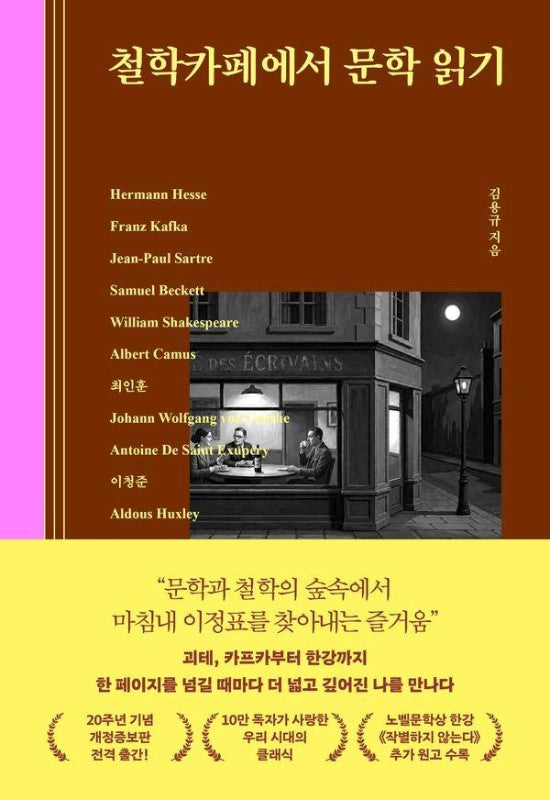
Reading Literature at the Philosophy Cafe (Revised Edition)
Author Kim Yong-gyu · Publisher Ungjin Jishik House · Published 2026-07-22 · ISBN 9788901300290 About the BookInto the BookNight prepares for the coming dawn, and winter anticipates the blooming spring. This is precisely what the Philosophy Cafe aims to do: to open the window while awaiting the brightening twilight, to silently pray for you, a beautiful landscape, and to write...
See full description ↓Description
Author Kim Yong-gyu · Publisher Ungjin Jishik House · Published 2026-07-22 · ISBN 9788901300290
About the Book
Into the Book
Night prepares for the coming dawn, and winter anticipates the blooming spring. This is precisely what the Philosophy Cafe aims to do: to open the window while awaiting the brightening twilight, to silently pray for you, a beautiful landscape, and to write a letter to you, saying "I love you." I hope you will accept it with joy.
--- p.11
As a cafe, the Philosophy Cafe naturally offers not only branded coffee, cappuccinos, and cafe lattes, but also espressos. All of them possess rich aromas and unique flavors. This means that a variety of content is available, from trivial information about works to various topics that can cultivate knowledge, and even philosophical interpretations of them. Therefore, your choice is your freedom.
--- p.13
Then, the answer to the question we wanted to know, "On what basis could Goethe rescue Faust from the clutches of Mephistopheles?" has already been presented by Goethe. However, considering that Faust made no effort or struggled for his salvation, what could this statement truly mean?
--- p.55
A mature human being is one in whom the two opposing worlds within them, like Mrs. Eva, are in harmony. Only such a person can "discover the secret hidden within themselves, shed that shell, and return to their true nature," that is, achieve self-realization.
--- p.84
Today, the city is still bustling and noisy with people. Yet it feels like a desert. We meet countless people today. Among them are colleagues, friends, and family. Yet we feel lonely. So we soon ask, "We meet, but did we truly meet?"
--- p.88
From this perspective, jealousy, whether Othello's evolutionary psychological jealousy or the ontological jealousy depicted in "Flower Crab Grave," is clearly a type of neurotic symptom. It is a psychological illness. From Fromm's perspective, jealousy is not another face of love but merely another face of possessiveness. Therefore, we can now answer the question posed at the beginning of this essay: "Can there be love without jealousy, or jealousy without love?"
--- p.132
This means that even from his family, he received cold treatment, as in "the things in the next room must be removed." The terrifying truth this work reveals is Kafka's insight that even the purest and most beautiful familial love is based on economic relationships. Therefore, even if it is family, if the economic relationship, that is, his "what-it-is-ness," changes, the love for him also changes accordingly.
--- p.143
Marcel believed that all humanity begins at home. Therefore, he asserted that "for a human to be human, they must be 'familial'." According to him, the family is the first "community" in this world that can be called "we (le nous)" in the purest sense.
--- p.149
Sartre called the essence of the popular life enjoyed by modern people who speak like others, live like others, and find peace within it, what Kierkegaard perceived as leveling, conformism (le conformisme). The cafe customers and strolling crowds in *Nausea* are prime examples of this.
--- p.168
The boredom that Vladimir and Estragon in Beckett's *Waiting for Godot*, and all of us more than anyone else, fundamentally embrace, is "deep boredom." If you think about it, this boredom is the fundamental and fated boredom of the human condition, being caught by death, which may come at any time and whose nature is unknown, while at the same time being placed in a void.
--- p.203
To be without one's own private place means no longer being human. _Hannah Arendt
--- p.258
If we, for any reason, abandon the path to a 'society where humans live as humans,' what would we truly be? What path would we be on then, and what should we call ourselves? Should we call ourselves beasts? Please consider it.
--- p.283
Through this scene, Huxley's point is clear: there is something more important to humans than happiness and stability, and that is freedom. Even at the cost of unhappiness, humans desire the right to choose and carry out their own lives freely.
--- p.304
Here lies a problem that confronts the utopia we dream of—a problem that is most serious but easily forgotten. It is that a utopia must be humane not only in its ideals but also in its methods of realization.
--- p.330
In this way, for Proust, recollection not only overlaps two different times but also places two different spaces side by side, thereby creating a "supernatural space." Pule explained this by saying, "Thanks to memory, time is not lost. If time is not lost, space is not lost either. With retrieved time, there is also retrieved space."
--- p.356
*I Do Not Bid Farewell* is Han Kang's visceral outpouring of that non-language—that wail that is neither poetry, prose, literature, nor language, nor civilization—that lump of fresh blood, that pile of charcoal ash, that overturned sea, that mad blizzard. It is a narrative written while enduring the human suffering that Primo Levi, who survived Auschwitz, described as "the moment I felt myself to be human, that is, the moment I felt responsibility."
--- p.368
This arduous yet profound journey, this flickering candle, will someday save us. Just as Proust's recollection saves individuals, Han Kang's mourning will save the community. It will let us know who we are and what we must do, guiding us from hell to heaven. This is surely why Han Kang, regarding *I Do Not Bid Farewell*, states, "Like my other novels, this novel also speaks about human violence, but ultimately, like lighting a candle at the end of the novel, it is a novel that is moving towards that brightness, towards light," and therefore asks that it be read as "a novel about profound love."
--- p.402
Table of Contents
New Edition Commemorative Foreword: Once Again, Sitting by the Cafe Window
Preface: Cafe Latte? Or Espresso?
Resignation? Or Realization?
- Goethe's *Faust* Part 1
Mephistopheles also tempts you | From history to myth | Judged, redeemed | I watered the potted plant by the window with tears | The ultimate self-denial, infinite self-resignation
The Man Who Even Conquered the Devil
- Goethe's *Faust* Part 2
Why did God save him? | The eternal feminine leads us upward | Indiscriminate self-realization, brutal courage | Genealogy of Romanticism | Religious salvation and secular salvation
How to Quell Storm and Stress
- Hermann Hesse's *Demian*
Emil is everywhere | Between the world of light and the world of darkness | The bird breaks out of its egg | Paternal conscience and maternal conscience | Bravely, and without fear
The Aesthetics of Encounter and Relationship
- Antoine de Saint-Exupéry's *The Little Prince*
We meet, but did we truly meet? | The desert is within us | What is essential is invisible | In the beginning was the relationship | Why the stars look beautiful
The Functional Relationship Between Love and Jealousy
- William Shakespeare's *Othello*
Between love and jealousy | Encountering the green-eyed monster | A naturalistic interpretation of jealousy | Between Eros and Agape | Love, that desolate and empty feeling | To possess, or to love?
The Cold Hard Truth About Family
- Franz Kafka's *The Metamorphosis*
Home is not a sanctuary | Kafka's unsettling truth | The evil spirit unleashed by capitalism | To be human, one must be 'familial' | The way home, the way back to being human
Breaking from Unbearable Routine
- Jean-Paul Sartre's *Nausea*
I wanted to shoot myself | Loathsome daily routines | Superfluous existences | Where is the escape? | Life is meaningless, therefore, it is meaningful
An Actor Without a Script on an Empty Stage: Humanity
- Samuel Beckett's *Waiting for Godot*
Boredom that even melts time | The unbearably heavy meaninglessness of life | Eternal silence in infinite space | To fall, or to exist?
I Rebel, Therefore I Exist
- Albert Camus's *The Plague*
Sometimes I, too, stand in the desert | Absurdity, the meaninglessness of life and the world | People facing absurdity | The rebellious human, Sisyphus | A slightly different 'giving meaning to meaninglessness' | Even if it's not true, as if it were
Where is That Island?
- Choi In-hun's *The Square*
A problem that must be solved by oneself | Public square or private room? | Public sphere or private sphere? | *Utopia* VS. *New Atlantis* | The way to that island
Your Heaven, Our Hell
- Lee Cheong-jun's *Your Heaven*
Those who act do not dream | The difficult and arduous path to heaven | Three protagonists, three answers | We can revert to beasts | Is 'our heaven' an impossible dream?
We Demand the Right to Be Unhappy
- Aldous Huxley's *Brave New World*
Are there rules for a human farm? | First blueprint, eugenics | Second blueprint, behaviorist psychology | *The Republic*, *Rules for a Human Farm*, and *Brave New World* | The right to create one's own future
Big Brother is Watching You
- George Orwell's *Nineteen Eighty-Four*
The revival of 'Procrustean bed' | What happens in Room 101? | What we lose in a surveillance society | What we lose in a totalitarian society | Can humans forget that humans are human?
A Time Travel to Find Myself: Recollection
- Marcel Proust's *In Search of Lost Time*
Love goes, old times remain | Memory and recollection | Juxtaposition of time, coexistence of past, present, future | Juxtaposition of space, the super-temporal space created by recollection | Retrieved time, retrieved space, retrieved self
A Time Travel to Find Ourselves: Mourning
- Han Kang's *I Do Not Bid Farewell*
Did such a thought not occur to you? | A historical tragedy turned into a question mark | So death passed me by | An unforgettable person, an unabandonable project | As stars are sucked into a massive black hole | Han Kang's ghost, Levinas's black hole | Discrepancy between fact and truth, discrepancy between proof and understanding | The arduous journey to profound love
Product Details
Related products

The book is priced at its original Korean retail price (KRW 1,000 = A$1). Air freight is charged separately at checkout.
Orders close every Tuesday, are sent to Korea on Wednesday, and arrive in store one week after dispatch — 8 to 14 days from your order. Order today and pick up from Wed 4 Nov; we'll email you as soon as your books arrive.
Collect at the book corner in our Lidcombe or Eastwood store. No home delivery. Please have your order number and name ready.
First book A$15 + A$6 per extra book — 1 book $15 · 2 books $21 · 3 books $27 · 4 books $33, calculated automatically at checkout. The more books you order together, the lower the cost per book.
Titles temporarily out of stock in Korea may be delayed by about one week. If a title is out of print or unavailable, we refund that book in full and proceed with the rest of your order.
 Reading Literature at the Philosophy Cafe (Revised Edition)
$20.00
Reading Literature at the Philosophy Cafe (Revised Edition)
$20.00