
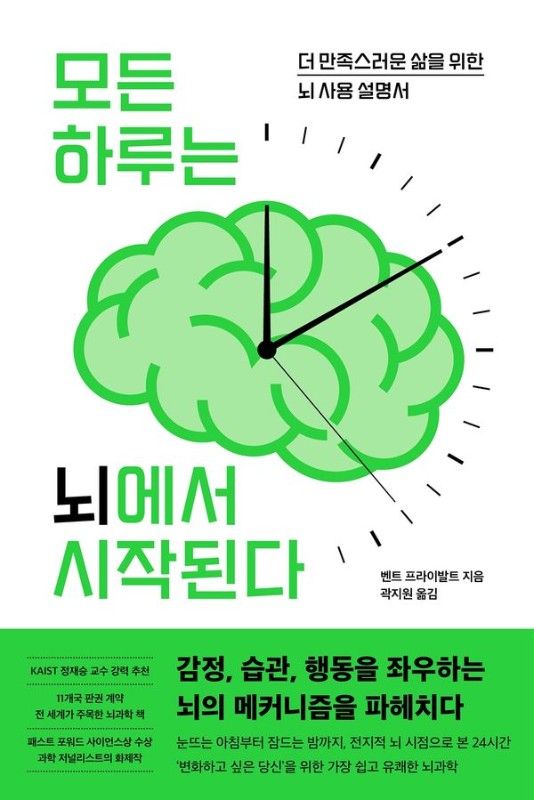
Every day begins in the brain.
Author Bent Freiwald · Publisher RHK · Published 2026-08-24 · ISBN 9788925568379 About the BookUnderstanding the Brain Through ‘My Day’When an Ordinary Day Meets NeuroscienceFrom 3 AM, deep in dreams, until bedtime, "Every Day Begins in the Brain" explores the brain by following our ordinary daily routines. The brain is constantly working during familiar moments like sleeping, waking up, eating...
See full description ↓Description
Author Bent Freiwald · Publisher RHK · Published 2026-08-24 · ISBN 9788925568379
About the Book
Understanding the Brain Through ‘My Day’
When an Ordinary Day Meets Neuroscience
From 3 AM, deep in dreams, until bedtime, "Every Day Begins in the Brain" explores the brain by following our ordinary daily routines. The brain is constantly working during familiar moments like sleeping, waking up, eating breakfast, working, meeting people, and exercising. What makes this book unique is precisely this "familiarity." Because it explains neuroscience through scenes everyone experiences daily, rather than unfamiliar cases or special situations, readers naturally connect the book's stories to their own experiences.
How much do we truly know about what happens inside our brains during those familiar moments of sleeping, waking, and eating breakfast? For instance, even at 3 AM when we're dreaming, the brain doesn't rest. During REM sleep, visual areas activate, just as they do when awake, creating dream scenes, and memory-related brain regions activate, bringing past experiences into dreams. Conversely, activity in areas involved in rational judgment decreases, allowing us to accept scenes that would be nonsensical in reality as natural within a dream. Even the phenomenon of "dreaming," which we experience daily but rarely examine, is viewed anew through the lens of brain function.
In this way, this book doesn't just present neuroscience as knowledge to be acquired. By encouraging readers to apply it to their own daily lives, it helps them understand the abstract principles of brain function as their own stories. It doesn't just stop at "learning" neuroscience; it allows readers to "experience" it through their own day.
This approach aligns with the author's long experience of communicating neuroscience to the public through podcasts and newsletters. Rather than delivering technical jargon and complex research results directly, the author, skilled at translating them into everyday scenes everyone has experienced, explains the latest neuroscience research in easy-to-understand and approachable language. This allows readers unfamiliar with neuroscience to grasp brain mechanisms by following their own daily routines.
Answering All Everyday Questions
Useful Neuroscience for a Better Day
While our lives vary, our concerns and questions are similar. How can we sleep better? How can we improve work efficiency? How can we break harmful habits? How can we overcome the grief of a breakup? Why can't we put down our smartphones? The author says that to find answers to these questions, we must first understand the brain that drives our actions and emotions. Knowing the brain's mechanisms not only allows us to view everyday problems from a new perspective but also helps us find ways to create a more satisfying life.
For example, why do we tend to overeat even when we want to maintain healthy eating habits? It takes several minutes for the brain to process nutritional information and register satiety, so eating too quickly can lead us to consume more than necessary before we feel full. If, in addition, recent body fat has decreased, the hypothalamus interprets this as a crisis signal, further increasing appetite through brain activity. This is why diet control failures cannot be solely attributed to a lack of willpower. And that's not all. This book also shares valuable knowledge about brain mechanisms useful for our lives, such as how the brain processes feelings of loss during dreams and the principles behind how exercise helps alleviate depressive symptoms.
Therefore, understanding the brain allows us to find clues on how to change, instead of reprimanding ourselves for lack of control or self-restraint. By knowing what to do for good sleep, what environment to create for better concentration, and how to manage stress and emotions, we can change our small daily choices for the better.
Ultimately, understanding the brain is about understanding ourselves more accurately. When we know why we repeat certain behaviors or in what environments we concentrate more easily, we can find suitable methods for personal change. This is what this book calls "understanding the brain and regaining control of your life."
From the Book
I will explain what happens inside your brain. In this process, you will learn knowledge that is truly helpful in your daily life. How to control dreams, why concentration falters in an open-plan office, the real secret to exercising more, how to reduce smartphone use, common traits of people with strong willpower, why you laugh at the same jokes as your friends, why you black out when you drink too much, why stress keeps you from sleeping, and even the solutions to these problems.
---p.12
Scientists believe a similar pattern occurs in the human brain. Memories are stored by reactivating daytime experiences hundreds of times during sleep. This is one of the crucial reasons we need to sleep. However, this high-speed simulation primarily occurs during non-dreaming stages, so we are completely unaware of it.
But recent research suggests that during the dreaming stage (REM sleep), the brain goes a step further. It doesn't just review; it mixes new memories with old ones. It creates a "life mixtape" that forms unexpected connections between memories, which becomes the biological foundation for the "creativity" we yearn for.
---pp.44-45
Subjects who dreamed about emotional pain, such as breakups, had recovered from their depression. Matthew Walker described this as dreams acting as "nighttime psychotherapy." It's a perfect cure that doesn't even require a waiting period. So, how exactly does our brain perform such magic?
---p.48
Such optical illusions and differences in interpretation reveal an important truth: how we perceive the external world depends more on what happens inside our brains than on the external world itself.
(…) We live by trusting what we see and hear every day. But at the same time, realizing that we always perceive the world in an "interpreted state" can lower the intensity of heated arguments. If we perceive even the same wavelength of color differently, what about when we debate immigration policies with friends? What about when we communicate through facial expressions and gestures? And what about when we read complex research results and statistics? (…) We interpret the same world, the same data, the same wavelengths in completely different ways.
---pp.80-81
The problem arises when adenosine binds to these 'dual receptors'. When adenosine occupies the spot, it becomes difficult for dopamine to sit in its place. It's similar to a situation on a bus where a man spreads his legs excessively on a two-person seat, forcing you to stand. Dopamine wants to lift your mood, but it can't do its job properly if there's no space. However, when caffeine appears, the situation changes. Caffeine takes adenosine's place instead. But it doesn't spread its legs. It sits quietly in its half-seat. Then dopamine can also sit comfortably next to it. As a result, you feel better. It's the same in the brain as on the bus.
---p.90
Our decisions are not fixed. The brain adjusts its decision-making style to suit the situation. Sometimes quick decisions are needed (e.g., in dangerous situations), and sometimes careful decisions are required (e.g., during interviews). In stressful situations, the brain tends to prioritize speed over accuracy. This is why people often rely on habits under pressure or stress. When there's no time for complex deliberation, simply doing what you've always done is more efficient.
---p.109
However, if this alarm state is repeatedly triggered by continuous consumption of high-fat or high-sugar foods, the temporary response becomes chronic. Glial cells become accustomed to this constant stimulation, as if continuously searching for potential invaders. As a result, the arcuate nucleus in the hypothalamus, the affected brain region, stops responding properly to leptin and insulin hormones. These hormones originally tell the brain, "Hey, that's enough!" but this function becomes paralyzed. Consequently, instead of feeling full, your hypothalamus remains in 'hunger mode'.
---p.112
Many people believe that a dopamine detox can 'reset' dopamine levels. But our brains don't work that way. Dopamine is not a substance that can be refilled through detox once 'used up.' It is continuously produced and regulated. In short, you cannot 'fast' from naturally occurring brain chemicals.
---p.134
The body is very important for thinking. However, our surrounding environment plays an equally significant role. In cognitive science, this is called 'embodied cognition' or 'distributed cognition.' This is the idea that cognition is not simply controlled by the brain or influenced solely by the body, but strongly interacts with the physical environment we inhabit. Our thoughts and actions are embedded within a network of environmental factors. Consider the act of writing a grocery list. We use paper and pen, or an app, to reduce the load on our memory. In this case, the memo pad is not just a tool, but becomes part of your thought process. The brain is, in a sense, 'outsourcing.' Tools and technology are considered aids that expand our cognitive abilities.
---pp.180-181
The reason noise has such a powerful impact on our cognition lies in how the brain processes stimuli. The brain doesn't just passively receive its surroundings; it actively 'predicts.' In other words, your brain constantly forms hypotheses about what will happen next. The more difficult it is to predict the environment, the more energy is consumed in processing it.
(...) What particularly troubles us are so-called 'half-conversations,' such as overhearing only one side of a phone call from a customer at the next table in a cafe. American psychologist Lauren Emberson proved that when we only hear half of a conversation during work, our attention is far more dispersed than when we hear the entire conversation. The reason is simple: our brains automatically try to fill in the missing half of the information. This process exhausts the brain and ultimately erodes our valuable cognitive resources.
---p.182
Research on the short-term effects of naps has already been active. The remaining question is what difference a regular napping habit makes in old age. To clarify this, a Japanese research team conducted a five-year follow-up study on adults aged 65 and over. Cognitive function was measured at the beginning and end of the study, and participants recorded their sleep habits, napping habits, and other lifestyle factors through interviews. The most important result for us is this: people who enjoyed short naps (less than 30 minutes) had almost a 50 percent lower risk of developing memory and thinking problems compared to those who did not.
---pp.200-201
Like other addictive substances, dopamine is at the heart of love. Therefore, if love departs and the dopamine supply is cut off, we must find it elsewhere. That means we must induce the brain to produce dopamine on its own by trying things we've never done before. This could include joining a sports club for the first time and learning a new sport, going to a play after several years, taking a pottery class, undertaking a new professional challenge, or trying unfamiliar cooking recipes. In short, it means 'throwing yourself into life.' According to Fisher, such attempts not only help heal the wounds of lost love but also prepare us to meet someone new again someday.
---pp.314-315
Table of Contents
Introduction: A Few Thoughts
AM 3:00 While You Sleep
How Neuroscientists Discovered Dreams
What Happens in the Brain When You Dream
How the Brain Decides What to Dream About
The Healing Power of Dreams
Why Do We Have Nightmares?
Scientific Ways to Deal with Nightmares
How to Control Dreams
AM 6:30 Waking Up the Day with a Cup of Coffee
The Brain Wakes Up
The External World as a Puzzle
Why You Can't Trust Your Perception
Can Coffee Be Addictive?
How Coffee Wakes You Up
AM 8:00 The Brain's Desired Breakfast
How the Brain Knows Hunger
How the Brain Dictates Our Actions
Why We Feel False Hunger
Why You Love Ice Cream But Hate Broccoli
Can Sugar Be Addictive?
The Impact of Habits on Eating Habits
Should You Do a Dopamine Detox?
Why Diet Management Shouldn't Rely Solely on Willpower
AM 9:00 Work Time Requiring Concentration
Your Brain is Not a Computer
Nature Changes Your Brain
Why Nature Is So Beneficial
Unconscious Signals from Your Body
Why You Need to Keep Moving While Working
Why Does Concentration Lapse in Cafes?
Music That Helps vs. Hinders Work
PM 1:30 Short Nap and Regrettable Meeting
The Impact of Naps on Your Brain
Things to Keep in Mind When Napping
Why Thoughts Change When Thinking Together
Why Brainstorming Produces the Worst Ideas
PM 6:00 The Brain Exercising After Work
Why Just Watching Sports Helps
Imagination Makes You a Better Athlete
How Exercise Makes You Smarter
How Much Exercise Is Enough?
Exercise Helps Mental Health
How to Convince Your Brain to Exercise Regularly
What Determines Self-Control?
Can Willpower Be Trained?
Common Traits of People with Strong Self-Discipline
PM 8:00 A Beer with Friends
Does Your Brain Have a Sense of Humor?
How Alcohol Changes Your Brain
Why Do You Black Out When You Drink a Lot?
PM 9:00 Memories of First Love Resurface
What Happens in the Brain When You Fall in Love
How Your Brain Gets Engulfed in Jealousy
What Happens in the Brain When You Experience a Breakup
Neuroscience Insights into Maintaining Relationships
PM 10:00 Before Bed, a Book Instead of a Smartphone
Why You Can't Put Down Your Smartphone
The Benefits of Reading
Why Reading Today Is Different from Before
How to Read with Renewed Focus
How the Brain Processes Audiobooks
PM 11:00 Time to Go to Sleep
Why Stress Keeps You from Sleeping
Why Do You Crave Unhealthy Foods When You Don't Get Enough Sleep?
What Happens in the Brain When You Lack Sleep
Conclusion: Two Final Thoughts
Acknowledgements
Glossary
References
Product Details
Related products




The book is priced at its original Korean retail price (KRW 1,000 = A$1). Air freight is charged separately at checkout.
Orders close every Tuesday, are sent to Korea on Wednesday, and arrive in store one week after dispatch — 8 to 14 days from your order. Order today and pick up from Wed 21 Oct; we'll email you as soon as your books arrive.
Collect at the book corner in our Lidcombe or Eastwood store. No home delivery. Please have your order number and name ready.
First book A$15 + A$6 per extra book — 1 book $15 · 2 books $21 · 3 books $27 · 4 books $33, calculated automatically at checkout. The more books you order together, the lower the cost per book.
Titles temporarily out of stock in Korea may be delayed by about one week. If a title is out of print or unavailable, we refund that book in full and proceed with the rest of your order.
 Every day begins in the brain.
$22.00
Every day begins in the brain.
$22.00