
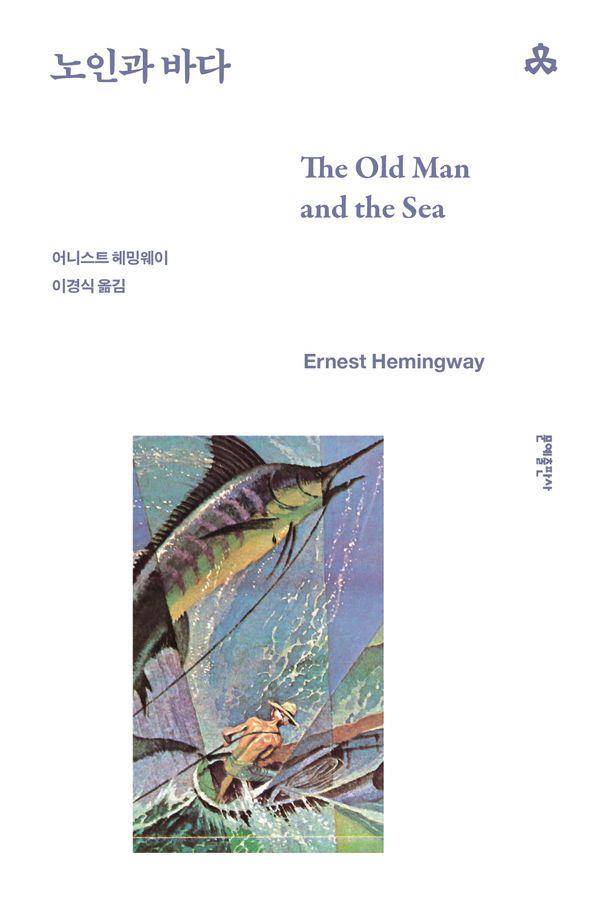
The Old Man and the Sea - World Literature Series 18, Moonye Publishing
Author Ernest Hemingway · Publisher Munye Publishing Co. · Published 2025-04-28 · ISBN 9788931024852 About the Book"Man is not made for defeat.""A man can be destroyed but not defeated."The courage and devotion of man against life's adversities,An indomitable will depicted in clear prose –Hemingway's masterpiece.This collection brings together "The Old Man and the Sea," a novella that decisively contributed to...
See full description ↓Description
Author Ernest Hemingway · Publisher Munye Publishing Co. · Published 2025-04-28 · ISBN 9788931024852
About the Book
"Man is not made for defeat."
"A man can be destroyed but not defeated."
The courage and devotion of man against life's adversities,
An indomitable will depicted in clear prose –
Hemingway's masterpiece.
This collection brings together "The Old Man and the Sea," a novella that decisively contributed to Ernest Hemingway, a master of 20th-century American literature, winning the Pulitzer Prize and the Nobel Prize in Literature, and "The Snows of Kilimanjaro," a short story first published in Esquire magazine in 1938 and later adapted into a film.
"The Old Man and the Sea" tells the story of an old fisherman named Santiago who battles a giant marlin in a struggle of a lifetime. In this work, Hemingway explores the yearning, patience, courage, and will of a pure human being, vividly depicting the happiness, akin to a "lion's dream," achieved through such an indomitable human spirit. In "The Snows of Kilimanjaro," a man, while on an African safari with his wife, injures his knee and faces death from an infection, reflecting on his past life through a stream of consciousness.
Hemingway focused on the physical and emotional nature of human beings rather than ideas, philosophies, or concepts, describing the futility that humans, as mortal beings, encounter with intense yet restrained prose. The resilient will and dignity of man in the face of life's adversities, shadowed by hardship and death, and the pursuit of a better life evoke deep empathy and emotion in readers of all generations.
Nobel Prize in Literature laureate
BBC's 100 Novels That Shaped Our World
Peter Boxall's 1001 Books You Must Read Before You Die
"Man is not made for defeat."
"A man can be destroyed but not defeated."
"The Old Man and the Sea" is a novel depicting the Cuban old fisherman Santiago's lifelong struggle after catching a giant marlin. After 84 days without catching a fish, Santiago renews his spirit and goes out into the deep sea. He eventually catches a colossal marlin, measuring 5.5 meters long and weighing over 700 kilograms, and battles the fish for three days, testing his physical and mental limits.
After a fierce struggle, Santiago triumphs, straps the fish to his boat, and heads home, expecting to earn a large sum from selling it. However, the fish's blood attracts sharks. Santiago manages to kill and drive away the sharks with a harpoon and knife, barely protecting the marlin, but is attacked again by a pack of sharks that night.
"The Old Man and the Sea" is a novella published by Ernest Hemingway, a master of 20th-century American literature, in 1952. It was a decisive work that contributed to Hemingway winning the Pulitzer Prize and the Nobel Prize in Literature. Hemingway focused on the physical and emotional nature of human beings rather than ideas, philosophies, or concepts, describing the futility that humans, as mortal beings, encounter with intense yet restrained prose. In this work, he explores the yearning, patience, courage, and will of a pure human being, vividly depicting the happiness, akin to a "lion's dream," achieved through such an indomitable human spirit.
"I don't want to leave anything behind."
"I don't want to leave anything behind."
"The Snows of Kilimanjaro" is a short story first published by Hemingway in Esquire magazine in 1936, later included in his short story collections and published as a standalone book, and adapted into a film of the same name in 1952. "The Snows of Kilimanjaro" begins by describing Kilimanjaro, Africa's highest mountain. The Maasai call the western summit of the mountain "the House of God," and near the summit lies the dried and frozen carcass of a leopard, though no one knows why it is there.
Harry, a writer, is on an African safari with his wife Helen when his right knee is pricked by a thorn, leading to infection and necrosis, bringing him face-to-face with death. Feeling no more pain, and with the fear of death gone, he reflects on his life through a stream of consciousness.
Harry regrets not being able to write the good stories he had kept in mind until he understood them well enough, and procrastinating until he ultimately failed to write them. On the other hand, he also considers that he won't fail at trying to write anything either. Helen regrets coming on the safari, and Harry confesses that he never loved Helen, scoffing at her wealth and lifestyle and showering her with insults.
At dawn, Harry hears a plane and exchanges jokes with his old friend, Compton, the pilot who has come for him. Compton tells him that the small plane cannot carry Helen, so Harry boards alone. Heading towards the western summit of Kilimanjaro, he sees a legendary leopard. Harry soon realizes that the plane he is on signifies death. Waking in the middle of the night to the cries of hyenas, Helen finds Harry dead, his legs dangling from the bed.
The courage and devotion of man against life's adversities, and his indomitable will,
Hemingway's masterpiece depicted in clear prose.
Edmund Wilson, known as one of the most important literary critics of the 20th century, noted that the characters Hemingway features in his works are "bullfighters, racetrack managers, gangsters, soldiers, prostitutes, drunkards, drug addicts, and other human beings." In Hemingway's works, these characters do not represent a specific class or typical traits; rather, a unique internal or external aspect of humanity is depicted with greater intensity. Most notably, Hemingway's characters are often portrayed as "natural men" stripped of all mental and intellectual elements, seemingly having lost human emotions such as love, pangs of conscience, or jealousy. Consequently, Hemingway's literary world is rife with violence and death, reminiscent of a "valley of the shadow of death."
"The Old Man and the Sea" is often compared to Melville's "Moby Dick." While the latter features symbolism, philosophy, epic narrative, and strong individuality, Hemingway's work is often judged to lack such elements. There is no trace of ideas, philosophy, or concepts. There is only the sea, the fish, the old man, and the boy. The sea is just the sea, the clouds are just clouds, and the fish is just a fish, nothing more. Hemingway introduces only primitive humans whose essence is directly linked to physical actions and what they wish to say, devoid of ambiguous thoughts and concepts. Through these primitive individuals, the old man, the author clearly expresses the self. And at the end of the old man's struggle, which is neither a final victory nor a defeat, there is only a sense of happiness akin to a lion's dream.
Perhaps Hemingway filled the empty void created by negation and futility in the modern world and society with a physical, behaviorist definition. This path was for him the sole spiritual affirmation and modern ethic in a world rife with post-war fin-de-siècle pessimism. In "The Old Man and the Sea," Hemingway portrayed an ideal human being, one his own subjective consciousness could acknowledge, through pure objective external description. That was Santiago, the old man.
Table of Contents
The Old Man and the Sea
The Snows of Kilimanjaro
Literary Analysis
Ernest Hemingway Chronology
Product Details
Related products




The book is priced at its original Korean retail price (KRW 1,000 = A$1). Air freight is charged separately at checkout.
Orders close every Tuesday, are sent to Korea on Wednesday, and arrive in store one week after dispatch — 8 to 14 days from your order. Order today and pick up from Wed 4 Nov; we'll email you as soon as your books arrive.
Collect at the book corner in our Lidcombe or Eastwood store. No home delivery. Please have your order number and name ready.
First book A$15 + A$6 per extra book — 1 book $15 · 2 books $21 · 3 books $27 · 4 books $33, calculated automatically at checkout. The more books you order together, the lower the cost per book.
Titles temporarily out of stock in Korea may be delayed by about one week. If a title is out of print or unavailable, we refund that book in full and proceed with the rest of your order.
 The Old Man and the Sea - World Literature Series 18, Moonye Publishing
$8.00
The Old Man and the Sea - World Literature Series 18, Moonye Publishing
$8.00