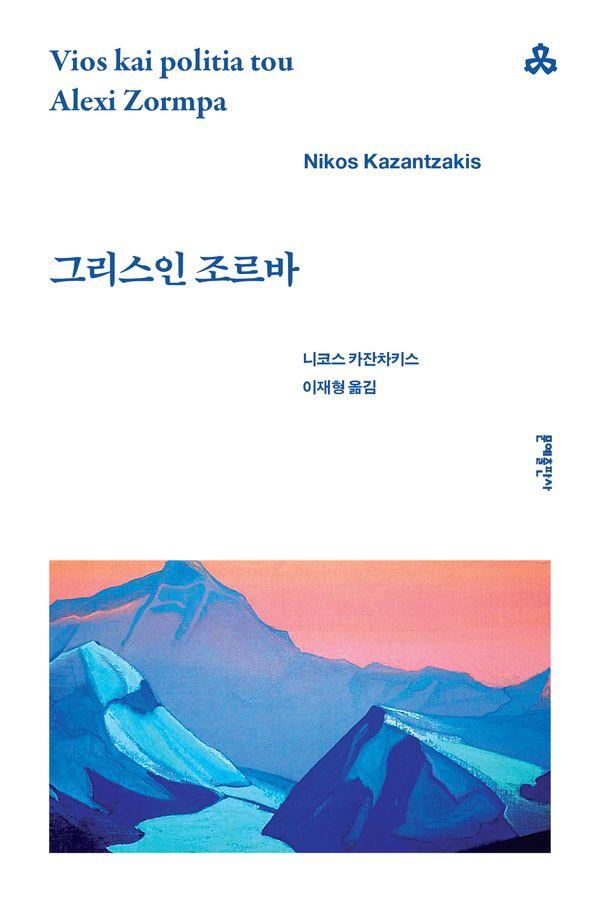
Zorba the Greek - World Literature Series 127
Author Nikos Kazantzakis · Publisher Munye Publishing · Published 2025-09-19 · ISBN 9788931025781 About the Book★ Selected as one of the 100 Great Works of World Literature by the Nobel Institute★ Selected as one of the 100 Classic World Novels Preferred by Korean WritersA work that reflects on the absolute freedom that permeates our livesthrough Zorba, a boisterous, free-spirited, spontaneous,...
See full description ↓Description
Author Nikos Kazantzakis · Publisher Munye Publishing · Published 2025-09-19 · ISBN 9788931025781
About the Book
★ Selected as one of the 100 Great Works of World Literature by the Nobel Institute
★ Selected as one of the 100 Classic World Novels Preferred by Korean Writers
A work that reflects on the absolute freedom that permeates our lives
through Zorba, a boisterous, free-spirited, spontaneous, and superhuman individual
who enjoys dancing and singing, a true free spirit!
“Boss, my heart is deeply wounded by suffering every time.
But my heart is wounded so often that it heals immediately and the wound is invisible.
My body is covered in healed wounds. That’s how I can endure.”
A time to reflect on the absolute freedom that permeates our lives
through Zorba, a free spirit
《Zorba the Greek》 is a masterpiece published in 1946 by the national Greek writer Nikos Kazantzakis, a great work of literature that delves into the essence of human life. It is a bestseller translated into dozens of languages, and a work that has inspired countless people to reflect on their lives and pursue a free life. There are two protagonists. One is the intellectual 'I', an idealist who tries to understand the world only through books, and the other is 'Zorba', a free spirit who lives by instinct and intuition. The novel unfolds around the time they spent together operating a coal mine on the island of Crete, and Zorba's words, actions, and philosophy of life gradually transform the inner world of 'I'. Zorba is a character who speaks through life itself. Pain and pleasure, death and love, failure and passion. He is a being who instinctively reacts to all of these, suppresses nothing, and embraces life in his own way. 'I' and 'Zorba', who are opposite in every way, show an inseparable, even complementary relationship through their respective adventures. Although their joint mining business fails, Zorba dances while drinking wine, and the narrator follows him, feeling liberated from all attachments. Kazantzakis tries to show the practice of 'non-possession' through Alexis Zorba and the narrator. Although the business goes bankrupt and they lose what they have, the narrator is liberated from himself, who had been confined to books, through Zorba, who lives a free life.
What does it mean to be alive? A question posed by Zorba, who lives a simple but fierce life,
eating, drinking, and loving.
Every passage and every dialogue in 《Zorba the Greek》 is perfect in itself. There is no meaningless passage, no meaningless dialogue. Every passage and dialogue reflects on and questions universal themes such as life and death, love, and religion. Thus, readers of this work cannot help but feel an attachment to the various characters, especially to Zorba, who embodies the joys and sorrows of life with his whole body at every moment. Zorba eats, drinks, dances, loves, and plays the santur, living a simple yet fierce life. The narrator 'I' likes to read books, write, and meditate on what he feels and the meaning of all things, captivated by Buddha and the meaning of his life. 'I', less impulsive than Zorba, more thoughtful and obsessed with metaphysical anxieties, is literally a 'desk-bound intellectual'. Conversely, Zorba is liberated from human prejudice and meanness, like a child, and seeks to discover the simplest wonders of this world with an open heart at every moment. 'I' tries to be like Sindbad the Sailor, but is trapped in his consciousness and knowledge. Through 'I', Kazantzakis makes us reflect on various themes that permeate our lives, especially the absolute freedom that is so hard to obtain. And he asks: What does it mean to be alive?
A realm of thought that fuses literature and philosophy, and a masterpiece that sings of 'life' itself
in 20th-century literature
Through the character of Zorba, Kazantzakis showed the true nature of humanity, not theory or philosophy, but a living, breathing human being. This is why 《Zorba the Greek》 is regarded as a philosophical work of literature that is different from the metaphysical reflection of European literature at the time. Beyond traditional storytelling, this work incorporates nihilism, existentialism, Buddhist philosophy, and the traditions of the Greek Orthodox Church. As a deep realm of thought, 'I', the intellectual in the book, was a 'being of thought', and Zorba was a 'man of action'. This contrast poses a deep question about the subject in modern literature. 《Zorba the Greek》 brought modern Greek literature to the world stage in the history of world literature and richly incorporated the emotions, labor, traditions, songs, food, and dances of the Greek people. Since then, it has influenced countless works of literature, film, theater, and art.
Today, we live in an age where we have lost Zorba.
The recovery of action and instinct: 'How to live life passionately, conscious of death.'
In an uncertain era, amidst competition, anxiety, and information overload, we are losing the 'ability to love life as it is' and the 'courage to dance again even after failure,' just like Zorba. Zorba shouts at us to feel life again. Modern society measures life with 'knowledge' and 'efficiency'. However, Zorba does not fear fear. For those who suffer from identity confusion and emotional suppression today, Zorba is the most human model of freedom. Zorba instinctively knows that life is finite, and thus he loves, rages, and laughs more intensely. Zorba's message, "Life is so short, how can one not love?", resonates even more strongly with 21st-century readers.
Table of Contents
Zorba the Greek
Work Commentary
Nikos Kazantzakis Chronology
Product Details
Related products
The book is priced at its original Korean retail price (KRW 1,000 = A$1). Air freight is charged separately at checkout.
Orders close every Tuesday, are sent to Korea on Wednesday, and arrive in store one week after dispatch — 8 to 14 days from your order. Order today and pick up from Wed 30 Sep; we'll email you as soon as your books arrive.
Collect at the book corner in our Lidcombe or Eastwood store. No home delivery. Please have your order number and name ready.
First book A$15 + A$6 per extra book — 1 book $15 · 2 books $21 · 3 books $27 · 4 books $33, calculated automatically at checkout. The more books you order together, the lower the cost per book.
Titles temporarily out of stock in Korea may be delayed by about one week. If a title is out of print or unavailable, we refund that book in full and proceed with the rest of your order.
 Zorba the Greek - World Literature Series 127
$11.00
Zorba the Greek - World Literature Series 127
$11.00