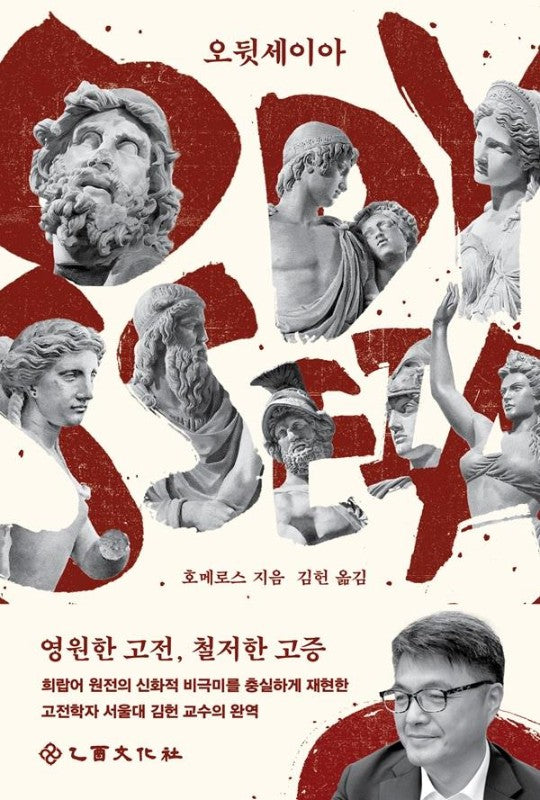
The Odyssey: An Eternal Classic, Meticulously Researched, Christopher Nolan's Film "Odyssey" - Complete Unabridged Translation from the Original Greek
Author Homer · Publisher Eulyoo Publishing · Publication Date 2026-08-10 · ISBN 9788932476469 About the BookA faithful reproduction of the mythical tragic beauty of the Greek originalA complete translation by Kim Heon, a classical scholar and professor at Seoul National UniversityEven setting aside the literary value and imagination of 『The Odyssey』, the reason this work represents Western classics and is...
See full description ↓Description
Author Homer · Publisher Eulyoo Publishing · Publication Date 2026-08-10 · ISBN 9788932476469
About the Book
A faithful reproduction of the mythical tragic beauty of the Greek original
A complete translation by Kim Heon, a classical scholar and professor at Seoul National University
Even setting aside the literary value and imagination of 『The Odyssey』, the reason this work represents Western classics and is continuously discussed to this day is the sheer power of its storytelling. The countless adventures and hardships faced by the protagonist, Odysseus, constantly stimulate our imagination and curiosity. This is evident from director Christopher Nolan being inspired by 『The Odyssey』 to create the film “Odyssey,” and numerous painters, including John William Waterhouse, creating many masterpieces on this theme. However, for this to be truly appreciated, an appropriate translation that can fully convey the depth of the original is essential. The reason it took 22 years for the translator to complete the translation of 『The Iliad』 and 『The Odyssey』, a period longer than it took for Odysseus to return home after the Trojan War, is due to the constant effort to present a version that is more thorough in its historical research.
In 『The Odyssey』, following Homer's intent to arrange words according to a unique meter, inversed sentences that deviate from typical word order are frequently seen. Words that form a single sentence are sometimes spread across several lines. This is possible because Greek allows for relatively free word order. In this respect, Korean is more advantageous than languages like English, where meaning changes significantly with word order, in preserving the feel of the original Greek text.
The translator has utilized the characteristics and advantages of both Greek and Korean in this translation. While general declarative sentences are easy to read, they are somewhat lacking in vividly reproducing the scenes Homer intended to portray. Inverted sentences, though perhaps unfamiliar, are the most appropriate form for how the original text paints images. Furthermore, they have the advantage of more accurately conveying the rhythmic quality of an epic poem that can be felt when reading 『The Odyssey』.
Ancient Greeks who thought with their diaphragm and felt bile surge
A primeval worldview with a vivid sense of reality
Another distinguishing feature of this book is its faithful translation of ancient Greek concepts, conveying them vividly. While other versions of 『The Odyssey』 translate the Greek word 'phrenes' as wisdom, discernment, spirit, or understanding, this book uses the literal meaning, 'diaphragm'. This might feel somewhat unfamiliar, but it clearly reveals how different Homeric humans were from us. The ancient Greek expression 'to use the diaphragm' is similar to our saying 'to use one's head' when engaging in intellectual activity. Just as we commonly use the expression 'to use one's head', ancient Greeks naturally used the phrase 'to use the diaphragm'.
Homer differentiated the human heart into three terms: 'ētor', 'kēr', and 'kradiē'. The translator rendered these as 'heart', 'core', and 'milt' respectively. This approach, too, aims to convey the meaning more directly to the reader, rather than replacing it with expressions that denote emotional or affective functions. When Greeks felt anger, they expressed it with the physiological substance 'bile', which is also translated directly, not as 'anger' or 'wrath'. Following this principle, instead of a plain and perhaps bland translation like "lest the maiden should harbor anger in her heart," the translator attempted a more unfamiliar rendering such as "lest bile should surge in the maiden's diaphragm." Such directly felt expressions offer a new 『Odyssey』, utterly different from previous translations, imbued with the salty sea breeze and the scent of bronze.
From the Book
The significant differentiation of this translation will be evident in my translation principles, which will be revealed later, and in the effort to preserve Homer's view of humanity. Through this translation, dear readers, you will enter Homer's world and meet Odysseus. And in that encounter, you will encounter a different, unique Odysseus than the one you have known until now.
- From page 7
Tell me, Muse, of the man of many twists and turns, who wandered very much, after he sacked the sacred city of Troy. He saw the cities of many men and learned their minds, and he suffered many pains on the sea, deep in his spirit, seeking to save the lives of his comrades and to achieve his homecoming.
- From page 79
A great wave carried it, hither and thither with the current. Just as the late summer Boreas drives thistles hither and thither across the plain, stoutly entwined thistles. So the winds drove the raft across the ocean, hither and thither. At times Notos threw it to Boreas to drive it, and at times again Eurus yielded it to Zephyrus, chasing it on.
- From page 236
May I go to the Phaeacians as an object of affection and pity. As he prayed thus, Pallas Athena listened to him. But she could not yet appear to him face to face. For she respected her father's brother. But he was fiercely enraged against godlike Odysseus, until he reached his own land.
- From page 262
The blessed gods do not love impious deeds; they respect the laws and proper measure of mortals. Even hostile and malicious people, when they set foot on other people's land, and Zeus grants them spoils, if they depart to return home with their ships full, the fear of retribution seizes their diaphragms more powerfully.
- From page 475
What a good diaphragm has faultless Penelope, daughter of Icarius, how well she remembered Odysseus, her married husband! So her fame will not vanish concerning her virtue, the immortal gods will compose a pleasant song for earthly beings for Penelope whose diaphragm is intact.
- From page 742
Table of Contents
Introduction: How to Read 『The Odyssey』?
Part One: Odysseus Outside Ithaca
Part 1: The Adventures of Telemachus
Book 1: Council of the Gods, Athena and Telemachus Meet
Book 2: Telemachus Convenes an Assembly and Begins His Journey
Book 3: Visit to Pylos, Telemachus and Nestor Meet
Book 4: Visit to Sparta, Telemachus and Menelaus Meet
Part 2: From Calypso to Scheria
Book 5: Odysseus Leaves Calypso's Island
Book 6: Scheria, Nausicaa and Odysseus Meet
Book 7: Odysseus Enters the Palace of Alcinous
Book 8: Alcinous's Hospitality and Odysseus's Tears
Part 3: The Adventures of Odysseus
Book 9: Ismarus, Lotus-Eaters, Cyclops
Book 10: Aeolus, Laestrygonian Cannibals, Circe
Book 11: Visit to Hades and Conversation with the Shades
Book 12: Circe's Prophecy, Sirens, Scylla and Charybdis, Helios' Cattle
Part Two: Odysseus Within Ithaca
Part 4: Outside the City of Ithaca
Book 13: Return to Ithaca and Odysseus's Transformation
Book 14: Eumaeus the Swineherd and Odysseus Meet
Book 15: Telemachus Returns to Ithaca
Book 16: Odysseus and Telemachus Meet
Part 5: Inside the City of Ithaca
Book 17: Odysseus Enters the City and the Palace
Book 18: The Duel of Irus and Odysseus, the Suitors' Wickedness
Book 19: Preparation for Revenge and Conversation with Penelope
Book 20: Odysseus Endures Mockery and Insult
Part 6: Revenge, Reunion, and the Completion of Homecoming
Book 21: The Suitors' Archery Contest
Book 22: Odysseus's Revenge and the Suitors' Demise
Book 23: Purification of the Palace, Reunion with Penelope
Book 24: Reunion with Laertes, Conflict with the Suitors' Families
Product Details
Related products

The book is priced at its original Korean retail price (KRW 1,000 = A$1). Air freight is charged separately at checkout.
Orders close every Tuesday, are sent to Korea on Wednesday, and arrive in store one week after dispatch — 8 to 14 days from your order. Order today and pick up from Wed 28 Oct; we'll email you as soon as your books arrive.
Collect at the book corner in our Lidcombe or Eastwood store. No home delivery. Please have your order number and name ready.
First book A$15 + A$6 per extra book — 1 book $15 · 2 books $21 · 3 books $27 · 4 books $33, calculated automatically at checkout. The more books you order together, the lower the cost per book.
Titles temporarily out of stock in Korea may be delayed by about one week. If a title is out of print or unavailable, we refund that book in full and proceed with the rest of your order.
 The Odyssey: An Eternal Classic, Meticulously Researched, Christopher Nolan's Film "Odyssey" - Complete Unabridged Translation from the Original Greek
$25.00
The Odyssey: An Eternal Classic, Meticulously Researched, Christopher Nolan's Film "Odyssey" - Complete Unabridged Translation from the Original Greek
$25.00