
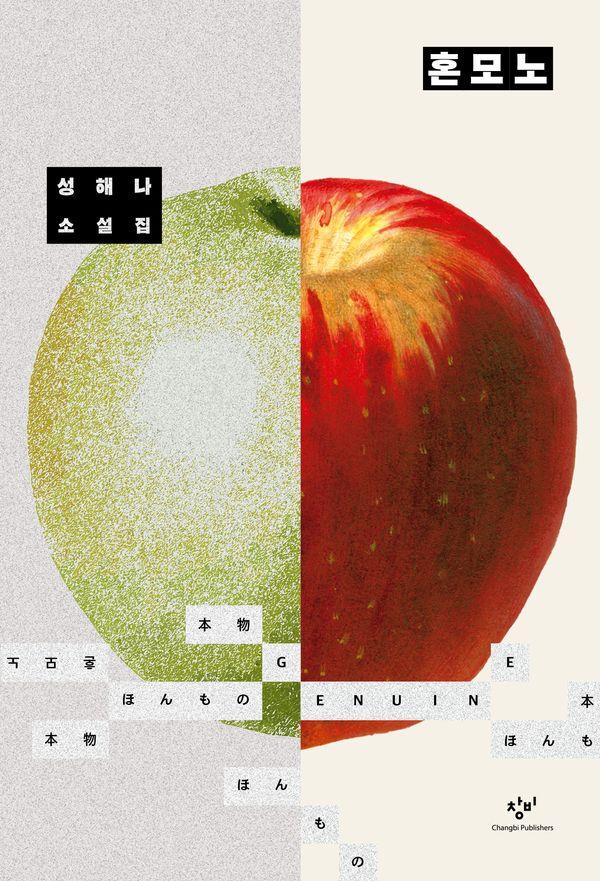
Honmono
Author Seong Haena · Publisher Changbi Publishers · Publication Date March 28, 2025 · ISBN 9788936439743 Book IntroductionWhat is real and what is fake?Questioning "Honmono" at that boundaryWhat first catches the eye in 『Honmono』 is its title, whose meaning is not immediately clear. "Honmono" is a transliteration of the Japanese word "本物" (honmono), meaning "the real thing." It was once...
See full description ↓Description
Author Seong Haena · Publisher Changbi Publishers · Publication Date March 28, 2025 · ISBN 9788936439743
Book Introduction
What is real and what is fake?
Questioning "Honmono" at that boundary
What first catches the eye in 『Honmono』 is its title, whose meaning is not immediately clear. "Honmono" is a transliteration of the Japanese word "本物" (honmono), meaning "the real thing." It was once widely known online as a neologism used to mock "nuisances" or "otaku." As the author stated in an interview that she wanted to talk about the current era, where even falsehoods become truths if many believe them, just as this originally positive word became distorted in meaning, this collection of stories explores the boundary between "real" and "fake" while asking fundamental questions about what "real" truly is.
The protagonist of the title story "Honmono" is Moon-su, a shaman of 30 years. One day, he realizes that "Grandma Jang-su," whom he revered as a deity, has left him. Just then, a young woman named Shin-aegi, barely twenty, moves in next door and tells him, "Grandma said you were too old" (p. 145), and that she has come to him. This event shakes the foundation of Moon-su's belief, as he had believed his faith was "real." Moon-su struggles to pretend to be "real" to live as a "fake" shaman, yet even while acquiring a miniature ritual sword, he refuses to take on the "Today's Horoscope" section, which he considers "something only a clumsy shaman would do" (p. 122). Although he loathes Shin-aegi, who sneers, "What would a guy who just imitates know?" (p. 120), he feels concern when he hears shouting from her house. He constantly asks himself, "What is real, and does it truly exist separately from the fake?" (commentary, Yang Kyeong-eon).
Meanwhile, the conflict between Moon-su, a middle-aged man who traditionally worshipped Grandma Jang-su, and Shin-aegi, a young shaman who seems "equal to Grandma" (p. 144), vividly portrays the common generational antagonism in modern society. In this way, "Honmono" is a provocative masterpiece that not only delves into individual desires and anxieties but also raises questions about social issues such as generational conflict and the confrontation between tradition and modernity.
An Overwhelming Narrative That Engages You Breathlessly
The Future of Korean Literature, Shining with Envy-Inducing Talent
Another work that addresses these issues timely and concretely is "Smooth." It portrays a single day in the life of Dewey, a third-generation Korean-American and agent for the world-renowned artist Jeff, during his first visit to Korea, much like a black comedy. Ignorant of Korea, which he considered "a crime-ridden area full of shops selling snake liquor and dog meat" (p. 69), he was "more American" (p. 69) than a "real" American. While lost in Korea for Jeff's art exhibition, he accidentally joins a procession of people holding "American flags and 'Thai national flags'" (p. 84). Facing warm and kind elderly people at this "festival" (p. 86), he feels a sense of connection and belonging to Korea. However, the moment an elderly person, who had shown him unconditional kindness, refers to Gwanghwamun Square as 'Syngman Rhee Square,' we, who had been enjoying the novel like Jeff's artwork where "anxiety and deficiency were smoothly carved out" (p. 82) into the shape of a sphere, feel a chill from within.
The narrator of "Guilty Club: Touching a Tiger," the opening story of the collection, is "I," a member of the "Guilty Club," a group of so-called "true" (p. 12) fans who admire the world-renowned film director Kim Gon. Kim Gon is facing public ethical condemnation for an incident he committed in the past, but the members of the Guilty Club believe that it is the role of a "true" fan to cover up and keep quiet about the incident. "I," too, denies the incident out of a desire to be "true." However, when Kim Gon finally admits his wrongdoing and apologizes, "I" feels something burst inside. Later, during a "tiger touching" experience at a zoo in Chiang Mai, "I" realizes what that something was. In this way, "Guilty Club: Touching a Tiger" vividly portrays the ambivalent desire known as "guilty pleasure" through the familiar culture of fandom, while also making us reflect once again on what truths are hidden behind what we easily consider "true" and what distinguishes the real from the fake.
The other works that follow also leave their own unique and strong impressions. There's "Gu's House: 98 Galwol-dong," a faction piece that, like a detective documentary, explores who designed the brutally cruel building based on the "Namyeong-dong Interrogation Center." Then there's "Ingtae-gi," a social commentary novel where a daughter-in-law and her father-in-law engage in a raw battle of desires as she prepares for her child's birth abroad. "Friendly Feelings" depicts characters working at a regional regeneration startup who, with "idealistic" (p. 211) intentions, meet returnees to rural areas and confront each other's true selves. And finally, "Metal" tenderly unfolds the process of three friends, who had a metal band in high school, facing reality. Each of these stories, as actor Park Jung-min says in his recommendation, "Why watch Netflix? You can just read Seong Haena's books," are so vivid and clear, like slices of reality, that they allow the reader to fully experience the world within the novel. The overwhelming narrative, once opened, is impossible to stop reading and will even provide the pleasure of devouring the thick collection of stories in one sitting.
“It no longer matters.
Neither honor, youth, timing, nor antagonism,
not even the real and the fake.”
Constantly moving between "real" and "fake," Seong Haena, who questions what "honmono" is, never offers smooth, spherical answers. 『Honmono』 stops instead on the rough and precarious edge of the boundary that separates the real from the fake. In the face of this "neither swallowable nor spit-outable" (p. 240) polyhedron, with no perfect right or wrong answers, no entirely good or evil people, no grand farewells or easy sutures, all we can do is "not lose strength" in "the exploration of 'the real,' and the endeavor to walk truthfully" (commentary) and follow Seong Haena's trustworthy steps, which will open up the future of Korean literature, continuing to walk and re-walk that ambiguous boundary.
Author's Note (excerpt)
An owl does not take flight hastily. Before flapping its wings, it surveys its surroundings carefully, sets its direction deliberately, and then lands.
I, too, wish to catch sentences with sharp talons, perceive the pains of society with a broad perspective, and listen intently to the stories of those far away with open ears.
Until I can breathe more deeply than now. I hope you will watch over me, from near and far.
Spring 2025
Seong Haena
Recommendations
Lee Ki-ho (Novelist)
Novelists often seem to wander in search of material, but in fact, the opposite is more often true. That is to say, it is more frequent for material to knock on the author's studio door late at night, making sounds like jingling keys. And at that very moment, the author's ability and response are put to the test. The stories in Seong Haena's second collection, 『Honmono』, are diligent and intense records of such visitors. What is peculiar is that these records do not dwell on the structural poetics of the material itself, but rather penetrate the shabby wounds of the people who support that structure. Thus, architecture, film, metal, and sculptural art disappear, and in their place remain only people who are 'fierce, passionate, subversive, and therefore even more futile.' Wounds that shine brighter because of the gleaming 'stainless steel.' The honest attitude of not easily glossing over generational conflict, the boldness of mercilessly stripping away artificial morality, the intensity of not being deceived by warmth. Let me correct myself. The material did not simply come to the author. Seong Haena called those materials forth. It would not be wrong to call it the author's 'divine inspiration.'
Park Jung-min (Actor)
Suddenly, a thought occurred to me.
'Chungmuro lost a brilliant actress named Seong Haena. A puzzling defeat, indeed.'
Seong Haena's works are full of things one couldn't imagine without actually becoming the character. They are specific yet clear. They are even truly humorous and understated. It's superb acting. While reading the book, just in case, I searched for two characters and one location. I was completely fooled. It's an envious talent. In front of Seong Haena, I am merely "a guy who just imitates." Sometimes, if I'm looking at a script and there's a character I can't quite figure out, I might even call her for an interpretation. Bowing to a genius isn't a matter of pride, after all.
This collection of stories is a party of 'immersion.' It's full of works I want to make into movies. Such are the captivating characters, situations, and emotions. These are writings that encompass a world within one person. Her sentences, which delve deep into situations and capture the exact emotions, are vivid. I thought that when the book comes out, I must write the following sentence and gift it to the directors around me.
'Why watch Netflix? You can just read Seong Haena's books. Dreamed by Park Jung-min.'
Table of Contents
Guilty Club: Touching a Tiger
Smooth
Honmono
Gu's House: 98 Galwol-dong
Friendly Feelings
Pregnancy Chronicle
Metal
Commentary | Yang Kyeong-eon
Recommendations | Lee Ki-ho · Park Jung-min
Author's Note
Publication Venues of Included Works
Product Details
Related products
The book is priced at its original Korean retail price (KRW 1,000 = A$1). Air freight is charged separately at checkout.
Orders close every Tuesday, are sent to Korea on Wednesday, and arrive in store one week after dispatch — 8 to 14 days from your order. Order today and pick up from Wed 7 Oct; we'll email you as soon as your books arrive.
Collect at the book corner in our Lidcombe or Eastwood store. No home delivery. Please have your order number and name ready.
First book A$15 + A$6 per extra book — 1 book $15 · 2 books $21 · 3 books $27 · 4 books $33, calculated automatically at checkout. The more books you order together, the lower the cost per book.
Titles temporarily out of stock in Korea may be delayed by about one week. If a title is out of print or unavailable, we refund that book in full and proceed with the rest of your order.
 Honmono
$22.80
Honmono
$22.80