
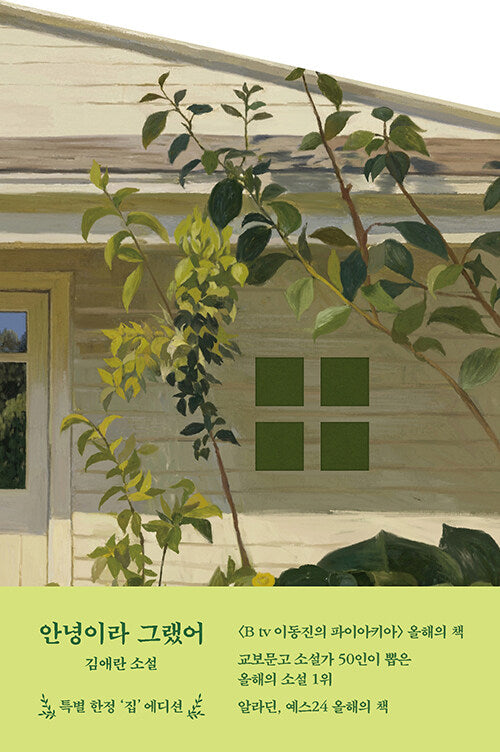
I said hello (home edition)
Author Kim Ae-ran · Publisher Munhakdongne · Published 2025-06-20 · ISBN 9791141602376 About the Book"I would argue that Kim Ae-ran has long been a sociologist,and now more than ever, she unequivocally is."_Shin Hyeong-cheol (Literary Critic)Includes "Good Neighbor," winner of the 2022 Oh Young-soo Literary Award,and "Home Party," winner of the 2022 Kim Seung-ok Literary Award Excellence Prize.Novelist Kim Ae-ran returns...
See full description ↓Description


Author Kim Ae-ran · Publisher Munhakdongne · Published 2025-06-20 · ISBN 9791141602376
About the Book
"I would argue that Kim Ae-ran has long been a sociologist,
and now more than ever, she unequivocally is."
_Shin Hyeong-cheol (Literary Critic)
Includes "Good Neighbor," winner of the 2022 Oh Young-soo Literary Award,
and "Home Party," winner of the 2022 Kim Seung-ok Literary Award Excellence Prize.
Novelist Kim Ae-ran returns with a new collection of short stories, eight years after 『The Outside is Summer』 (Munhakdongne, 2017). 『Hello, I Said So』 features seven short stories, including "Home Party," which won the 2022 Kim Seung-ok Literary Award Excellence Prize with the praise that it "sharply exhibits her unique ability to capture particles of emotion floating in social spaces and give them clear expression," and "Good Neighbor," winner of the 2022 Oh Young-soo Literary Award. While still demonstrating her forte in building a multi-layered world with powerful emotional appeal and dilemmas, this collection reveals a slightly cooler and more dispassionate Kim Ae-ran.
The protagonist of this short story collection could be said to be 'space.' As expressed in the story "Home Party" (p. 42), "Many events in plays begin with 'invitation' and 'visit,' 'intrusion' and 'escape'," and in this book, the stories unfold as characters visit someone else's space. These spaces are either elegant and stable, suggesting the host's aesthetic sense and comfort ("Home Party"), or a detached house overseas that, thanks to cheap prices and low accommodation costs, allows for a month-long trip, "a luxury enjoyed for the first time in life" ("A Small House in the Forest"). Or it could be a rented house that has been carefully tended and used but now needs to be prepared for moving out for a new owner ("Good Neighbor"), or a bookstore opened by quitting a job and investing all savings ("Lemon Cake"). The reason space is important in 『Hello, I Said So』 is that it doesn't merely function as a backdrop to the story, but is synonymous with the characters' lives themselves. Especially for Kim Ae-ran, who has described the meaning of "a room" in our society with unique insight, certain spaces are places that indicate someone's economic and social status, and a comprehensive and complex place containing a person's entire history. Therefore, the conflicts that arise around space in this collection can be seen as clashes of different life standards. Entering someone else's space, in other words, is an event that steps outside the boundaries of one's own life.
In "Home Party," Kim Ae-ran asks, "How difficult is it for one person to stand in another's shoes?" (p. 24) Will visiting another's space be a path to broader understanding, or an intrusion that breaks each other's standards? In a reality where it is harder than ever to move beyond the boundaries of 'I' to 'we,' where the visible landscape and the people we relate to are increasingly replaced by monetary values, Kim Ae-ran's question feels all the more urgent. And that question can be rephrased as: When a common experience of abandonment and disappointment has occurred, and a new starting line has appeared, what has changed and what has been preserved compared to before? Or, what should change and what should be preserved? This is precisely Kim Ae-ran's way of greeting us, at a time when asking for the well-being and peace of others has become more earnest than ever.
A different kind of experience in emotion, perception, and thought
Kim Ae-ran's shining present
If space is the protagonist of 『Hello, I Said So』, then we, following the story, are visitors invited into unfamiliar spaces alongside the characters. Just as characters' senses are keenly expanded as they step into new places, our own five senses are opened wider than ever with Kim Ae-ran's stories, experiencing things that were previously invisible and inaudible. For example, in "Home Party," when Lee Yeon, invited to the home of CEO Oh, a 'social mainstream' figure whose life trajectory is completely different from her own, cautiously walks into the house, instinctively recognizing how the furniture and interior throughout the house create a 'narrative luster,' and constantly being aware of the subtle line drawn between herself and CEO Oh, we cannot help but wonder what is hidden behind the glances, expressions, and conversations exchanged between CEO Oh and her acquaintances, following Lee Yeon, who is sensitive to the information around her.
Kim Ae-ran's observational skills, delving deeply into the hidden aspects not apparent on the surface, also shine in "A Small House in the Forest." In "A Small House in the Forest," 'I' am currently on an overseas trip with my husband. The reasons we could take a month-long trip were the excuse of finally going on our long-delayed honeymoon, and the fact that 'I' recently quit my job, but "the biggest influence was the price" (p. 51). While initially satisfied with the cheap local prices and low accommodation costs at our destination, 'I' soon felt uncomfortable for precisely that reason. After realizing that the woman who cleaned our accommodation every day was around my age, "I started to feel a bit flustered by the blatant class difference I encountered in a foreign country" (p. 66). This is because, "while cheap prices and affordable goods are good, the fact that the labor that produces them is cheap still feels awkward" (ibid.). How to tip her and what to call her are intertwined with this perception, making what would be a simple matter for some a huge problem for 'me,' requiring all the ways of life I have lived so far.
The strong emotional turmoil an individual feels when perceiving a class distinction between themselves and others is further revealed in a complex way in the subsequent short story "Good Neighbor." The narrator, a reading instructor, faces two immediate problems: one is that Si-woo, a student she teaches, is about to move; the other is that she herself needs to move. The difference is that Si-woo's family is moving to a larger "own home," while the narrator needs to find a new home in a situation where real estate prices have skyrocketed in recent years. The narrator had felt pride and satisfaction teaching Si-woo, but when Si-woo's mother suggested that she continue teaching Si-woo after they moved, she couldn't answer easily.
In this situation, the piercing question that cuts through the middle of the story is this: 'What does it truly mean to be a good neighbor?' Kim Ae-ran explores the possibility, or impossibility, of us becoming good neighbors amidst the real-world conditions that make it difficult. When words like "community, neighbor, solidarity" (p. 125) are honestly spoken through the mouth of a character in the story, we realize with a sharp sting how these natural and familiar values have been shattered in recent years, and what has accelerated this.
A greeting for our times,
asking for well-being and peace for us weak ones.
Characters who keenly perceive the differences between themselves and others appear in other stories as well. In "Foreign Body Sensation," Ki-tae, a bank employee, can't hold back during a conversation with his juniors and gives them a "piece of advice" as an elder about the benefits they received that he didn't, only to immediately regret it. Ki-jin in "Lemon Cake" accompanies her mother, who has come to Seoul for a hospital examination, and considers this brief time like "doing a big homework assignment." Yet, thinking of her mother returning home alone, she feels "regret, apology, annoyance, relief, pity, and guilt" (p. 209) simultaneously amidst "the obvious fact that my today and your today are different" (p. 214).
As they age a little, as their environment changes, and as their concerns shift, the characters often feel friction in their relationships with others and are frustrated by a sense of something undigested, a foreign body sensation, remaining within them. However, this sense of difference does not always lead to negative outcomes. Kim Ae-ran also focuses on the beautiful moments that difference creates. Ji-soo in "Like Raindrops" is in a situation where she has lost everything and feels pushed to the brink. Ji-soo, who calls a wallpaper hanger to neatly wrap up her "final" moments without burdening anyone, instead finds solace from her and feels the faint possibility of a "new beginning." This might be because the wallpaper hanger didn't fully understand Ji-soo's situation, or perhaps because she didn't presumptuously pretend to.
The act of reaching understanding through not knowing also happens in "Hello, I Said So." Eun-mi, who broke up with her lover long ago and recently lost her mother, is learning English online because "studying a foreign language makes me feel as if I still have some possibilities and opportunities left" (p. 226). Of course, Robert, the native English teacher, doesn't know about Eun-mi's circumstances. Likewise, Eun-mi doesn't know what kind of loss Robert has experienced. When these two bravely reveal their situations bit by bit, like playing twenty questions, and walk towards each other, taking hints from what they share, we see how not many words and sufficient time, but rather few words and limited time, illuminate each other's core. And as the title "Hello, I Said So" implies, it is also a journey from misunderstanding to understanding. In the past, Eun-mi was listening to a pop song with her lover and misunderstood a part of the lyrics as "hello." Her lover corrected her mistake by telling her the correct lyrics, but later apologized for his actions that day. That is, for overlooking the possibility that "there are things in our lives that can only be right in the wrong way" (p. 253).
Thus, the characters are able to close a chapter of their lives by embracing past mistakes and misunderstandings. According to the dictionary, "hello" means both "nice to meet you" and "goodbye" (p. 222), a word used at moments of meeting and parting. However, for Kim Ae-ran, "hello" becomes a word necessary not only to open and close a relationship well, but also to open and close a chapter of life well. And it is a word that, without correcting someone's misunderstanding or mistake, quietly nods towards that person, and through it, wishes for their peace. In that case, we can say this: 『Hello, I Said So』, where Kim Ae-ran's deep and mature sense of the times shines in every piece, is a book by and for the contemporary generation.
Table of Contents
Home Party 007
A Small House in the Forest 045
Good Neighbor 097
Foreign Body Sensation 143
Lemon Cake 189
Hello, I Said So 217
Like Raindrops 257
Commentary | Shin Hyeong-cheol (Literary Critic)
Love Your Neighbor as Your Money 295
Author's Note 315
Product Details
Related products
The book is priced at its original Korean retail price (KRW 1,000 = A$1). Air freight is charged separately at checkout.
Orders close every Tuesday, are sent to Korea on Wednesday, and arrive in store one week after dispatch — 8 to 14 days from your order. Order today and pick up from Wed 4 Nov; we'll email you as soon as your books arrive.
Collect at the book corner in our Lidcombe or Eastwood store. No home delivery. Please have your order number and name ready.
First book A$15 + A$6 per extra book — 1 book $15 · 2 books $21 · 3 books $27 · 4 books $33, calculated automatically at checkout. The more books you order together, the lower the cost per book.
Titles temporarily out of stock in Korea may be delayed by about one week. If a title is out of print or unavailable, we refund that book in full and proceed with the rest of your order.
 I said hello (home edition)
$16.80
I said hello (home edition)
$16.80