
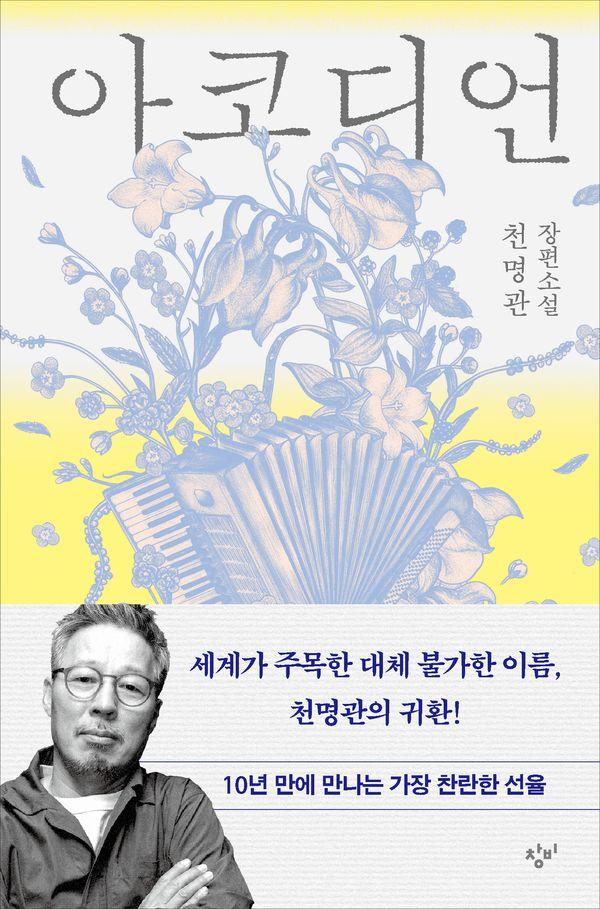
Accordion (Hardcover)
Author Cheon Myeong-kwan · Publisher Changbi Publishers · Publication Date 2026-06-22 · ISBN 9788936439965 About the BookAn accordion that changed a destinyA scorching survival drama written by children with tin cans In a blizzard during wartime evacuation, Dong-i loses his mother's hand and becomes an orphan left on the streets. Dong-i, who has lost his parents, home, and even his...
See full description ↓Description
Author Cheon Myeong-kwan · Publisher Changbi Publishers · Publication Date 2026-06-22 · ISBN 9788936439965
About the Book
An accordion that changed a destiny
A scorching survival drama written by children with tin cans
In a blizzard during wartime evacuation, Dong-i loses his mother's hand and becomes an orphan left on the streets. Dong-i, who has lost his parents, home, and even his name, is pushed into an encampment of beggars run by 'Pastor Yang.' Children, including Dong-i, are dropped off in front of bus stops, underpasses, and department stores, enduring each day with the sound of coins dropping into their tin cans and filling their hungry bellies with thin gruel. Pastor Yang's false charity, the ruthless violence of the supervisor 'Ami,' and the temptation of 'Cloud Pills,' a drug that temporarily relieves pain, slowly erode the children. The world says the war is over, but for them, the city is still a battlefield where they must push and bite each other to survive.
Amidst this, Dong-i meets children who endure life in their own ways. There's 'Yeon-i,' who is blind but captivates passersby with her clear, deep voice; 'Geobugi,' who cannot walk but understands situations with his extraordinary memory and judgment; and 'Kkamsang,' who, despite losing an arm, nimbly senses the flow of the street. Then, 'Mickey,' a houseboy who has learned English and cunning survival skills from frequenting American military bases, appears, expanding Dong-i's world beyond the encampment in Haebangchon to unfamiliar and glamorous places. All of them carry wounds, but they are never confined by their deficiencies. Though frightened and suspicious of each other, in critical moments they throw themselves into saving one another, and even in hunger, they sing, run, and fight, refusing to give up on their lives.
What shakes Dong-i's destiny is an old, red accordion. In front of the instrument, which reminds him of the harmonium his mother used to play long ago, the boy discovers his talent for recreating a song he's heard only once with his fingertips. The moment the listless Dong-i straps the accordion onto his shoulder and stands in front of the post office, and Yeon-i's singing voice is added to its melody, begging instantly transforms into a street performance. The alms suddenly sound like applause, and amidst the street where sadness and excitement surge together, a different rhythm finally emerges in the children's day. Music wasn't magic that changed the world in an instant, but it awakened them to the fact that they weren't just abandoned beings, but beings who could play their own lives.
The melody of popular songs spreading across the bustling streets
A passionate ensemble of beings navigating an era of ruins
In the novel, music is not just a simple theme; it is the heartbeat of the era itself. The chapter titles, unfolding with "Lucky Seoul," "Mokpo's Tears," "Shushan Boy," "Hong Kong Lady," and "Bésame Mucho," restore the atmosphere of that time as vividly as the actual songs. Popular songs flowing from electronics stores, hymns filling the encampment, the exotic rhythms of American military clubs, and the boisterous applause of theaters transform post-war Seoul into a grand stage. Hungry children sell songs, adults buy desires, and the city exudes both ruin and vitality. Cheon Myeong-kwan vividly captures the sounds, smells, and lights of this contradictory era with palpable realism.
In particular, the scene where Dong-i follows Mickey through the back door of an American military club starkly highlights the disparity of inaccessible worlds. Children outside with tin cans, and musicians inside playing jazz under glittering lights. Passing through this dizzying contrast, Dong-i keenly realizes that for some, music is the language of the stage, but for them, it can only be labor for survival. Adults draw the children's talents into greedy calculations, and the children who survived through song are once again trapped in the shackles of oppression because of that very song.
The seemingly endless oppression takes an unexpected turn with an unforeseen event. Surviving children bury their dead friends and hide in the Ggulbawi cave, experiencing a time without adult supervision for the first time in their lives. They cook and sing with the accordion, salvaged from the ashes, as proof of their remaining lives, but this precarious peace they've barely grasped does not last long. When their cruel former master, whom they thought was dead, reappears before the children, the snare of exploitation they believed they had escaped begins to tighten around their necks once more.
A song that begins anew on the edge of a cliff
The rhythm of life ultimately passed on to the next person
As the latter half progresses, the story speeds up and becomes more fiercely turbulent. Yeon-i, holding a newborn, is once again driven out into the cruel streets, and while the shouts and slogans of protestors cover the city, the children's precarious world is also sucked into a larger vortex of violence. With the appearance of 'Yukson-i,' a cruel hunter with a scarred face, sunken eyes, and a sixth finger gleaming in the lighter's flame, the novel heats up with breathtaking tension. The moment the children, who had endured beatings and hunger, now run to grasp the direction of their own lives, the novel creates a profound ripple with a chilling thrill.
On this precarious precipice, Dong-i realizes what he truly must protect and pass on. The accordion is no longer an object proving a boy's talent. The accordion, an instrument taken from someone, now becomes a voice that continues someone's breath. Proof that a suppressed life, not easily recorded, can ultimately become a unique song. At this pivotal turning point, the novel expands beyond a street survival story into a deeply moving epic.
The reason we should open the first page of 『The Accordion』 is clear. This work meticulously and fascinatingly portrays how vulnerable beings in a ruthless era hold onto each other's breath and endure on the brink. From the scene where the boy, who was hunched over a tin can, stands before the crowd with an accordion, to the passage where the children of Ggulbawi light a fire again from the ashes, and in the latter half where Yukson-i's shadow closely follows the children, readers hold their breath, watching which path they will choose in the next alley. The sight of shadows, not recorded in the bold type of history books, being revived with vivid warmth is sometimes heartbreakingly desperate, but the ensemble of children, determined to hold hands and not miss the rhythm of life, leaves a deep and lasting impression.
This story, drawn from the lowest place swept by war, begins with the sound of coins dropping into a tin can and spreads relentlessly with the old breath of the accordion, the roar of passing streetcars, and the shouts of the street. Like an instrument that holds a deep breath and pushes out its inner sound each time it folds and unfolds, 『The Accordion』 manages to extract a touching rhythm from the creases of a crumpled life. This is an overwhelming return that Korean literature has long awaited, and a brilliant achievement that proves why the name Cheon Myeong-kwan is irreplaceable in the landscape of our literature. That even in ruins, life ultimately does not stop its song. Cheon Myeong-kwan conveys this firm truth through the rough breaths of wounded children, unfolding it before us as a hot and sorrowful masterpiece.
Table of Contents
Lucky Seoul
Amazing Grace
Mokpo's Tears
Shushan Boy
Tennessee Waltz
Hong Kong Lady
Life in a Foreign Land
Nineteen Pure Hearts
Bésame Mucho
Epilogue 1
Epilogue 2
Author's Note
Product Details
Related products


The book is priced at its original Korean retail price (KRW 1,000 = A$1). Air freight is charged separately at checkout.
Orders close every Tuesday, are sent to Korea on Wednesday, and arrive in store one week after dispatch — 8 to 14 days from your order. Order today and pick up from Wed 7 Oct; we'll email you as soon as your books arrive.
Collect at the book corner in our Lidcombe or Eastwood store. No home delivery. Please have your order number and name ready.
First book A$15 + A$6 per extra book — 1 book $15 · 2 books $21 · 3 books $27 · 4 books $33, calculated automatically at checkout. The more books you order together, the lower the cost per book.
Titles temporarily out of stock in Korea may be delayed by about one week. If a title is out of print or unavailable, we refund that book in full and proceed with the rest of your order.
 Accordion (Hardcover)
$18.00
Accordion (Hardcover)
$18.00