
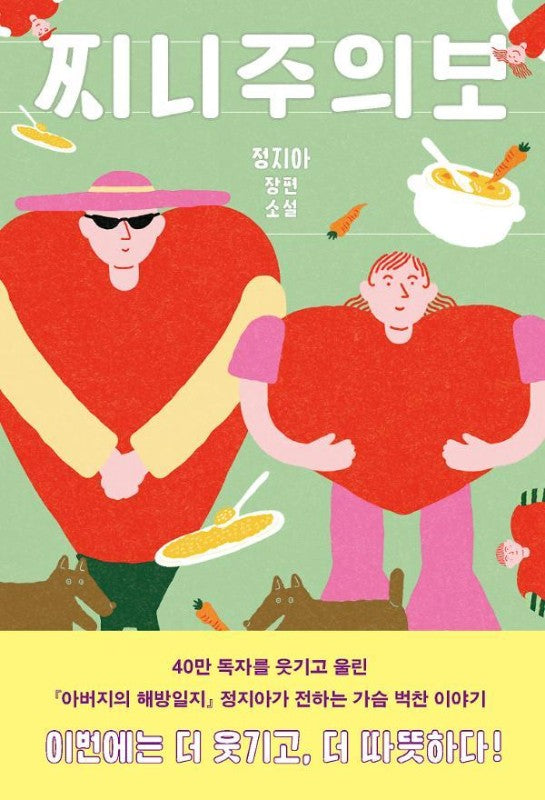
Jjin-i Advisory
Author Jung Ji-a · Publisher Changbi · Published 2026-08-17 · ISBN 9788936439996 About the Book'Jinni Alert' Issued in a Peaceful Country VillageThose Who Want to Drive Them Out, and Two Women Who Have Closed Their DoorsFrom the very first page, the novel draws the reader into the heart of Supyeong Village. At 8:30 AM, at an emergency meeting in the...
See full description ↓Description
Author Jung Ji-a · Publisher Changbi · Published 2026-08-17 · ISBN 9788936439996
About the Book
'Jinni Alert' Issued in a Peaceful Country Village
Those Who Want to Drive Them Out, and Two Women Who Have Closed Their Doors
From the very first page, the novel draws the reader into the heart of Supyeong Village. At 8:30 AM, at an emergency meeting in the village hall, 'Teacher Yoon,' a self-proclaimed intellectual and power-broker in the village, dramatically reveals a major incident: Seongjin and Hyejin, two young women who moved from Seoul to the countryside, or 'Jinnis' as they are called, are 'rejis' who "like each other." However, the village elders' understanding of 'reji' is not lesbian, but an old term for women who worked in tearooms. When 87-year-old Han confidently declares, "If there were new rejis, I'd surely know," the solemn meeting quickly veers off in an unexpected direction. Even after finally grasping the meaning of the word, 'Jeolgol-daek' calmly asks, "If they like each other, they'll live together, won't they? If they didn't like each other, would they live together, even if they were both women?"
The real conflict begins now. Faced with the deep-seated belief that women can live together but not love each other, the Jinnis suddenly become strange and dangerous beings. Teacher Yoon raises his voice, insisting that the "devil's spawn" must be driven out immediately, and the Jinnis, who had sought refuge in Supyeong Village to escape the world's harsh gaze, once again lock their doors. The villagers cannot understand the two women, and the Jinnis cannot tolerate their violent rudeness. A critical 'Jinni Alert' is finally issued in the once-quiet Supyeong Village.
A Grand, Hilarious Village Play Where Laughter Erupts with Every Word,
and Hearts Are Touched When They Turn Away
However, Teacher Yoon's plan does not go as intended. Most notably, Suan, the village chief's Vietnamese wife, stands in the way of the villagers trying to drive out the Jinnis. For Suan, who immigrated to an unfamiliar land twenty years ago and has lived as a foreigner, the Jinnis' plight is not someone else's problem. "Did they kill someone, or steal something? What did they do to deserve all this fuss?"
Suan, who boasts a more outspoken tongue than anyone else in Supyeong Village, injects an unpredictable vitality into the story. Yet, what dismays the Jinnis even more than the unyielding stares are the contradictory actions of the elders. While whispering about driving them out, they discreetly leave dried radish greens soup and eggplant side dishes on the Jinnis' doorknob. After unsettling them with awkward questions, they turn around and press freshly made pumpkin pancakes into their hands. In front of these peculiar neighbors who "inflict fatal wounds and then offer food," making it impossible to tell if they hate or care for them, the boundaries between good and evil, courtesy and rudeness, that the Jinnis firmly believed in, begin to waver.
Then, Kihee, the Jinnis' friend from Seoul, arrives with her pet chickens, 'Ppidoli and Ppisuni,' turning the village upside down once more. The absurd commotion that unfolds between the urban woman who pushes her chickens in a stroller like children and the elders who have never considered chickens as anything other than livestock, evokes both uproarious laughter and illustrates how two entirely different worlds can unexpectedly intertwine.
Jung Ji-a does not explain heavy social issues like discrimination, migration, aging, and caregiving in a didactic tone. Instead, she joyfully clashes different standards of life within vivid colloquialisms, like responding to a scolding of "Just shut your mouth and eat" with "How can you eat with your mouth shut?", and in a chain of interconnected incidents. The commotions caused by characters with diverse stories, engaging in a give-and-take, keep the reader engrossed without a single dull moment.
"First, you have to save someone who's drowning."
A Meal's Worth of Heart Arrives Before Complete Understanding
As the story progresses, the novel gains unexpected depth and resonance. Teacher Yoon, who had most vehemently ostracized the Jinnis, now faces the crisis of losing even his last home. As he, who had been an antagonist his whole life, is pushed to the brink, the villagers cluck their tongues but cannot turn away. "No matter how much we dislike him, what can we do? First, you have to save someone who's drowning." And an unexpected person extends a hand to Teacher Yoon. It's not because their hatred has vanished, nor because they completely understand each other. It's simply because a neighbor, whose face they see every day and with whom they've shared meals, is in trouble. From this choice, the boisterous village commotion expands into a poignant narrative of how vulnerable beings, on the edge of a precipice, cling to each other's breath.
Jung Ji-a does not depict a beautiful reconciliation where people are suddenly enlightened and prejudices are cleanly washed away. The people of Supyeong Village remain rude and self-centered until the very end, interpreting the Jinnis' lives through their own standards. Teacher Yoon, too, instead of offering a sincere apology, simply sends an overwhelming amount of side dishes that are too much to eat. In the awkward food, which is neither easy to accept nor discard, gratitude and pride, apology and stubbornness are inextricably intertwined. It is precisely because of this imperfection that their relationships gain a more realistic persuasiveness and a lasting resonance.
A picture of the most cheerful and passionate community of our time,
where after a good laugh, one invariably longs for people.
What makes "Jinni Alert" special is that it doesn't resolve sharp conflicts with safe and pretty answers. In an age where people neatly categorize others and easily cut off those with different opinions, Jung Ji-a argues that perfect understanding and forming 'sides' are not prerequisites for living together. She suggests that specific moments—like caring for someone when they're sick despite gossiping and quarreling, or being the first to offer help when a disliked neighbor is in danger—are more powerful than grand concepts. Novelist Hwang Sok-yong praised this work, saying, "This humorous, traditional play-like novel, which we knew well but had forgotten, is far from old-fashioned; it's truly 'glocal' in today's terms. The immediate, immersive pleasure of seeing the story unfold before your eyes is also exceptional." This implies that the story, told in the most regional dialect of the southern provinces, vividly unfolds contemporary issues such as queerness, migration, old age, family, care, and community. Because it embraces both the warmth of an old village and new relationships of the present, "Jinni Alert" transcends specific generations or tastes, making a wide range of readers laugh and feel deeply.
If "My Father's Liberation Diary" led to the discovery of a person beyond ideology, "Jinni Alert" leads to the discovery of a neighbor beyond prejudice. A story that makes you laugh from the first chapter and disarms your heart by the last. People who seemed utterly incompatible stumble and clash, eventually remaining by each other's side. Jung Ji-a once again succeeds in making it difficult to hate anyone. It is a spicy, salty, tear-inducingly delicious feast of life offered to all of us who, though weary of people, can never truly give up on them.
From the Book
It was a day that couldn't be better. The wind, which had been blowing since the previous afternoon from unknown origins and to unknown destinations, raged like a madwoman jumping rope, and after midnight, a light rain began to scatter. The wind, subtly dampened by the light rain, seemed to have seeped into the ground with the rain, for it suddenly subsided. It was a quiet rain that didn't even stir the sleep of light-sleeping dogs. The humidity that permeated the air soothed the anxieties of all living things, and that night, everyone's sleep was deeper and sweeter than ever. That night, the space between heaven and earth, washed by the rain, was literally empty.
--- p.7
"Those things, they say."
"Who are 'those things'?"
"What did the Jinnis do?"
"The Jinnis, they say. They're 'rejis,' rejis."
--- p.20
Whack! A crisp sound echoed clearly in the silent night air. Suan's hand was so swift that the village chief inadvertently dropped the cigarette he was smoking and awkwardly stroked the area nearby, which her hand hadn't even touched. Suan looked down at the chief dismissively and snorted.
"Tsk, you petty man! Are you really going to kick them out? Are you so afraid of old women who are on their deathbed?"
"I have a crazy friend."
"No, she raises them as pets, like our Chapssal Mochi."
--- p.80~81
Hyejin underwent various tests and counseling at her uncle's mental hospital. When her laced sneakers and phone were taken away and she heard the iron door close, Hyejin believed her mother had truly abandoned her. She was diagnosed as perfectly normal and was able to leave the hospital after a week. During the drive back to Seoul in her mother's car, Hyejin didn't say a word. Being hit by her mother and being hospitalized in a mental institution were both unbearable shocks for Hyejin. After that day, Hyejin closed the door to her heart toward the world. The moment she revealed her true feelings, she would be confined to a mental hospital; not a single person in the world supported her, not even her mother, who she always thought would be on her side. Was it her mother's fault that Hyejin's heart closed that day? Or was it the world's fault? In her ambiguity, Hyejin blamed herself. It's the way of the world for a protruding stone to eventually be chiseled, and in a heterosexual world, homosexuals are protruding beings. But now, Suan was talking so easily about lesbians as if they were on par with Koreans or Americans. Not only the Jinnis, but also the chief felt somehow relieved, and the homeowner, deep in thought, was silent for a moment.
--- p.100~101
"What happened?"
"No, my child isn't like this. Until yesterday, she wouldn't even look at an earthworm!"
--- p.118~119
Han chuckled. After urging the chief to investigate, the chief moved on. Teacher Yoon must be burning with anxiety. Time was pressing. No matter how much he disliked him, he was still a fellow villager. As a chief who received national funds, it was his duty to roll up his sleeves and get involved in village matters. After seeing the villagers out, the chief, who was the last to leave, was about to close the gate when Han poked her head in and shouted.
"Thank you, Reji Bodhisattva! You'll be blessed!"
Reviews
According to one critic, Jung Ji-a's novels bloomed late. Like a jujube tree whose new leaves sprout only after late spring, her writing is rich and firm.
The story begins when two lesbian women from the city unexpectedly move to a remote village inhabited only by elders. This humorous, traditional play-like novel, which we knew well but had forgotten, is far from old-fashioned; it's truly 'glocal' in today's terms. The immediate, immersive pleasure of seeing the story unfold before your eyes is also exceptional.
As the dilapidated old houses and the pasts of their inhabitants are revealed like cracks in old porcelain, conflicts intensify, but they ultimately embrace and heal each other.
It conveys the warmth that even if the outside world is already hell, it's still worth living because 'we' are here.
- Hwang Sok-yong (Novelist)
Table of Contents
Everyone Has Secrets
Everyone Is a Little Bad
Everyone Has a Peculiar Side
Everyone Lives by Their Own Standards
Everyone Has a Reason
Everyone Lives Unaware
Author's Note
Product Details
Related products

The book is priced at its original Korean retail price (KRW 1,000 = A$1). Air freight is charged separately at checkout.
Orders close every Tuesday, are sent to Korea on Wednesday, and arrive in store one week after dispatch — 8 to 14 days from your order. Order today and pick up from Wed 21 Oct; we'll email you as soon as your books arrive.
Collect at the book corner in our Lidcombe or Eastwood store. No home delivery. Please have your order number and name ready.
First book A$15 + A$6 per extra book — 1 book $15 · 2 books $21 · 3 books $27 · 4 books $33, calculated automatically at checkout. The more books you order together, the lower the cost per book.
Titles temporarily out of stock in Korea may be delayed by about one week. If a title is out of print or unavailable, we refund that book in full and proceed with the rest of your order.
 Jjin-i Advisory
$16.80
Jjin-i Advisory
$16.80