Don't Send Me (Hardcover)
Author Kazuo Ishiguro · Publisher Minumsa · Publication Date 2021-04-09 · ISBN 9788937444371 About the BookReflection and Critique on "The Human Way of Life"While "Never Let Me Go" is set in the late 1990s, it posits a world where human cloning is possible. There are numerous institutions, not just one or two, that raise cloned humans specifically for organ transplantation,...
See full description ↓Description
Author Kazuo Ishiguro · Publisher Minumsa · Publication Date 2021-04-09 · ISBN 9788937444371
About the Book
Reflection and Critique on "The Human Way of Life"
While "Never Let Me Go" is set in the late 1990s, it posits a world where human cloning is possible. There are numerous institutions, not just one or two, that raise cloned humans specifically for organ transplantation, and their operating policies and methods vary. Hailsham, a boarding school completely isolated from the outside world, is one such place. Kathy, Ruth, and Tommy, who spent their school days together at Hailsham, are cloned humans but possess reason and emotion, and they think for themselves. They constantly ponder their "originals," the individuals from whom they were cloned, and silently accept their fate as organ donors while hoping to prolong their lives, even if just a little.
The human desire for life extension has manifested itself through continuous genetic cloning experiments in genetic engineering and biotechnology, and through works using genetic cloning as a theme in popular culture, such as literature and film, for a long time. Dystopian works like Margaret Atwood's "The Handmaid's Tale," Aldous Huxley's "Brave New World," and Michael Bay's film "The Island" warn of the dangers of a new world achieved through advanced scientific development. However, this work goes a step further. It questions the dignity of life through the lives of cloned humans who are complete living beings, just like humans, but whose existence is predicated on their sacrifice for human desires.
In the final part of the novel, the protagonist and narrator, Kathy, after realizing the reality of the different lives demanded of them, laments, "Is there anyone who thinks we don't have souls?" This is because for them, as cloned humans, it is "their only life." Tommy, stating that Miss Lucy, a teacher at Hailsham who was fired for trying to make them face the truth, was right, blurts out, "It's all so shameful." Tommy's words contain the author's sharp critique of humanity and civilization.
This work addresses the cutting-edge question of whether future humanity could truly be happy if it were someday actually possible for humans to extend their lives by killing cloned humans who are living beings with reason and emotion. And it sternly warns that without such contemplation, the future might become a dystopia, not a utopia. In an interview, the author stated that through this work, he wanted to "focus on the human way of life." The Evening Standard also commented that it is "not a warning about the dangers of human cloning, but an insight into how our way of life is moving into the realm of science." This perspective also permeates the author's entire body of work, which is based on Eastern philosophy.
'Never Let Me Go'
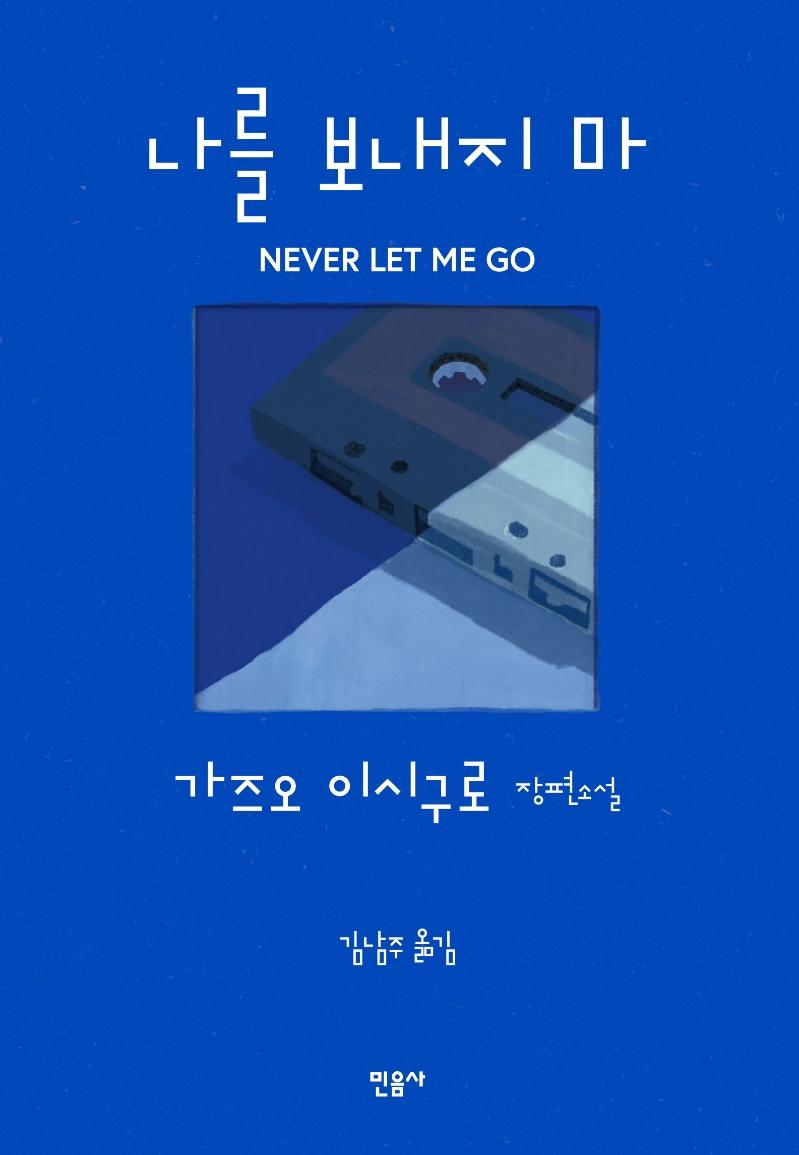
The original title of the novel, "Never Let Me Go," is also the title of the third track on Judy Bridgewater's pop song cassette tape. In this work, the cassette tape containing "Never Let Me Go" is a key motif that shows the difference in perspective between humans and cloned humans, and it is also a motif that drives the novel by connecting the friendship and subtle romantic feelings of the three protagonists.
One afternoon, Kathy plays the cassette tape in her boarding school bedroom, then hugs a pillow, closes her eyes, and slowly dances, singing along to the pop song's chorus: "Oh, baby, baby, never let me go..." Kathy interprets the song differently from its original meaning. She imagines a miracle happening to a woman who desperately wanted a baby all her life but couldn't have one, and she gives birth to a baby. The woman then holds the baby in her arms and murmurs the chorus, meaning "don't abandon me." At that moment, Madame, an outsider involved in the operation of Hailsham, witnesses the scene and wipes away tears.
If Kathy projected her fate as a cloned human who couldn't have children onto the song, Madame saw Kathy's gesture as a helpless resistance to a new world where the extension of human life became possible through scientific advancement, and she felt pity. This also shows the intersection of Kathy's infinitely "human" perspective and Madame's coolly rational, "ordinary person's" gaze.
After this incident, Kathy loses the cassette tape, which was a precious treasure to her, and never finds it. Several years later, they visit Norfolk, "where lost items from all over the country are collected and stored." In an antique shop there, Kathy finds a cassette tape identical to the one she lost earlier, and Tommy gives it to her as a gift. Subsequently, for Kathy, the cassette tape becomes "a memory of Tommy, with whom she once shared feelings of love," and is remembered for the rest of her life as "nostalgia for Hailsham in her memories," which is now a closed and vanished school.
This work evokes a serious reflection on the dignity of human life, and on life and death, "in an original way that confronts the reader with raw death and loss and the unbearable fragility of the things we love" (The Times Literary Supplement). This work, distinguished by the author's sophisticated writing style, will provide an opportunity to reflect on human dignity, modern society, and the achievements of science and technology.
Contents
Part 1 11
Part 2 201
Part 3 353
Translator's Afterword 492
Product Details
Related products
The book is priced at its original Korean retail price (KRW 1,000 = A$1). Air freight is charged separately at checkout.
Orders close every Tuesday, are sent to Korea on Wednesday, and arrive in store one week after dispatch — 8 to 14 days from your order. Order today and pick up from Wed 28 Oct; we'll email you as soon as your books arrive.
Collect at the book corner in our Lidcombe or Eastwood store. No home delivery. Please have your order number and name ready.
First book A$15 + A$6 per extra book — 1 book $15 · 2 books $21 · 3 books $27 · 4 books $33, calculated automatically at checkout. The more books you order together, the lower the cost per book.
Titles temporarily out of stock in Korea may be delayed by about one week. If a title is out of print or unavailable, we refund that book in full and proceed with the rest of your order.
 Don't Send Me (Hardcover)
$19.00
Don't Send Me (Hardcover)
$19.00