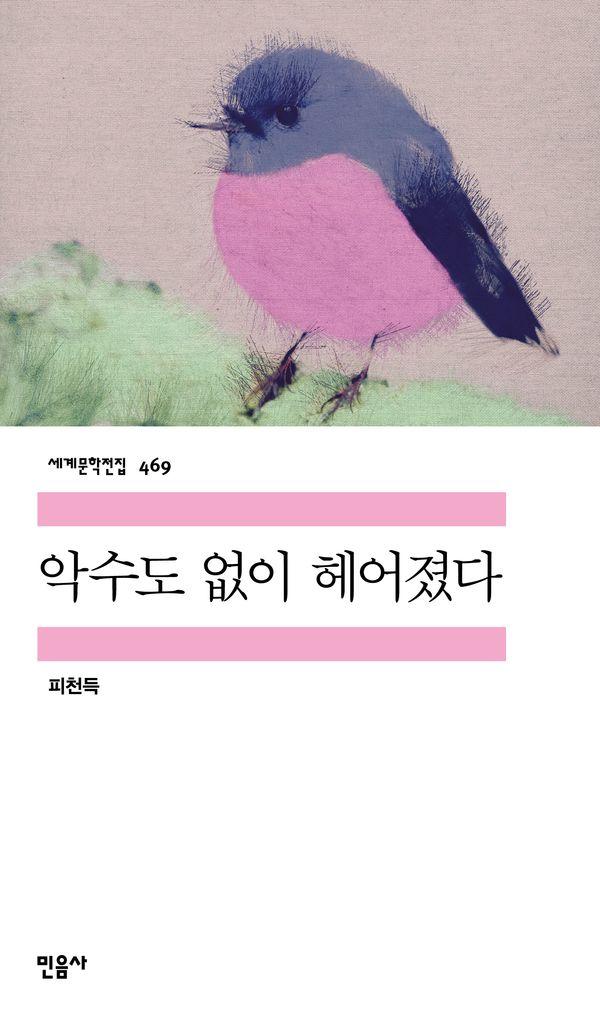
We Parted Without Even a Handshake - World Literature Collection 469
Author Pi Cheon-deuk · Publisher Minumsa · Publication Date 2025-12-12 · ISBN 9788937464690 Book IntroductionThe writer who understood "the individual," lived as "the individual," and desired "the individual"Pi Cheon-deuk was a Korean poet, essayist, English literature scholar, and translator. Born in 1910 and passing away in 2007, he was an intellectual who fully experienced the 20th century. Amidst the tumultuous...
See full description ↓Description
Author Pi Cheon-deuk · Publisher Minumsa · Publication Date 2025-12-12 · ISBN 9788937464690
Book Introduction
The writer who understood "the individual," lived as "the individual," and desired "the individual"
Pi Cheon-deuk was a Korean poet, essayist, English literature scholar, and translator. Born in 1910 and passing away in 2007, he was an intellectual who fully experienced the 20th century. Amidst the tumultuous era of colonialism, war, division, and industrialization, he trusted individual emotions and daily life more than the slogans of the times. The writings he left behind as a 20th-century intellectual quietly testify to the attitude and ethics of a person who lived as a modern individual. His writings are not only humble literature that comforts the mind but also a rare record that shows how the 'birth of the individual,' a core theme of modern literature, was contemplated and embodied in Korean society.
Aesthetic standard of Korean essay literature
Despite living through a turbulent period, his concise and restrained sentences created transparent lyricism, becoming the aesthetic standard for Korean essays. His writings, which combine pure childlike innocence, clear and noble emotions, and a refined and unadorned spirit, are a landmark that elevated modern Korean essays to the realm of cultured literature and have become an eternal spiritual haven for Koreans. Works engraved as the epitome of essays, such as "Inyeon (Ties)," "My Beloved Life," "May," and "A Copper Coin," elegantly and freshly convey Pi Cheon-deuk's essayistic spirit, which loved small and beautiful things from an early age. We Parted Without a Handshake re-gathers works that represent the pinnacle of this aesthetic, clearly presenting a standard that Korean essays have achieved to today's readers.
The person who loved and left
The core of Pi Cheon-deuk's literature is 'love'. His love is not an emotional confession or an outburst of passion, but an attitude towards life and an ethic for viewing the world. His love is not a desire to possess or change others, but rather a form of patience that accepts things as they are and respects them to the end. In literary terms, it manifests as sentences that carefully hold onto small and insignificant moments instead of dramatic events or heightened narratives. The attitude of not turning away from small and vulnerable things, easily passing daily routines and relationships, and the restraint of stepping back in the face of unspoken emotions form the aesthetic character of his love. For Pi Cheon-deuk, love was not about revealing but about protecting, not about asserting conviction but about observing for a long time. That was the quietest and firmest reality of the love he showed through his lifelong writings.
A sensibility that praises youth
Pi Cheon-deuk's writing, fresh and vibrant, is notably ageless. In many of his writings, Pi Cheon-deuk consistently praises youth. This might be partly because he wrote these pieces in his middle age, after his own youth had passed. His longing for an irretrievable past, rather than keeping him in the past, actually led him to find the essence of happiness in the present and reality, with an attitude of contentment and restraint. In this, readers also come to contemplate the attitude of accepting the flow of time and the dignity of aging. This book is a record of an intellectual who, even at the end of his life, never lost the ability to love life.
Additional inclusion of letters sent to his son
To Pi Cheon-deuk's readers, he is remembered as a father who deeply loved and missed his daughter, "Seo-yeong." However, in reality, he was also a father to his son, and his son, Pi Su-yeong, consistently took on the practical role of organizing and managing his works after his passing. Pi Su-yeong is a renowned doctor who established the first neonatal medical system in Korea at Asan Medical Center, and he spent his entire life in the medical field until he retired at the age of eighty as an advisor to Hana Medical Foundation. The letters included in this book are those Pi Cheon-deuk sent to his son when Dr. Pi Su-yeong was working as a neonatologist at the Duluth Clinic in Minnesota, USA. The letters frankly reveal his worries and concerns for his son, the loneliness of his later years having all his children far away, and the deep affection hidden in his restrained words. This is also a record that quietly illuminates "the face of a father," which was rarely revealed in Pi Cheon-deuk's literature.
Kim Ji-su's 'Interview Commentary' included
The commentary included in this book is an expanded critique that doubles as an interview. Kim Ji-su's interview commentary allows Pi Cheon-deuk's literature to be re-read in today's language. She evokes the individual outside the text, interweaving a person's life and writing in a multifaceted way, and expands We Parted Without a Handshake from a simple collection of essays into a book about attitudes toward life that are relevant again in this era.
Starting from the perspective of a reader of Pi Cheon-deuk, it calmly asks and follows the father's feelings for his daughter, what kind of father he was to his son, what kind of people he enjoyed associating with, and what kind of life he lived as the author's family, questions that many readers have long been curious about. This interview commentary opens up ways for readers to read Pi Cheon-deuk's writings differently and more deeply.
From the commentary
I started reading the first chapter with a relaxed mind, immersed in reminiscence, but before I even finished one page, I sharpened my pencil with trembling hands and started underlining. When was the last time I encountered such concise, elegant, vivid, and humbly profound Korean words? The aura given by the unhesitating beautiful prose was tremendous. Teacher Pi Cheon-deuk said, "An essay is a stroll of the mind" and "the light of an essay is the color of a dove or a pearl." He wrote that it is a literature that is "leisurely yet not lazy" and "the path of an essay is to go where one wants to go." The sentences written with effortless grace land freshly in the right places of the five senses due to their precision and refinement of expression. Most of Pi Cheon-deuk's prose begins with a trivial sentence and concludes affectionately, causing ripples of embrace in one's chest. (Omitted) After reading this piece, whenever I went for a walk by the Han River, I found myself checking which dove's neck feathers were shiny, even on cold days when the river was frozen solid. I lifted my chin towards the sky and whispered, "Let's forget the hardships in the sunlight." Teacher Pi's sentences thus deeply penetrate the reader's life.
Table of Contents
Foreword 13
Life is beautiful with small ties
Essay 17
New Spring 20
Early Spring 23
Skylark 25
Spring 28
Letter Sent to Paris 31
May 34
Garden Party 36
Rose 40
Beauty of Women 42
Ramie Cloth 45
Water Skiing 48
Dream 50
Gift 52
Flute Player 56
Too Much 58
Depending on How You Look At It 60
Woman's Letter 62
Toy 64
Furniture 66
Tears 68
Taste and Style 71
Hoyt Collection 73
Telephone 75
Country Herb Pharmacy 77
Longevity 79
Chuseok at Hwangpotan 81
Waiting for a Letter 83
Pocket Money 85
Gold Ring 88
Moving 90
Boston Symphony 94
Seo-yeong
Mom 99
That Day 105
Brilliant Days 109
To Seo-yeong 111
One Day 114
Seo-yeong 116
Seo-yeong Goes to College 120
To My Daughter 124
Seo-yeong and Nan-yeong 127
Maternal Great-Uncle 131
Inyeon (Ties) 134
Yu-sun 138
Dosan 143
To Teacher Dosan 146
Chunwon 148
Shakespeare 151
Do Yeon-myeong 153
Robert Frost I 157
Robert Frost II 160
Charles Lamb 163
Brooke's Patriotic Poem 166
Feminine Heart 169
Chiong 172
Portrait of a Scholar 177
Einstein 180
My Beloved Life
My Beloved Life 185
Elegance 189
Reflected Glory 192
Pi Ga Ji Byeon (A Fictional Episode) 196
Story 200
Sleep 204
Image of Salvation 208
Doodle 212
A Copper Coin 215
Alcohol 218
Pilgrimage 224
Biwon (Secret Garden) 230
Travel Sketch 233
Saturday 237
Tender Heart 240
Invitation 243
Traveler on a Summer Night 245
Prayer 248
Friendship 250
August 15, 1945 253
Concord Hymn 255
To a Friend's Daughter Getting Married 258
Function of Humor 262
Preservation of Cultural Heritage 264
End of Year 266
Later Years 269
To Su-yeong
Undated 272
March 19, 1976 274
May 15, 1977 276
April 3, 1977 278
April 3, 1980 280
September 4, 1980 282
Card. Undated 283
Work Commentary
Meeting the Abyss of Humility _Kim Ji-su (Journalist/Writer)
Author Chronology
Product Details
Related products

The book is priced at its original Korean retail price (KRW 1,000 = A$1). Air freight is charged separately at checkout.
Orders close every Tuesday, are sent to Korea on Wednesday, and arrive in store one week after dispatch — 8 to 14 days from your order. Order today and pick up from Wed 21 Oct; we'll email you as soon as your books arrive.
Collect at the book corner in our Lidcombe or Eastwood store. No home delivery. Please have your order number and name ready.
First book A$15 + A$6 per extra book — 1 book $15 · 2 books $21 · 3 books $27 · 4 books $33, calculated automatically at checkout. The more books you order together, the lower the cost per book.
Titles temporarily out of stock in Korea may be delayed by about one week. If a title is out of print or unavailable, we refund that book in full and proceed with the rest of your order.
 We Parted Without Even a Handshake - World Literature Collection 469
$15.00
We Parted Without Even a Handshake - World Literature Collection 469
$15.00