
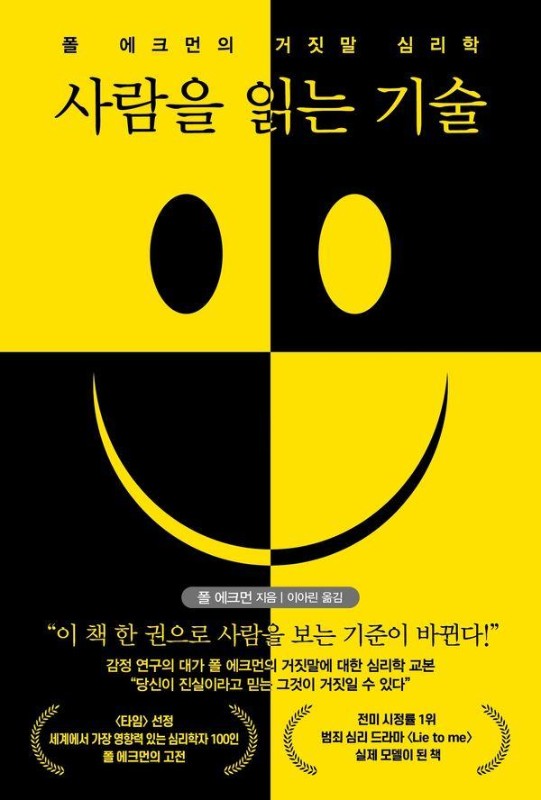
Telling Lies: Clues to Deceit in the Marketplace, Politics, and Marriage by Paul Ekman
Author Paul Ekman · Publisher Hankyung BP · Published 2026-08-18 · ISBN 9788947503136 About the BookOne of Time's 100 Most Influential People in the WorldThe Most Influential Psychologist of the 21st CenturyOfficial Psychological Analyst for the US FBI and CIAThe Book that Inspired the Fox TV Drama 'Lie to Me'"What if what you believe to be true is a lie?"The...
See full description ↓Description
Author Paul Ekman · Publisher Hankyung BP · Published 2026-08-18 · ISBN 9788947503136
About the Book
One of Time's 100 Most Influential People in the World
The Most Influential Psychologist of the 21st Century
Official Psychological Analyst for the US FBI and CIA
The Book that Inspired the Fox TV Drama 'Lie to Me'
"What if what you believe to be true is a lie?"
The Most Scientific and Reliable Way to Read the World's Lies
We meet someone every day. At work, at home, at school, and even online... Trust is probably the most important thing in human relationships. We have countless conversations within numerous human relationships every day, but people often harbor doubts during these conversations. Is the other person truly telling me the truth?
Everyone has probably experienced such doubts and anxieties at some point in their relationships: whether a lie is hidden behind unwavering eyes, what the true emotion is behind a gentle smile, or what the true feelings are of someone who avoids eye contact while speaking.
Paul Ekman, who has dedicated over 40 years to the study of lies and emotions, presents in this book methods for reading the signals of lies hidden in facial expressions, voices, and gestures. He states that one can discern another's true emotions through subtle changes in facial expressions that are difficult to intentionally control.
Sigmund Freud, the founder of psychoanalysis, once said that lies can never be truly hidden: "No mortal can keep a secret. If his lips are silent, he chatters with his fingertips; betrayal oozes out of him at every pore."
A Textbook on 'Reading Lies' Based on Scientific Evidence
The Ability to Detect Lies Can Be Learned!
What makes this book noteworthy is that it is not merely a collection of 'psychological tips' but is based on over 40 years of solid scientific research. In 1978, Ekman developed the world's first 'Facial Action Coding System (FACS)' to systematically classify facial movements, and based on this, he scientifically proved the principles and processes by which lies are revealed.
The US FBI and CIA, as well as investigative agencies in various countries worldwide, have actually utilized his research, and the drama 'Lie to Me,' for which he served as a consultant, gained significant popularity in the US, further validating his achievements.
The content covered in the book is extensive yet systematic. Why do people lie? How are types of lies classified? What conditions are necessary for a lie to succeed? What signals should be observed when detecting a lie? Are there pitfalls in lie detection? Can errors occur in the detection process? These questions are explained clearly and understandably.
The author states that this book "will be more helpful to lie detectors than to liars." The signals of falsehood hidden in a person's face, voice, and gestures are mostly revealed unconsciously. Therefore, by carefully observing subtle changes in facial expressions, tremors in the voice, small movements of the hands, etc., which the other person has difficulty intentionally controlling, anyone can read the other's true intentions and emotional state.
In an era that demands genuine trust and communication skills,
How can you read another person's true feelings?
The book uses a wide variety of examples, from everyday white lies to criminal psychology, negotiations, interviews, politicians' interviews, and conversations between couples and lovers, to show interestingly why people lie and in what situations lies succeed or fail. In particular, it explains core concepts that have become classics in psychology and behavioral analysis today, such as the two modes of lying—'concealment' and 'falsification'—and emotional masks used to hide emotions, microexpressions, and vocal changes, in an easy-to-understand manner.
In an era where trust and communication are more important than ever in human relationships, the spread of social media has led to meeting more people online and offline, but at the same time, distrust and misunderstandings have also increased. In the workplace, lies must be filtered out, in negotiations, the true intentions of the other party must be understood, and in family and friendships, deeper understanding is needed.
In that regard, this book provides practical wisdom necessary to understand others' true feelings and build genuine trusting relationships. As Professor Choi Jae-chun recommended, it is a book that "tells interesting things that can be immediately applied, while not losing scientific rationality." It offers practical advice that can be used immediately in various real-world situations, such as negotiations and interviews at work, meetings with clients, as well as criminal investigations, security interrogations, and medical consultations.
Furthermore, it also covers insights into the nature of human relationships, such as why lies are so prevalent in our society, whether the line between lies and truth is truly clear, how to view white lies, and who has the right to lie and who has the right to detect lies. The desire to instantly discern another's true feelings is a fundamental human instinct. In a reality where truth and falsehood are chaotically intertwined, it is hoped that through this book, one can properly understand the human psychology behind lies and find solutions for genuine human relationships.
Recommended for these readers!
Readers who want to understand human psychology and behavior
Professionals in fields where interpersonal relationships are crucial, such as negotiation, sales, interviews, and counseling
General readers interested in psychology and communication
Readers looking for profound classics in self-improvement and human relationships
Readers who enjoyed the drama 'Lie to Me'
From the Book
After reading this book, all the actions of those around you will no longer seem ordinary. The sound of someone suddenly swallowing might seem louder, the flaring of nostrils might catch your eye, and subtle changes in intonation might be noticed. However, let's not jump to conclusions too quickly. The true great virtue of this book is the author's thoroughness, as he discusses interesting content that can be immediately applied while never losing scientific rationality. As a natural scientist, I often felt uncomfortable reading psychology books that felt like listening to someone making unfounded claims, but this book completely avoids that, which is its greatest virtue.
--- From 'Recommended Reading'
Lying is a crucial aspect of life. The more we understand lying, the more useful it can be in life. People who believe that lying should always be condemned might shudder at this statement, but my view is this: the claim that one should never lie under any circumstances is an overstatement. Furthermore, I don't believe that all lies should be exposed. I agree with columnist Ann Landers when she said, 'Truth can sometimes be a cruel bludgeon.'
--- From 'Prologue'
The best way to conceal strong emotions is to wear a mask. Covering all or part of one's face with hands or turning one's head away from the person speaking is tantamount to confessing, 'I am lying.' The best mask is to feign emotions. This method not only deceives but also serves as the best camouflage. When emotions run high, it is difficult to keep one's hands still or maintain a blank expression. There is nothing harder than to appear calm or ambiguous when feeling a strong emotion.
--- From 'Chapter 1: We Believe Only What We Want to Believe'
Detecting lies is not a simple matter. The first reason is that there is too much information to judge. Speech, pauses in narration, vocal tone, facial expressions, head movements, gestures, posture, breathing, blushing or paling complexion, sweating—there are too many elements to observe. All these elements convey information simultaneously or sequentially, distracting the detector's attention.
--- From 'Chapter 3: Evidence of Lies That Leak Out Unconsciously'
The most crucial use for microexpressions, subtle expressions, and dangerous expressions is probably in building 'trust' and 'winning cooperative relationships.' Everyone has stories they wish to share if the listener is open and willing to understand. To gain such trust, one must be sensitive to the other person's feelings, especially those they are unaware of or worried about revealing.
--- From 'Chapter 4: Facial Expressions Don't Lie'
When lie clues are present, one can make the opposite mistake of disbelieving the truth, believing a truthful person's words to be a lie. Some fraudsters exploit this error by intentionally dropping lie clues to make the other person believe they have detected a lie. This is a trick often used by poker players, known as a 'false tell' in poker. "For example, suppose Player A coughs every time they bluff with a good hand. An observant opponent notices that A coughs whenever they bluff. Then, when the stakes are high in an important hand, A coughs again. But this time, they genuinely had an excellent hand, and the opponent, deceived by the trick, ends up losing everything without knowing why."
--- From 'Chapter 5: Do You Believe Lies? Do You Doubt the Truth?'
The success of a lie is independent of the liar's field. Not all lies between spouses are exposed, nor do all deceptions in business, crime, or international affairs succeed. Success and failure depend on the characteristics of the lie, the liar, and the lie detector. While international lies are much more complex than lies between parents and children, it is true that parents also find it difficult to avoid mistakes regarding their children's lies.
--- From 'Chapter 6: You Are Being Deceived Even Now'
This book will be more helpful to lie detectors than to liars. It is much easier to improve one's lie-detecting ability than one's ability to lie, and this skill can be learned. Without any special talent, anyone can understand my thoughts on 'how lies differ.' Anyone diligent can use the lie checklist to estimate the likelihood of a liar making mistakes.
--- From 'Epilogue'
Praise
Paul Ekman is a pioneer in the study of emotions and nonverbal communication. Through this book, he offers valuable and profound insights for both the general public and scientists. He clearly explains why and how people lie, why lies succeed or fail, the difference between skilled and unskilled lie detectors, and reliable lie clues. Based on data obtained through accurate and scientific research, he teaches how to wisely handle common lying situations in everyday life.
- The New York Times
Ekman deftly unravels his extensive research on nonverbal communication and deception, making it engaging and accessible to a broad audience. He opens up new perspectives on understanding human emotions and intentions. While scientifically explaining the subtle distinctions between falsehood and truth, the book also contains practical wisdom that can be applied immediately in daily life. This book will be genuinely helpful in reducing misunderstandings in human relationships and improving the quality of communication.
- Kirkus Reviews
This book stands out for its practical information on lies and lie detection, as well as its sharp analysis of ethical implications. Based on scientific evidence, it possesses textbook value, making it a valuable reference in various fields such as psychology, criminology, and neuroscience.
- Jerome D. Frank, Ph.D. (Johns Hopkins University School of Medicine)
Contents
Foreword by Professor Choi Jae-chun: Humanity Will Become Extinct from Despair and Boredom
Prologue: How to Detect Hidden Emotions
Part 1. The Deceived and the Deceivers
Chapter 1. We Believe Only What We Want to Believe
I Am Lying Now
People Whose Outward Appearance Differs from Their Inner Selves
What Is a Lie, and What Is the Truth?
Why Do People Lie?
Who Lies?
Chapter 2. The Liar's Dangerous Bet
Inconsistent Speech
Can Emotions Also Be Hidden?
What Liars Fear Most
Emotions Left by Lies
The Joy of Deception
Part 2. There Is No Perfect Lie
Chapter 3. Evidence of Lies That Leak Out Unconsciously
Words, the Undeniable Clue to Lies
Emotions Are Conveyed Through the Voice
Lies That Can Be Detected Through Body Language
The Autonomic Nervous System That Cannot Be Hidden at Will
Chapter 4. Facial Expressions Don't Lie
Facial Expressions Tell All
The Many Meanings Hidden Behind a Smile
Micro, Subtle, and Dangerous Expressions
Chapter 5. Do You Believe Lies? Do You Doubt the Truth?
Precautions When Interpreting Behavioral Clues of Lies
Part 3. Those Who See Through Lies
Chapter 6. You Are Being Deceived Even Now
How to Detect Lies
Why We Misunderstand Sincerity
Deception Even in War
Chapter 7. Lies That Moved the World
Who Can Be a Lie Detector?
Not All Liars Provide Clues
Lies in the Courtroom
Crucial Evidence of Lies
Chapter 8. People Who Deceived the World
Nixon and the Watergate Scandal
Jimmy Carter's Justified Lies
The Lies of the Vietnam War
The Challenger Disaster and Self-Deception
Clarence Thomas and Anita Hill
A Nation of Lies
Epilogue: Though the Lips Are Silent, the Face Speaks the Truth
Appendix: The Polygraph Lie Detector
Product Details
Related products


The book is priced at its original Korean retail price (KRW 1,000 = A$1). Air freight is charged separately at checkout.
Orders close every Tuesday, are sent to Korea on Wednesday, and arrive in store one week after dispatch — 8 to 14 days from your order. Order today and pick up from Wed 28 Oct; we'll email you as soon as your books arrive.
Collect at the book corner in our Lidcombe or Eastwood store. No home delivery. Please have your order number and name ready.
First book A$15 + A$6 per extra book — 1 book $15 · 2 books $21 · 3 books $27 · 4 books $33, calculated automatically at checkout. The more books you order together, the lower the cost per book.
Titles temporarily out of stock in Korea may be delayed by about one week. If a title is out of print or unavailable, we refund that book in full and proceed with the rest of your order.
 Telling Lies: Clues to Deceit in the Marketplace, Politics, and Marriage by Paul Ekman
$22.00
Telling Lies: Clues to Deceit in the Marketplace, Politics, and Marriage by Paul Ekman
$22.00