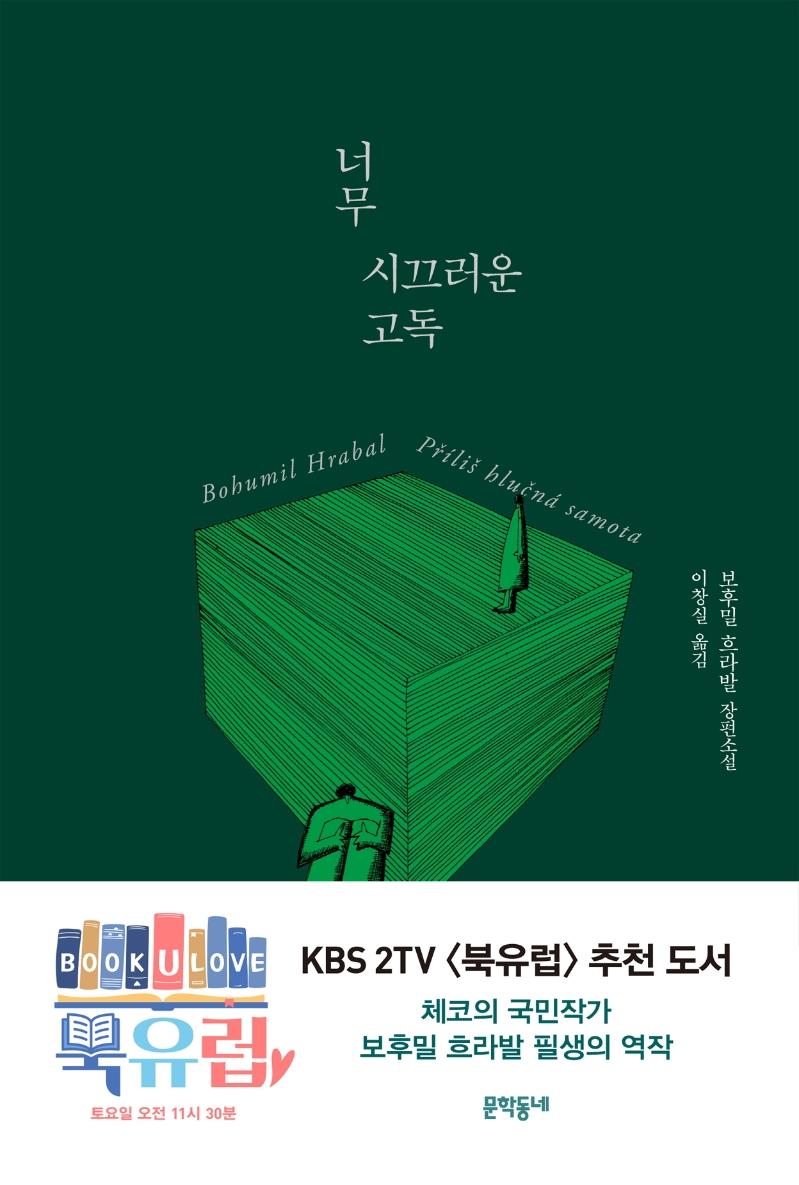
Noisy Solitude: Such a Dream (Hardcover)
Author Bohumil Hrabal · Publisher Munhakdongne · Published 2016-07-08 · ISBN 9788954641548 About the BookThe endless labor and agony of a man who confined himself to a basement The narrator of the novel, Hanta, has worked as a paper baler for thirty-five years. In a dark and dirty basement, he operates a baler with his bare hands, endlessly compressing discarded...
See full description ↓Description
Author Bohumil Hrabal · Publisher Munhakdongne · Published 2016-07-08 · ISBN 9788954641548
About the Book
The endless labor and agony of a man who confined himself to a basement
The narrator of the novel, Hanta, has worked as a paper baler for thirty-five years. In a dark and dirty basement, he operates a baler with his bare hands, endlessly compressing discarded paper that pours in. Through a trapdoor in the ceiling, books filled with humanity's accumulated knowledge and culture descend daily. These include brilliant literary works by Nietzsche, Goethe, Schiller, and Hölderlin, as well as magazines containing theater reviews by Miroslav Rutena and Karel Engelmüller. Hanta's task is to quickly shred and compress them, but he finds himself drawn to the charm of these discarded paper piles destined for destruction. He reads and rereads the torrent of books, becoming 'unintentionally' cultured. Hanta absorbs the knowledge contained within the waste paper like alcohol. He lives in a dirty environment teeming with cockroaches and rats, constantly receiving pressure and insults from his boss, but the thought of the incoming books makes the repetitive labor bearable. He collects valuable books separately, and his apartment is filled with tons of books. These precariously stacked books, threatening to collapse at any moment, are his only joy, allowing him to find a unique happiness in his solitary life. Now an old man, he once had women in his life: Mancha, his childhood sweetheart, with whom he almost spent his life, and a gypsy woman who coincidentally came to live with him one day. He reminisces about these memories, continuing his labor endlessly, much like the myth of Sisyphus. The work is so arduous that he needs to drink several liters of beer each day to endure it, yet he has done it for thirty-five years, and even dreams of buying a baler and continuing the work until his dying breath if he were to retire.
I am alone only to live in a solitude densely packed with thoughts. In a way, I am a Don Quixote pursuing eternity and infinity. Even eternity and infinity would be no match for people like me. (pp. 18-19)
The End of a World Faced by a Man Who Dreamed of Eternity
Wit and emotion never lost while tackling the weighty theme of the clash of two worlds
His passionate monologues, narrated in a cynical yet humorous style, captivate the reader. The story shifts between present and past. The main narrative is Hanta's contemplation through the tediously repetitive shredding work, interspersed with intriguing episodes. These include the endless battles of rat factions, his somewhat comical pity for cockroaches constantly throwing themselves toward death, and witty descriptions of people who approach him for valuable books. The episode with Mancha, the woman who shared his heart in the past, is humorous enough to make one burst into laughter. And the episode with the gypsy woman who lived with him for a short time, though seemingly dry, evokes emotional resonance and ultimately delivers profound moving.
Each of the eight chapters begins with essentially the same sentence, with slight variations. "For thirty-five years, I have been working in a pile of waste paper. (...) For thirty-five years of compressing books and waste paper, I, steeped in type for thirty-five years, have become like the encyclopedias, of which I must have compressed at least three tons with my own hands." He has done this work since his youth and wishes to continue it until his dying breath, but an event occurs that changes his life. One day, he goes into the city and witnesses a colossal baler, dozens of times larger than his own, and people in a modern facility, wearing uniforms and drinking Coca-Cola while compressing waste paper. They handle the paper with gloved hands and chat about their upcoming Greek vacation during breaks. This becomes a turning point that completely reshapes Hanta's world.
After witnessing this, he realizes his world is ending. He throws himself into the work of compressing waste paper with a frantic intensity, not even glancing at the books he loves. Without opening the precious books he cherished so much, he begins to work solely for efficiency, just like the uniformed balers in the city. However, he soon realizes that his life, his world, cannot be lived that way.
In humiliation and tension, a sudden realization struck me deep in my bones. I would never be able to adapt to a new life. Like all those monks who committed suicide en masse when Copernicus revealed that the Earth was no longer the center of the world. They couldn't imagine a world completely different from the one that had sustained their lives until then. (p. 106)
Profound Insight into Labor and Human Existence
A pointed satire on the times from a master of European literature
『Too Loud a Solitude』 is a short novel, barely 130 pages long, yet the weight of its meaning is by no means light. Through the life of an old man named Hanta, Bohumil Hrabal offers profound insights into humanity's incessant need to labor, the changes in human life after the advent of machines replacing workers, and reflections on humanity and existence. He encapsulates this not merely as a philosophical discourse, but as an intriguing story about living individuals and a poignant satire on the times, all within a single novel.
Furthermore, this novel, which uses the myth of Sisyphus as a motif, poses sharp questions about eternal labor and what constitutes the true liberation of human intellect. Hanta ultimately ends his world by walking into his own baler. This might seem to symbolically depict the end of modernity, but it can also be read as a critique of frenzied developmentalism progressing without direction. It can be interpreted as a political and philosophical allegory about a society that, due to indiscriminate development, regresses, becoming enslaved and dull.
This novel is closer to a long meditation by an old dreamer witnessing the end of a world. Hrabal delicately portrays the mental state of a person living in a harsh society where books are treated as mere scraps of paper. His thoughts sometimes appear to be in a drunken stupor or hallucination, yet they maintain a constant clarity, making us ponder and dream not about the collective, but about the individual. And above all, it reminds us of 'things that are disappearing.' The most beautiful and hopeful part of this novel lies in Hanta's unwavering grip on love and compassion. The maxim "Heaven is not humane," which constantly repeats like a chorus throughout the novel, is ultimately varied as follows. This is why, despite his tragic end, we can find and feel a paradoxical warmth and breath of peace within it.
Heaven is not humane. Yet beyond that heaven, something, compassion and love, surely exists. That which I had long forgotten, completely erased from my memory. (pp. 85-86)
Table of Contents
Chapter 1 9
Chapter 2 21
Chapter 3 35
Chapter 4 49
Chapter 5 69
Chapter 6 87
Chapter 7 105
Chapter 8 119
Translator's Note 133
Product Details
Related products

The book is priced at its original Korean retail price (KRW 1,000 = A$1). Air freight is charged separately at checkout.
Orders close every Tuesday, are sent to Korea on Wednesday, and arrive in store one week after dispatch — 8 to 14 days from your order. Order today and pick up from Wed 21 Oct; we'll email you as soon as your books arrive.
Collect at the book corner in our Lidcombe or Eastwood store. No home delivery. Please have your order number and name ready.
First book A$15 + A$6 per extra book — 1 book $15 · 2 books $21 · 3 books $27 · 4 books $33, calculated automatically at checkout. The more books you order together, the lower the cost per book.
Titles temporarily out of stock in Korea may be delayed by about one week. If a title is out of print or unavailable, we refund that book in full and proceed with the rest of your order.
 Noisy Solitude: Such a Dream (Hardcover)
$15.00
Noisy Solitude: Such a Dream (Hardcover)
$15.00