
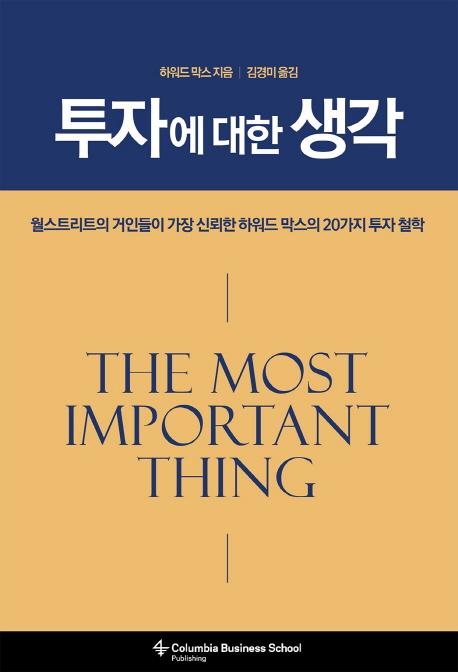
Thoughts on Investment: 20 Investment Philosophies from Howard Marks, Wall Street's Most Trusted Investor (Hardcover)
Author Howard Marks · Publisher Business Map · Published 2012-09-28 · ISBN 9788962604658 About the BookThe 20 most important investment principles for achievingoutstanding results in both the worst crises and the best opportunitiesEveryone wants to make money. All of economics is based on the belief that everyone pursues profit. Capitalism is no different. Driven by the pursuit of profit, people...
See full description ↓Description
Author Howard Marks · Publisher Business Map · Published 2012-09-28 · ISBN 9788962604658
About the Book
The 20 most important investment principles for achieving
outstanding results in both the worst crises and the best opportunities
Everyone wants to make money. All of economics is based on the belief that everyone pursues profit. Capitalism is no different. Driven by the pursuit of profit, people work harder and take risks with their money. As a result of this pursuit, humanity has achieved and enjoyed much material progress. However, because of its universality, it is difficult to beat the market. Today, millions of people are competing for their own investment returns.
To earn higher returns than other investors, you need either luck or exceptional insight. However, hoping for good fortune is not a good investment strategy. The author emphasizes the importance of focusing on one's own insights. He calls this "second-level thinking." For example, "Let's buy stocks because it's a good company" is first-level thinking, while second-level thinking is: "It's a good company, but everyone is overestimating it. As a result, the stock is overpriced and expensive. Sell it!" First-level thinking is simple and superficial, something anyone can do. But because anyone can do it, it cannot produce outstanding results. Remember that the goal of investing is to achieve above-average returns, not average returns. First-level thinking is merely an opinion about the future. However, second-level thinking is profound, complex, and difficult. To achieve above-average investment performance, you must be different from ordinary investors. That is, you must think more intelligently than other investors. You must be different and better than others. This is second-level thinking.
The author also introduces excellent insights into risk and intrinsic value. In particular, he emphasizes the importance of risk control and management over three chapters. The author argues that investment consists of exactly one thing: dealing with the future. The problem is that no one knows the future for certain. Risk is unavoidable. The author emphasizes that dealing with this risk is an essential element of investment. He summarized the principles of risk awareness as follows:
First, determine how much risk exists and whether you can tolerate that risk.
Second, confront not only potential returns but also the accompanying risks.
Third, always evaluate the risks you took when investing.
Elroy Dimson, Professor at London Business School, said that risk means more things can happen than will happen. Therefore, the path to long-term success lies in risk control rather than aggressive investment. The author argues that for most investors, their performance over their entire investment history is determined less by how great their successes were and more by how many failures they had and how bad those failures were. In other words, an excellent investor is one who can skillfully control risk.
In addition, principles such as waiting patiently for opportunities, the role of luck, inverse investing, and defensive investing will offer wise guidance to investors navigating the worst of times.
In an era of recession, a Wall Street philosopher offers
short but profound insights into investing
This book is highly unique. It does not explain investment methods, nor does it describe absolute secrets to investment success or step-by-step training. Nor does it contain valuation formulas involving numbers or fixed ratios. Instead of simplifying investing, the author reveals special memos filled with excellent insights to demonstrate how complex investing is.
Not many people possess the qualities to become great investors. Some may become capable through learning, but this does not apply to everyone. Even an effective investment strategy is only valid in certain cases, not always. Even a master investor cannot always be right.
Therefore, for successful investing, one must carefully consider various different aspects simultaneously. If even one is missed, the results may not be satisfactory. Just as bricks come together to form a sturdy wall and a house, each of the "most important things" discussed in this book will come together to form the foundation of successful investing.
Table of Contents
Foreword Investment Needs a Philosophy ㆍ11
Most Important Principle 01 Think Deeply ㆍ15
Most Important Principle 02 Understand Market Efficiency ㆍ24
Most Important Principle 03 What is Value? ㆍ38
Most Important Principle 04 Understand the Relationship Between Price and Value ㆍ51
Most Important Principle 05 What is Risk? ㆍ62
Most Important Principle 06 Recognize Risk ㆍ86
Most Important Principle 07 Control Risk ㆍ102
Most Important Principle 08 Pay Attention to Cycles ㆍ116
Most Important Principle 09 Understand the Characteristics of the Investment Market ㆍ126
Most Important Principle 10 Counter Negative Influences ㆍ137
Most Important Principle 11 What is Contra-Investing? ㆍ155
Most Important Principle 12 Find Undervalued Assets ㆍ169
Most Important Principle 13 Be Patient and Wait for Opportunities ㆍ181
Most Important Principle 14 The One Thing I Know is That I Don't Know ㆍ196
Most Important Principle 15 Know Where We Are ㆍ208
Most Important Principle 16 Do Not Underestimate the Role of Luck ㆍ222
Most Important Principle 17 Invest Defensively ㆍ234
Most Important Principle 18 Avoid Unseen Traps ㆍ253
Most Important Principle 19 Create Added Value ㆍ275
Most Important Principle 20 Adhere to All Principles ㆍ286
Product Details
Related products



The book is priced at its original Korean retail price (KRW 1,000 = A$1). Air freight is charged separately at checkout.
Orders close every Tuesday, are sent to Korea on Wednesday, and arrive in store one week after dispatch — 8 to 14 days from your order. Order today and pick up from Wed 21 Oct; we'll email you as soon as your books arrive.
Collect at the book corner in our Lidcombe or Eastwood store. No home delivery. Please have your order number and name ready.
First book A$15 + A$6 per extra book — 1 book $15 · 2 books $21 · 3 books $27 · 4 books $33, calculated automatically at checkout. The more books you order together, the lower the cost per book.
Titles temporarily out of stock in Korea may be delayed by about one week. If a title is out of print or unavailable, we refund that book in full and proceed with the rest of your order.
 Thoughts on Investment: 20 Investment Philosophies from Howard Marks, Wall Street's Most Trusted Investor (Hardcover)
$15.00
Thoughts on Investment: 20 Investment Philosophies from Howard Marks, Wall Street's Most Trusted Investor (Hardcover)
$15.00