
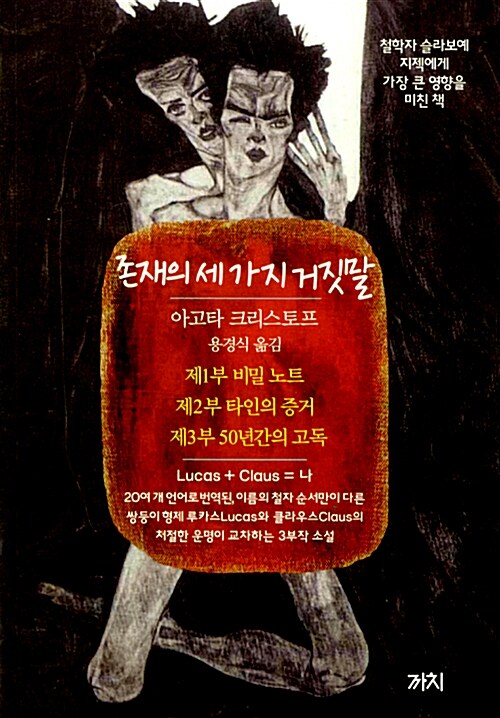
Three Falsehoods of Existence (Revised 3-Volume Omnibus Edition)
Author Agota Kristof · Publisher Kkachi · Published 2014-12-30 · ISBN 9788972915744 About the BookThe very book recommended by numerous prominent figures, including philosopher Slavoj Žižek and novelists Shin Kyung-sook and Kim Yeon-su!A trilogy translated into over 20 languages, portraying the brutal intertwining destinies of twin brothers Lucas and Claus, whose names only differ in the order of their letters.Throughout...
See full description ↓Description
Author Agota Kristof · Publisher Kkachi · Published 2014-12-30 · ISBN 9788972915744
About the Book
The very book recommended by numerous prominent figures, including philosopher Slavoj Žižek and novelists Shin Kyung-sook and Kim Yeon-su!
A trilogy translated into over 20 languages, portraying the brutal intertwining destinies of twin brothers Lucas and Claus, whose names only differ in the order of their letters.
Throughout the entire novel, in "The Notebook" (Part 1), "The Proof" (Part 2), and "The Third Lie" (Part 3), what is the author's true intention in manipulating images by intertwining contradictory phenomena and characters? Agota Kristof's "The Notebook Trilogy," often compared to Milan Kundera as another Eastern European author, is her representative work, translated into over 20 languages and becoming a global bestseller. In a recent interview, philosopher Slavoj Žižek cited this novel as having the greatest influence on him, stating, "The ideal world I dream of as a philosopher is contained within it." "The Notebook Trilogy," a book highly recommended by numerous prominent figures including novelists Shin Kyung-sook and Kim Yeon-su, has been reborn in a single volume, greatly revised, to meet the expectations of many readers, having previously been published in three separate volumes.
Key Contents
Part 1 "The Notebook" (Published 1986)
Agota sent the manuscript of this work (Le Grand Cahier) simultaneously to three famous Parisian publishers: Gallimard, Seuil, and Grasset. Seuil reportedly accepted it for immediate publication without revisions. The book slowly penetrated the French readership, was dramatized, and has now been translated and introduced in over 20 countries. The author initially composed it by writing various scenes randomly and assembling them like a mosaic. The foundation of the composition was over 60 notebooks of writings that meticulously and cruelly explored the realities of the human world, featuring incisive and brutal scenes or farces written with detached objectivity. The reason for using the first-person plural (we) as the protagonist, rather than the singular, was to intentionally exclude excessive emotional or subjective expressions. Of course, it also signified the undifferentiated identity amidst the chaos caused by the successive appearances of the Nazis (occupying forces) and the socialist regime (liberating forces). The author states that she featured her older brother, whom she loved and who was only a year and a half older than her, as Claus, and herself as Lucas. The twin protagonists, "we," end up living with their grandmother in a small town near the border, trampled by the occupying forces symbolized by the swastika during the war, and then by the liberating forces symbolized by the hammer and sickle. There, they practice overcoming the worst situations. Morality does not exist for them. The children, without anyone's teaching or influence, create their own unique morality. They meticulously record their growth and sins in a large notebook. The separation of the twins simultaneously signifies the recovery and loss of identity that they, now differentiated into two, must overcome. The atmosphere of Part 1 is, in a word, a violent, dark world of children and a swirling vortex of demonic truth.
Part 2 "The Proof" (Published 1988)
When writing "The Notebook," the author reportedly did not plan this sequel (La Preuve). She merely left room with the vague idea of writing continuously whenever she felt like it. The author says that the story of Part 2 is "an image of my own life, split in two because Europe was split in two." In particular, its temporal setting is the period of the 1956 Hungarian anti-regime revolution. The loss of identity in the socialist system seems to be symbolized by "he" in the third person in Part 2. Of course, it is even clearer that it signifies the separation of "us." Unlike "The Notebook," where no proper nouns appeared, in "The Proof," all characters, including one of the twins, Lucas, are given names. The names of the twins, Lucas and Claus, are names with the same letters, only in a different order. Are they truly two, or one? This question, which constantly confuses readers in Part 3, is strongly highlighted by these names. Part 2 is the story of Lucas, who remains alone in his grandmother's house after Claus leaves in search of freedom. The separation of the twins, who had lived as one, is beyond sorrowful, almost painful. The small town (City K), the grandmother's house, the bookstore-stationery shop, the priest and the presbytery, the pubs, the cemetery, and the square, which were the setting for Part 1, reappear as they were. The interior of Lucas's grandmother's house also remains unchanged. Skulls of Lucas and Claus's mother and sister hang in the attic, and, most importantly, the precious "large notebook" is preserved. However, the well where the cleft-lipped girl used to draw water has dried up, and the pubs, unlike before, are quiet and desolate. Time has passed, and the era has changed. The small town, located in a border area that could not be entered without special permission, became isolated and ruined. Even though the war ended, the social atmosphere remained heavy and painful. Consisting of 8 chapters and an epilogue, Part 2 is much more multi-layered in terms of characters and structure compared to Part 1. A young woman wandering after giving birth to her father's child, a library employee undergoing psychiatric treatment due to her husband's wrongful death, an alcoholic bookstore owner who becomes a wreck while pursuing his dream of writing a book, an intelligent but disabled boy unaware of his birth secret, a handsome and intellectual but timid homosexual Communist official, an elderly insomniac who became a victim of the social system... the lives of these characters each contain enough stories to become a full-length novel. And Claus, who appears in Chapter 8, leaves the reader in a labyrinth. Uncertain proof of human existence. This connects to the episode of identity card issuance in the first chapter. "We" and "grandmother" in Part 1 did not need identity cards. They could live without even acknowledging school attendance notices.
Part 3 "The Third Lie" (Published 1991)
What is truth and what is falsehood? Is Part 1 the first lie, Part 2 the second lie, and Part 3 the third lie? This book is a cruel fable that oscillates between dream and lie. Unlike Parts 1 and 2, Part 3 is narrated in the first-person singular ("I"), but subjective thoughts and emotional expressions are still restrained. The twins reunite with difficulty, but after Claus's firm denial of Lucas, they separate more definitively. Even Lucas, who had insisted on the existence of his twin brother Claus to the embassy official, ends up denying the other. Following that denial, Lucas commits suicide, and Claus, upon hearing the news from the embassy official, anticipates that he, too, will inevitably die in the exact same way as Lucas. The memories of the twins, who lived as one in Part 1 and then lived separate lives as Lucas and Claus in Part 2, are not only shared in Part 3, but their family relationships also reveal mutual contradictions. What is the author's true intention in manipulating these contradictions? What is notable in Part 3 is that the narrator becoming "I" (first-person singular) signifies the recovery of identity resulting from the collapse of the socialist system. In the parts corresponding to the epilogues of Parts 2 and 3, Kristof continually alludes to the uncertainty of human existence and identity by drawing readers into an unexpected labyrinth.
- From "Author and Work Commentary"
Table of Contents
Part 1 The Notebook
Part 2 The Proof
Part 3 The Third Lie
Author and Work Commentary
Product Details
Related products
The book is priced at its original Korean retail price (KRW 1,000 = A$1). Air freight is charged separately at checkout.
Orders close every Tuesday, are sent to Korea on Wednesday, and arrive in store one week after dispatch — 8 to 14 days from your order. Order today and pick up from Wed 28 Oct; we'll email you as soon as your books arrive.
Collect at the book corner in our Lidcombe or Eastwood store. No home delivery. Please have your order number and name ready.
First book A$15 + A$6 per extra book — 1 book $15 · 2 books $21 · 3 books $27 · 4 books $33, calculated automatically at checkout. The more books you order together, the lower the cost per book.
Titles temporarily out of stock in Korea may be delayed by about one week. If a title is out of print or unavailable, we refund that book in full and proceed with the rest of your order.
 Three Falsehoods of Existence (Revised 3-Volume Omnibus Edition)
$18.00
Three Falsehoods of Existence (Revised 3-Volume Omnibus Edition)
$18.00