
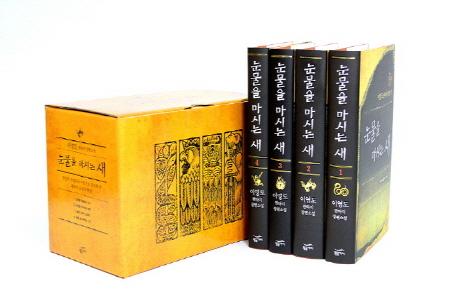
The Bird That Drinks Tears Set (4 Volumes, Hardcover)
Author Lee Yeong-do · Publisher Golden Bough · Published 2015-10-30 · ISBN 9788982735738 About the BookA new form of fantasy novel attempting a serious understanding and approach to rulersJ.R.R. Tolkien's The Lord of the Rings, which chronicled the conflict between absolute evil during World War II and the powers that had to wield influence against it, has been read by...
See full description ↓Description
Author Lee Yeong-do · Publisher Golden Bough · Published 2015-10-30 · ISBN 9788982735738
About the Book
A new form of fantasy novel attempting a serious understanding and approach to rulers
J.R.R. Tolkien's The Lord of the Rings, which chronicled the conflict between absolute evil during World War II and the powers that had to wield influence against it, has been read by many readers for half a century because it was written against the backdrop of a feudal era, which allowed for a thorough examination of the "king" as a symbol of power and the inner workings of the surrounding powers. However, this unique characteristic of fantasy novels came to demand new conditions with the flow of time. In a reality where the Cold War system has collapsed and the order of power is being reorganized, a new topic was desperately needed to address this. The Bird That Drinks Tears can be seen as a challenge to such a topic. The word "king," which encompasses the entire work, represents this. In The Bird That Drinks Tears, characters with a one-sided longing for the "king" (the desire to become king or to become a follower of the king) appear, unfolding events in completely different directions, or constantly discussing and reasoning about the king, thereby asking the reader, "What is the ruling class?" At the same time, the author provides his own answer in the title of the work. The meaning of the title, "The Bird That Drinks Tears," refers to "a king who drinks the tears that the people should shed" within the work. This meaning implies that the condition of a monarch is not a large army, wealth, or talent, but rather the responsibility to bear countless pains such as the people's sorrow and guilt. Thanks to the tears drunk by the king, the people can become cruel, oppress others, and start wars as much as they want. Moreover, "tears" are something harmful that humans expel from their bodies, and a king who drinks them cannot live long. The author, utilizing the characteristics of a fantasy novel to the fullest, conveys to humans who have only a vague fantasy about the powerful "king," the word that permeates the title and the entire work, the weight and true meaning of "king-ruler," and the fear that can arise from "the king" being put forward as a symbol of humanity.
A new epic fantasy novel created based on Eastern thought
The Bird That Drinks Tears has another distinct difference from existing Korean fantasy novels. Existing Korean fantasy novels, influenced by American or Japanese fantasy novels, mostly portray medieval Europe as their setting. However, The Bird That Drinks Tears was written with an Eastern sensibility, particularly a Korean emotional foundation. The 'Dokkaebi' (goblin), one of the four main races that appear, exemplifies this. They enjoy ssireum (Korean wrestling) and yutnori (a traditional Korean board game), and delight in scaring others by wearing a Dokkaebi Gamtu (goblin's magic hat), but they fear blood and dislike violence, thus having similarities to traditional Korean Dokkaebi. Furthermore, the language of the ancient kingdom, which serves as an important clue in the story, directly borrows our old language (language used during the mid-Joseon period), and the names of the creatures that appear, such as 'Dueokssini' and 'Marunarae,' are also created from pure Korean words, which further corroborates this. The appearance of temples, monks, and abbots, unlike existing fantasy novels that only featured priests, clerics, and archbishops, is also a new aspect.
Lee Yeong-do's unique settings and storytelling.
In The Bird That Drinks Tears, as in his previous works, Lee Yeong-do's unique and mysterious narrative captures the reader's attention. In particular, the four distinct races, each with its own unique characteristics, align with the story's progression, creating new plot twists at various points in the narrative. Among these, the most striking race is arguably the human race, which closely resembles modern humans. The fact that they are filled with would-be kings, each striving to expand their influence, yet are the weakest of the four races, reveals a contradictory aspect of humanity. Other races also possess similar contradictory traits. The Rekon, who resemble chickens, are arguably the most powerful in individual combat among the four races due to their towering height of 3 meters, strong physique, and divinely gifted weapons. However, their extreme individualism, driven solely by their own aspirations, prevents tribal unity, leaving them to always fight alone. The Dokkaebi, who can freely manipulate fire, could kill hundreds of thousands in an instant if they so desired. Yet, fundamentally fearing violence and blood, they have no impact on the world. The Naga, with their snake-like scales and cold-blooded nature, communicate through 'Nireum,' a spiritual communion rather than human 'words,' and have achieved a semi-immortal state by extracting hearts. However, their cold-blooded nature presents a physiological limitation, preventing them from withstanding the low temperatures of the northern regions. No race throughout the work remains in a perfect state.
The proverbs and maxims used in the work also maximize racial characteristics to engage the reader. For instance, the Rekon, who fear water, use insults such as "drown in a goldfish mansion" or "be covered in melted ice." The Naga, who use 'Nireum' (a spiritual language) instead of words, use variations like "Nireumdo an doenda" (It makes no sense) and "Nireum jallameokji mara" (Don't cut off my Nireum, meaning don't interrupt). Furthermore, the 'Gunryeongja' (Spirit Commander) and 'Yuryo Dorodang' (Toll Road Party), which transcend racial boundaries, are also unique elements found only in Lee Yeong-do's novels. A Gunryeongja is a single body inhabited by multiple souls over a long period, similar to the bodies seen in the movie Being John Malkovich. Born from a creature's desire for eternal life, this Gunryeongja constantly claims, "I will die without transferring again," but ultimately, at the time of death, shows its weakness by transferring to another for eternal life. The 'Yuryo Dorodang' is an organization that charges tolls for maintaining roads within the work. Travelers who pay to use the roads are considered customers, while those who use them without paying are automatically designated as enemies. However, due to their strict regulations, they fall into the contradiction of treating even the enemy of all humanity as a customer if they pay.
Contents
The Bird That Drinks Tears 1
The Bird That Drinks Tears 2
The Bird That Drinks Tears 3
The Bird That Drinks Tears 4
Product Details
Related products


The book is priced at its original Korean retail price (KRW 1,000 = A$1). Air freight is charged separately at checkout.
Orders close every Tuesday, are sent to Korea on Wednesday, and arrive in store one week after dispatch — 8 to 14 days from your order. Order today and pick up from Wed 21 Oct; we'll email you as soon as your books arrive.
Collect at the book corner in our Lidcombe or Eastwood store. No home delivery. Please have your order number and name ready.
First book A$15 + A$6 per extra book — 1 book $15 · 2 books $21 · 3 books $27 · 4 books $33, calculated automatically at checkout. The more books you order together, the lower the cost per book.
Titles temporarily out of stock in Korea may be delayed by about one week. If a title is out of print or unavailable, we refund that book in full and proceed with the rest of your order.
 The Bird That Drinks Tears Set (4 Volumes, Hardcover)
$66.00
The Bird That Drinks Tears Set (4 Volumes, Hardcover)
$66.00