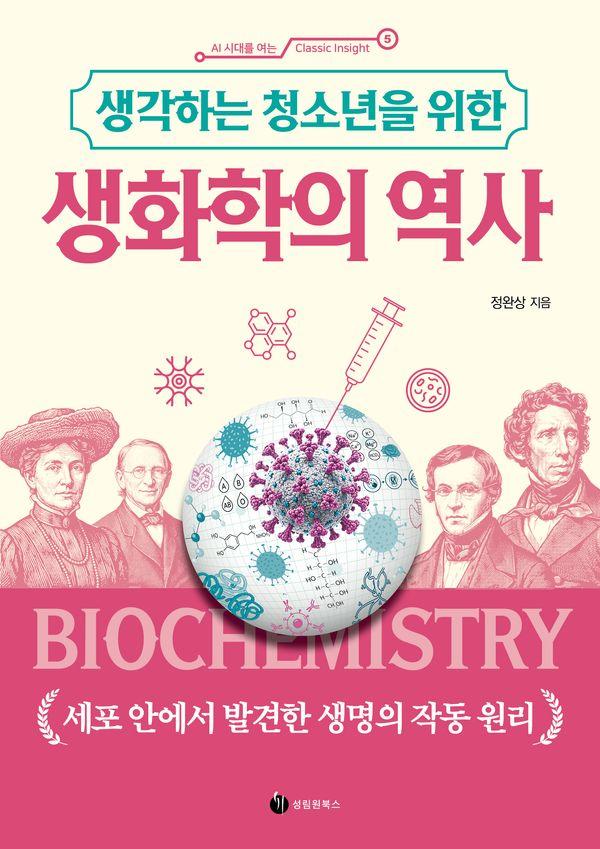
The History of Biochemistry for Thinking Teens - Classic Insight 5: Ushering in the AI Era
Author Jeong Wan-sang · Publisher Seongrimwon Books · Published 2026-07-01 · ISBN 9791124072271 About the BookA Way to Understand the Living World: Biochemistry in the AI Era ― How Life Connects and Sustains ItselfWhy does food taste richer when cooked? Why do some substances become energy in the body, while others act as toxins? The answer lies in the reactions...
See full description ↓Description
Author Jeong Wan-sang · Publisher Seongrimwon Books · Published 2026-07-01 · ISBN 9791124072271
About the Book
A Way to Understand the Living World: Biochemistry in the AI Era ― How Life Connects and Sustains Itself
Why does food taste richer when cooked? Why do some substances become energy in the body, while others act as toxins? The answer lies in the reactions of invisible molecules and cells. "A History of Biochemistry for Thinking Teenagers" re-examines biochemistry not as a field of formulas and terminology, but as the continuous flow of reactions occurring within cells.
Biochemistry is not a science that explains "what" a substance is, but rather a way of understanding "how" that substance functions within a cell. This book demonstrates how various phenomena, from reactions during cooking to human metabolism, enzyme action, and signal transduction, operate as a single interconnected system. Thus, in this book, biochemistry becomes a process, not a result, and a language for interpreting the flow of change, not a mere enumeration of information.
Biochemistry is not a "memorization subject" but a "new way of understanding change."
Biochemistry is not a collection of established theories, but a history of questions and explorations that have explained how substances change and interact. The Maillard reaction and caramelization show how the taste and aroma of food are created, and the discovery of enzymes revealed that life phenomena are regulated by specific molecules. Gluten formation and cheese making illustrate how changes in protein structure alter the properties of substances, and antioxidant research has suggested that cooking can activate nutrients.
Biochemistry extends further to core processes within cells. DNA replication and protein synthesis transmit life information, while gene expression and hormonal signals regulate cell function and whole-body responses. These principles expand into fermentation, pharmaceutical production, enzymatic detergents, and bioengineering, demonstrating that biochemistry is a fundamental language connecting daily life to industry and technology.
A Small Reaction Changes the World
The processes of bread rising, meat cooking, and drugs acting all begin at the molecular level. This book presents the history of biochemistry not as a mere list of discoveries, but as a narrative showing how a single small reaction changed human lives. By tracing how one experiment, one chemical equation, expanded into food, medicine, and environmental technology, it vividly illustrates how biochemistry has transformed the real world.
In the Age of AI, Why Re-read the History of Biochemistry?
Today, AI predicts molecular structures, analyzes drug responses, and models biological systems. However, asking the right questions and interpreting the results still remain human tasks. The reactions that explain the flavor of food, the way enzymes regulate life phenomena, and the impact of antioxidants on health all become benchmarks for our understanding of everyday life.
To the question, "Is understanding change merely knowing the result, or interpreting the process?" this book answers: the history of biochemistry is the human thought process of understanding the changes in matter and life, and it is a foundational understanding that is even more necessary in the age of AI.
For Thinking Teenagers, Yet a Liberal Arts Book for Everyone
"A History of Biochemistry for Thinking Teenagers" minimizes complex terminology and memorization, focusing instead on the flow of observation and interpretation. It offers unfamiliar readers a new perspective on everyday life, and familiar readers insights that deepen their thinking. The "teenager" in this book refers not to age but to attitude. It is an intellectual journey for all who question, connect, and seek to construct meaning for themselves.
Learn Critical Thinking from the Flow of Civilization-Changing Concepts!
Achieve both college entrance essay skills and interdisciplinary competence!
"A History of Biochemistry for Thinking Teenagers" is a liberal arts study guide designed with AI-era assessment methods and learning environments in mind. Instead of memorizing knowledge, it helps students grasp concepts structurally around the central question, "How has life been understood?"
1. The Power to Understand by Connecting Concepts
The Maillard reaction, enzymes, protein structures, antioxidant activity, as well as DNA replication, gene expression, and hormone signals—these are not isolated pieces of knowledge but are linked in a single flow. This book connects from food to cells, genetics, and biological regulatory systems, helping to understand life phenomena as a single reaction network.
2. Depth of Thought Revealed in Essays and Interviews
In an era where AI handles calculations, understanding the process is crucial. The ability to explain reaction principles leads to logical thinking and problem-solving skills. Furthermore, the process of incrementally dissecting a phenomenon at the molecular and cellular level naturally enhances the explanatory and interpretive abilities required in essays and interviews.
3. 'Traces of Inquiry' Left in Student Records
Enzyme reactions, cellular metabolism, hormone action, genetic regulation, and bioengineering technologies can all be expanded into inquiry topics. By interpreting phenomena at the cellular and molecular level and connecting them to medicine, environment, and technology, students can develop the ability to expand and explain concepts on their own.
4. From Students Who Solve Problems to Students Who Create Problems
Biochemistry is a field that asks, "Why does this change happen?" This book guides students to become explorers who interpret and question.
A History of Biochemistry for Complete Essays, Interviews, and General Knowledge
"A History of Biochemistry for Thinking Teenagers" is both a liberal arts book and an introduction to critical thinking. Through biochemistry, readers understand the principles of material change and life reactions, realize the power of questioning, and acquire a framework for interpreting invisible processes. It provides the most solid foundation for understanding the future.
In an era where AI handles calculations, what humans must prepare for is not 'answers' but 'questions.'
"A History of Biochemistry for Thinking Teenagers" is the most essential biochemistry liberal arts book, helping readers understand today's life science technology by tracing hundreds of years of observation and debate about life, and enabling them to interpret the living world for themselves.
Table of Contents
Chapter 1 The Roots of Biochemistry 13
From Understanding Life to Material 14
Ancient Egypt and Mesopotamia: Understanding the Body by Division 15
Ancient China: Viewing the Body as a Single System 16
Indian Ayurveda: Life as Balance and Flow 17
Greek Natural Philosophy and Alchemy: Seeking the Origin of Matter 19
The Belief That It Can Only Come from Living Things 20
Wöhler's Synthesis of Urea 22
Branches of Thought 25
Chapter 2 Discovery of Nutrients and Understanding of Life 27
How Did Food Become Science? 28
Carbohydrates: Uncovering the Secret of Sweetness 29<
Proteins: The Building Blocks of Life 34
The Chemistry of Fats 35
The Discovery of Vitamins 36
Mineral Salts and the Chronicle of Salt 41
Iron and Hemoglobin: The Metal That Makes Blood Red 43
Electrolytes: Invisible Ions That Make Life Flow 46
Iodine That Saved Lives 47
Gut Microbes and New Nutrition 48
The Paradox of Healthy Alternatives: Margarine and Trans Fats 49
Branches of Thought 51
Chapter 3 Invisible Changes: Fermentation and Enzymes 53
Small Workers That Move Life 54
Ancient Humans Recognized the Power of Fermentation First 55
The History of Doenjang (Soybean Paste) 57
The History of Kimchi 59
Fermentation is a Chemical Reaction 60
Liebig and Catalysis 61
The Emergence of Enzymes 62
The Discovery of Amylase 65
Pepsin: A Protein-Digesting Enzyme 66
Why Fats Are Broken Down 67
James Sumner Confirmed the Reality of Enzymes 68
Lock and Key: Enzyme and Substrate 69
Enzyme Reaction Rate Expressed in an Equation 71
Branches of Thought 73
Chapter 4 Respiration: The Circuit That Sustains the Flame of Life 75
From Breath to Energy: The Flow That Connects Life 76
Alcmaeon's Insight: Life Is With Air 77
Aristotle's Concept of Respiration: Breath Is Wind Cooling Fire 79
Galen's Theory of Respiration: Breath Is the Spirit of the Soul 80
Completion of Circulation: From Harvey to Malpighi 81
John Mayow's Experiment: The Common Denominator of Flame and Life 84
The Secret of Oxygen Transport Revealed by Blood Color 86
Pasteur's Discovery of Two Types of Respiration 87
Carl Ludwig and Tissue Respiration 89
Otto Warburg and Cellular Respiration 90
Hans Krebs and the Cycle Within the Cell 92
Electron Transport Chain and ATP Production 94
HIF Protein: The Antenna That Detects Oxygen Deficiency 95
Evolution's Chosen Strategy for Respiration 97
Artificial Lungs and ECMO: Temporary Bridges for Respiration 98
Branches of Thought 101
Chapter 5 Beings Living by Light: The Science of Plants 103
Creating Life from Light and Air 104
From Medicinal Herbs to Living Organisms: Ancient Understanding of Plants 105
How Plants Became 'Chemistry' 106
Pioneers Who Discovered Air and Light 107
Photosynthesis and Carbohydrates 112
Melvin Calvin: The Journey from Light to Carbohydrates 115
The History of Fertilizers That Bring Life to Soil 117
Auxin: The Discovery of Plant Hormones 119
Haberlandt and the Birth of Plant Tissue Culture 121
Artificial Photosynthesis and Artificial Leaves 123
Branches of Thought 125
Chapter 6 Hormones: The Regulators of Life 127
Chemical Signals That Move the Body 128
The Discovery of Glands: The Door to the Body's Chemical Factory Opens 129
Thomas Willis: The Doctor Who Tasted the Secret of Sweetness 131
Berthold's Roosters: The First Scene of Endocrinology 133
Addison's Disease and Thyroid Treatment: Diseases Caused by Missing Substances 134
Adrenaline and Secretin: The First Hormones Humanity Held 137
The Birth of Endocrinology: Invisible Signals Directing the Body 140
Insulin: A Hormone That Became a Miracle Drug 141
Sex Hormones: Reading Body Differences Through Chemistry 144
Steroids and Cortisone: Hormones Out of the Lab 146
The Invention of the Birth Control Pill and Hormones 147
Brain Messengers That Control Mind and Behavior 148
Branches of Thought 155
Chapter 7 Mendel's Laws of Inheritance 157
Invisible Threads That Connect Generations 158
Ancient Greece: Imagining the Seeds of Life 159
Ancient Indian Perspective: Traits Are Created by Multiple Factors 160
Al-Zahrawi's Records: Diseases That Repeat in Families 162
The Beginning of Life Seen Through a Microscope 165
Preformationism and Epigenesis: Is Life Complete from the Start? 166
The Pea Plant Priest: Finding the Rules of Inheritance 168
The Rules the Pea Plants Revealed 170
Mendel's Forgotten Name Revived 171
Incomplete Dominance 175
Branches of Thought 177
Chapter 8 Chromosomal Genetics 179
Where the Blueprint of Life Resides 180
The Two Keys to Life: Discovery of Sperm and Egg 181
The Journey to the Secret of Cell Division 182
Walther Flemming: Documenting Chromatin and Cell Division 184
Meiosis: Why Generations Can Continue 187
Boveri and Sutton: Linking Inheritance and Chromosomes 189
How Did X and Y Appear? 191
Morgan's Fruit Fly Experiment: Seeing Genes on Chromosomes 194
Sturtevant: Mapping Invisible Genes 197
Branches of Thought 201
Chapter 9 Blood: The Science That Connects Life 203
Transfusion, Blood Types, and the Blood Donation System 204
Richard Lower's Bold Experiment 205
Jean-Baptiste Denis's Dangerous Gamble 206
James Blundell: "Human Blood for Humans" 207
The Identity of Blood Revealed Under the Microscope 209
Hemoglobin: The Secret of Red Color and Oxygen Transport 212
Landsteiner: Discovering the Hidden Rules of Blood Types 214
Ottenberg: Treating Patients with Blood Type Knowledge 217
Ludwik Hirszfeld: Blood Types Are Inherited 219
Rh Factor and Transfusion Accidents 222
Rare Blood Type: 'Cis-AB' 224
The Birth of Blood Banks: From Immediate Transfusion to Storage and Supply 226
Branches of Thought 229
Chapter 10 Discovery of Nucleic Acids 231
Nucleic Acids: The Oldest ID Card in the Body 232
Scheele and the Isolation of Organic Acids 233
Friedrich Miescher and Nucleic Acids: A Treasure Found in Pus 237
Kossel and Altmann: Deciphering the Alphabet of Nucleic Acids 240
What Are Nucleic Acids Made Of? 242
Decisive Experiments Proving DNA Is the Genetic Material 245
Chargaff's Rules: The Key to Unlocking the Structure 248
Branches of Thought 249
Chapter 11 The DNA Structure War 251
A Fierce Race Towards the Helix of Life 252
The Discovery of X-rays: Light Revealing Invisible Structures 253
The Braggs: Turning Diffraction Patterns into the Language of Structure 255
Francis Crick: From Physics to the Structure of Life 257
Maurice Wilkins: The First Generation to View DNA with X-rays 258
Rosalind Franklin: The Uncompromising Scientist 260
Watson: Moving Towards the Order of Life 263
The Battle for DNA Structure Discovery 267
Branches of Thought 275
Chapter 12 The Second DNA Revolution: Manipulation and Synthesis 277
From Gene Recombination to AlphaFold 278
Messenger RNA: The Discovery of the Cell's Messenger 279
Deciphering the Genetic Code 280
Restriction Enzymes: The Discovery of Molecular Scissors 284
First Successful Recombinant DNA Technology 285
Genetically Modified Organisms (GMOs): The Dawn of a New Era 287
Frederick Sanger: How to Read the Sentences of Life 288
Mullis and PCR: The Invention of the DNA Copier 291
Human Genome Project (HGP): Humanity's Grand Reflection 294
Cells Moved by Artificial Genomes 297
CRISPR-Cas9: Directly Editing the Genome 298
AlphaFold: AI Solves a 50-Year-Old Challenge 300
Branches of Thought 303
Chapter 13 The Body's Defense System: Immunity 305
Learning Immunity While Fighting Infectious Diseases 306
The Origin of Immunity: Wisdom Born from Fear 307
Edward Jenner and Vaccination: A Gift from Cows 309
Cholera and New Perspectives on Immunity 316
Metchnikoff and the Discovery of Phagocytosis 318
Pasteur and the Science of Vaccines 319
Eradication of Polio: The Great Rivalry of Salk and Sabin 321
COVID-19 and mRNA Vaccines 324
Branches of Thought 327
Chapter 14 Cloning: Copying and Designing Life 329
The Genomic Revolution of Rewriting Blueprints 330
Cutting and Grafting: Humanity's First Discovery of Cloning Technology 331
Spallanzani: Life Can Be Combined 332
Driesch and Sea Urchins: "The Whole" Exists Even in a Single Cell 334
Spemann's Hair Experiment: Revealing the Importance of the Nucleus 335
Meselson-Stahl: How Is DNA Replicated? 337
John Gurdon: Somatic Cell Nuclei Can Restart 340
Dolly: The World's First Cloned Adult Somatic Mammal 341
Expansion of Cloning Technology 342
Test-Tube Babies: Moving the Beginning of Life to the Laboratory 344
Human Embryonic Stem Cells: Opening the Door to Therapeutic Cloning 346
De-extinction: Technology That Reverses Extinction 347
Jurassic Park: The Boundary Between Imagination and Science 350
Branches of Thought 353
Chapter 15 Genetic Engineering and Agriculture 355
Seeds: Becoming the Blueprint of Life 356
The Birth of Agriculture: The Beginning of Selection 357
Medieval Agriculture and the Luxury of Experimentation 359
Establishment of Plant Hybridization and the Rise of the Seed Industry 360
Hybrid Vigor: Two Becoming More Than the Sum of Their Parts 361
Flavr Savr Tomato: The First Commercial GMO Crop 362
The Green Revolution: Designing Agriculture 364
What to Contain? Functional Food Crops 366
Soil-less Agriculture and Vertical Farms: Systems Instead of Soil 368
Self-Fertilizing Plants: Changing the Era of Nitrogen Fertilizer 370
Personalized Crops: The Era of Individualized Food 372
Can Plants Be Grown on the Moon and Mars? 373
Plants and Fungi: The Carbon Cycling Network Created by Roots 376
Branches of Thought 379
Chapter 16 Bioengineering: The Language That Designs Life 381
The Era of Programmable Life 382
DNA Synthesis and Assembly Technology 383
Genetic Circuits: Logic Gates Within Cells 384
Synthetic Minimal Cell: Leaving Only the Minimum Genes 385
Mini-Organs: Organoids 387
Optogenetics: Directly Controlling Cell Activity with Light 388
Antibiotics and Anticancer Drugs from Microorganisms 390
Sustainable Bioindustry: Savior of Energy and Environment 392
Branches of Thought 399
Chapter 17 Biochemistry in Everyday Life 401
From Taste to Skin: The Biochemistry of Daily Life 402
Maillard Reaction: The Magic of Flavor Imparted by Browning 403
Caramelization: The Dazzling Transformation of Sugar 405
Enzyme Activity: Invisible Scissors Dissecting Meat 408
Gluten: The Protein Network Designing Chewiness 409
Lycopene: The Change in Antioxidants 411
From Milk to Cheese: The Transformation of Protein 412
Detergents and Toothpaste: Molecular Tools Targeting Specifics 415
Disinfectants and Cosmetics: Chemical Conversations with Cells 417
Branches of Thought 421
Product Details
Related products

The book is priced at its original Korean retail price (KRW 1,000 = A$1). Air freight is charged separately at checkout.
Orders close every Tuesday, are sent to Korea on Wednesday, and arrive in store one week after dispatch — 8 to 14 days from your order. Order today and pick up from Wed 28 Oct; we'll email you as soon as your books arrive.
Collect at the book corner in our Lidcombe or Eastwood store. No home delivery. Please have your order number and name ready.
First book A$15 + A$6 per extra book — 1 book $15 · 2 books $21 · 3 books $27 · 4 books $33, calculated automatically at checkout. The more books you order together, the lower the cost per book.
Titles temporarily out of stock in Korea may be delayed by about one week. If a title is out of print or unavailable, we refund that book in full and proceed with the rest of your order.
 The History of Biochemistry for Thinking Teens - Classic Insight 5: Ushering in the AI Era
$23.00
The History of Biochemistry for Thinking Teens - Classic Insight 5: Ushering in the AI Era
$23.00