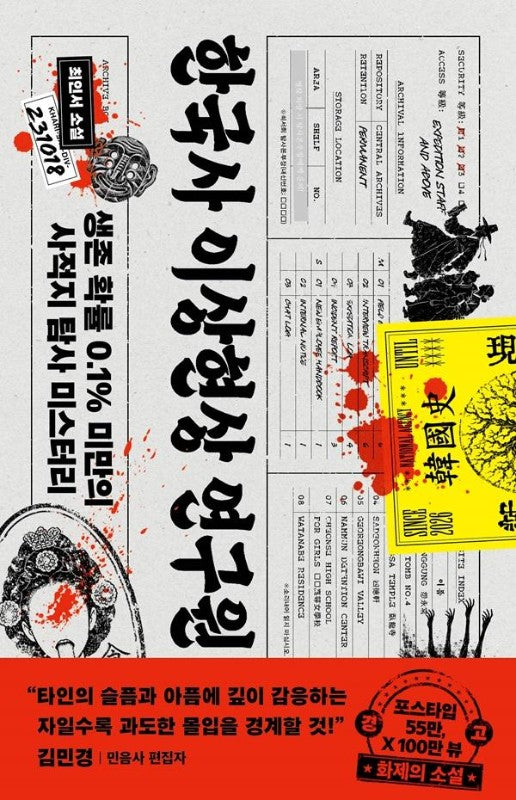
Korean History Anomalies Researcher (Standard Edition)
Author Choi In-seo · Publisher Dive · Published 2026-08-31 · ISBN 9791124137635 About the BookDisappearances continue at palaces, ancient tombs, and templesAnd a Korean archival mystery that tracks down the truth by following clues in documentsPalaces, underground ancient tombs, Goryeo temples, Japanese colonial-era houses… What if inexplicable abnormal phenomena repeatedly occur at historical sites managed by the state? 《Korean History...
See full description ↓Description
Author Choi In-seo · Publisher Dive · Published 2026-08-31 · ISBN 9791124137635
About the Book
Disappearances continue at palaces, ancient tombs, and temples
And a Korean archival mystery that tracks down the truth by following clues in documents
Palaces, underground ancient tombs, Goryeo temples, Japanese colonial-era houses… What if inexplicable abnormal phenomena repeatedly occur at historical sites managed by the state? 《Korean History Anomalies Institute》 is a series of exploratory mysteries set in a secret organization that investigates strange incidents occurring at historical sites across Korea.
This work, which recorded 550,000 cumulative views during its serialization on Postype and 1 million views of related posts on X (formerly Twitter), is Choi In-seo's first full-length novel that captivated readers solely by the power of its narrative.
The archival format, including exploration guidelines, incident reports, audio recordings, and field records, which unfolds from the very first chapter, gives readers an extreme sense of immersion as if they are new explorers of the institute, reading forbidden records.
However, 《Korean History Anomalies Institute》 does not merely remain a chilling ghost story. Based on meticulous historical research and his unique imagination, author Choi In-seo reconstructs the lives and sorrows of those who perished without a trace in the tumultuous waves of history. The process of reading the reports itself provides an experience of entering a vivid historical hallucination, confronting the sorrows that have long been dormant beneath the cold records.
“Explore, survive, but do not break the rules”
An original full-length novel that transforms the act of reading into an exploration
《Korean History Anomalies Institute》 consists of records from a secret research institute that began tracking the perpetrators after a series of incidents where people visiting historical sites disappeared without a trace. The warnings, exploration guidelines, incident reports, audio recordings, interview records, and staff chat logs in the main text are all documents left by explorers who risked their lives in the field.
"Never stare at them," "You must never let it be known that you are from the 21st century," "The moment you are swayed by the smell of blood and decay, and the sound of bells, you will be processed as killed in action."
In this world, rules are the only order that determines the life and death of an explorer. The reader is not an observer watching a complete story from the outside, but a new explorer who must uncover the truth of the incident by connecting deleted records and subtle clues left in reports amidst hallucinations and auditory hallucinations.
As clues are interpreted, one incident leads to a larger secret, and as the reality of the abnormal phenomena is approached, both the explorer and the reader lose their way back.
“Behind a line of historical records were people who lived ordinary lives until yesterday”
Ancient sorrow and deep solidarity at the end of terror
“History records countless events, but those records are always concise. Behind a line like 'A war broke out, causing numerous casualties' were the lives of people who disappeared without a trace. I have always felt fear in the face of this indifferent flow of history.”
_ From “Author’s Note”
The author shines a light on the lives of individuals who disappeared without even leaving a name in grand history. The strange beings that appear in palaces and ancient tombs are not merely devices to evoke fear, but traces left by those whose voices were stolen in tragic history, and mirrors reflecting the truth.
The author constantly asks the question, "Am I not merely consuming the victims of tragic history as material for ghost stories?" and deeply examines why the entities in the work have come to their current form. By portraying both the fragility and resilience of humans who ultimately do not give up on love and solidarity even in the face of history's immense violence, the author expresses deep condolence to those who have long been forgotten.
The moment you close the book, familiar places begin to look unfamiliar
The sorrow of those excluded from official records returns to the present as anomalies. This is why the bizarre entities in the work are not only monsters that threaten people but also desperate voices saying, "Remember me."
Furthermore, the solidarity and choices of explorers who refuse to abandon their colleagues even in a field where death is commonplace add human warmth to tragic horror. This is also why Minumsa editor Kim Min-kyung warned, "The more one can empathize with the sorrows and pains of others, and especially the more one deeply resonates with the solidarity and friendship of colleagues who have shared hardships, the greater the risk of becoming overly emotionally involved with the narrative in the book."
After closing the book, the familiar historical sites will appear different from before. Whose lives remain outside the records we believe to be history? And can we ultimately avoid turning away when confronted with their voices? 《Korean History Anomalies Institute》 is a novel that answers that question.
Recommendations
《Korean History Anomalies Institute》 Appreciation Guide
1. This book is the story of anomalous phenomena occurring at historical sites across Korea and the researchers who investigate them. Please open your mind as much as your imagination allows and immerse yourself as if you are in a real situation, as if you are a new researcher at the institute. (…) While reading, you may experience chills, excitement, dopamine, familiarity, strangeness, sadness, distress, and other symptoms of excessive immersion.
2. If you have visited Gyeongbokgung Palace, the National Museum of Korea, Bulguksa Temple, etc., or generally enjoy visiting historical sites, you may experience vivid field hallucinations while reading. (…) Please keep in mind that the scenes that come to mind are not real.
3. The more one can empathize with the sorrows and pains of others, and especially the more one deeply resonates with the solidarity and friendship of colleagues who have shared hardships, the greater the risk of becoming overly emotionally involved with the narrative in the book. (…)
4. After reading, if familiar Korean historical sites appear completely different from before or (…) you feel an inexplicable sense of déjà vu, immediately stop what you are doing and close your eyes. If you open your eyes before calming your mind, you will be processed as killed in action.
※ This recommender always supports readers' enjoyable reading experiences. ※
_Kim Min-kyung (Editor, Minumsa)
I hate and envy this author so much, I want to eat his brain. If the public encounters me in a news headline, it won't be as a literary award winner, but as a ghoul caught for gnawing on the brain of the author who wrote this novel. The ghoul must have been so intensely jealous of the author who completed a novel that didn't exist anywhere and that Seol Jae-in obviously couldn't write, and so desirous of his brain, that it crossed the forbidden line.
There's only one way to prevent such a disaster. For as many readers as possible to join this institute, confront [D-A-3-28 'Ghoul-Seol Jae-in'], and defeat it.
_ Novelist Seol Jae-in
In the book
Wonyounggung Palace was a new palace whose construction began in the ■■th year of King Gwanghae’s reign during the Joseon Dynasty. However, workers mobilized during the initial construction phase reported strange symptoms, and inexplicable casualties occurred one after another, leading to the suspension of construction shortly thereafter. After that, its existence was forgotten by the public, and currently, only the site remains at a certain location in Jongno-gu, Seoul, and is being secretly managed by this institute.
_From Wonyounggung Palace Exploration Guidelines (page 9 of the main text)
The entities within Wonyounggung Palace have human forms, but upon closer inspection, their facial features are jumbled or some body parts are missing. Therefore, we recommend that you move with your gaze lowered and do not stare at them.
_From Wonyounggung Palace Exploration Guidelines (page 12 of the main text)
February 29th was my mom's birthday, so my mom and I rented Hanbok and went to Changdeokgung Palace to see the Secret Garden. We had some time before entering the Secret Garden, so we decided to look around other places first. But as soon as we entered Injeongmun... (brief silence) the scenery completely changed the moment we crossed the gate. Suddenly, the perfectly fine palace buildings all turned into collapsing ruins. It was 2 PM, but it got dark and foggy, making it hard to see. All those people had disappeared, and it was just my mom and I, wondering what was happening.
_From 290331 Wonyounggung Palace·Jihari Tomb No. 4 Survivor Interview Transcript (page 70 of the main text)
Yena placed the documents on the desk, unable to even breathe. Just a few sheets of paper, yet how could they be so heavy? Each letter seemed to be wailing. The horrors and screams of that moment, which she had not seen or heard, vividly assailed Yena as if she had experienced them herself.
_From 281227 Georeungbawi Valley 〇th Exploration Log (page 97 of the main text)
On rare occasions, you may see a scene where appetizing meat grows abundantly in fields like rice ears. You will likely be tormented by an impulse to immediately rush and devour the meat.
However, keep in mind. The fields of Georeungbawi Valley are not an environment where plants can grow. Also, logically, meat cannot grow on plants. If the hallucination persists, please question why unidentified blood clots and bundles are abandoned in the rice paddies or furrows, and why the 'meat ears' that grow over them are exactly the size of a human baby.
_From Georeungbawi Valley Exploration Guidelines (page 336 of the main text)
'Sangsa-bul' will be weeping in a dark room, molding something. (…) They will be sobbing, saying 'I am carving the image of the deceased queen, but I cannot remember her face.' (…) After saying 'I can show you Her Majesty's portrait,' (…) present the portrait of Princess Nogukdaejang. It will confirm the face in the portrait, weep, and thank you.
At this time, request the rescue and escape of the missing person.
_From Waryongsa Temple Exploration Guidelines (page 126 of the main text)
Sadeokheon was the home of the ○○ Kim clan, a prominent family during the mid-Joseon Dynasty, renowned for producing many virtuous women over generations. However, during the Byeongja Horan war, when a daughter was captured by Qing soldiers and taken to Qing China, the family concealed this fact and falsely stated that "the daughter committed suicide to protect her chastity just before being captured as a prisoner," thus receiving official commendation from the government. However, it was later discovered that the daughter had escaped and returned, only to be strangled and abandoned in the 별당 (detached building) pond, leading to the revocation of the commendation. Afterwards, it is said that all family members suffered from strange symptoms accompanied by auditory and visual hallucinations, and then died mysterious deaths, and the place became an abandoned house.
_From Sadeokheon Exploration Guidelines (page 165 of the main text)
"That didn't happen because someone made a mistake. So it's not your fault, Ms. Yena. (…) I hope you don't blame yourself, Ms. Yena."
_It's not our fault (page 255 of the main text)
‘How can you say such a thing in this situation?’
Choi Seok-jin retorted, gripping the phone receiver on his office desk as if to crush it. He displayed the maximum anger a polite person could express to someone he couldn’t openly get angry at. (…) ‘……We've risked our lives to save people for five years. How much more do we need to prove?’
(…) Seok-jin closed his eyes tightly and composed himself.
“At present, there is only one clear method. To prepare for dangers that may strike at any moment.”
Even succumbing to powerlessness was a luxury for them. They had to do what they could.
_Besieged (pages 232-237 of the main text)
Table of Contents
1. Wonyounggung Palace Exploration Guidelines
Welcome to your new position
2. Jihari Tomb No. 4 Exploration Guidelines
Their Daily Lives
290331 Wonyounggung Palace·Jihari Tomb No. 4 Survivor Interview Transcript
281227 Georeungbawi Valley 〇th Exploration Log
Report on Anomalous Phenomena After 〇th Jihari Tomb No. 4 Exploration
291204 Meeting Transcript
3. Waryongsa Temple Exploration Guidelines
291218 Interview Transcript with Explorer Kim Ha-neul of Exploration Team 2
291218 Emergency Headquarters Meeting Transcript
In the Exploration Team 1 Meeting Room
4. Sadeokheon Exploration Guidelines
300104 Sadeokheon 〇th Exploration Log
300110 Wonyounggung Palace·Sadeokheon Survivor Transcript
Report on the Hyein Hospital Anomalous Entity Outbreak
300118 Second B-J-4-03 Interview Transcript
Besieged
Announcement to all Institute staff
It's not our fault
300125 Chat Log of Ji Tae-seong, Team Leader of Exploration Team 1
300126 Emergency Wonyounggung Palace Exploration Log
300126 Emergency Waryongsa Temple Exploration Log
Back to that place
5. Georeungbawi Valley Exploration Guidelines
Where are you?
Report on the 'Village Festival (tentative)' Incident
The Road to Death
6. Korean History Anomalies Institute Exploration Guidelines
Three Roads
Epilogue
Goryeo Code Decryption
Author’s Note
Product Details
Related products
The book is priced at its original Korean retail price (KRW 1,000 = A$1). Air freight is charged separately at checkout.
Orders close every Tuesday, are sent to Korea on Wednesday, and arrive in store one week after dispatch — 8 to 14 days from your order. Order today and pick up from Wed 28 Oct; we'll email you as soon as your books arrive.
Collect at the book corner in our Lidcombe or Eastwood store. No home delivery. Please have your order number and name ready.
First book A$15 + A$6 per extra book — 1 book $15 · 2 books $21 · 3 books $27 · 4 books $33, calculated automatically at checkout. The more books you order together, the lower the cost per book.
Titles temporarily out of stock in Korea may be delayed by about one week. If a title is out of print or unavailable, we refund that book in full and proceed with the rest of your order.
 Korean History Anomalies Researcher (Standard Edition)
$22.00
Korean History Anomalies Researcher (Standard Edition)
$22.00