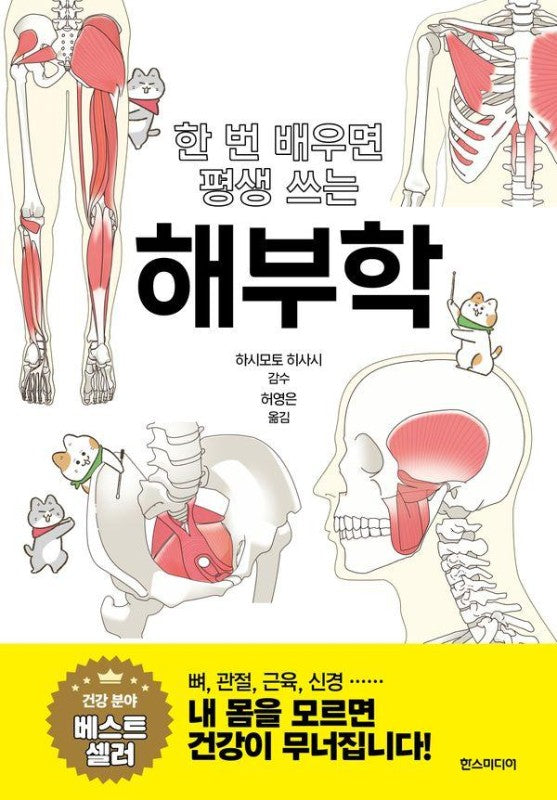
Anatomy: Learn Once, Use for Life
Author Hisashi Hashimoto · Publisher Hansmedia · Published 2026-07-31 · ISBN 9791124272589 About the BookInside the bookIn our daily lives, we move in various ways. From simple actions like raising or lowering a hand to complex movements like picking up food with chopsticks, putting it in our mouths, and chewing with our lower jaw, there are many types of movements....
See full description ↓Description
Author Hisashi Hashimoto · Publisher Hansmedia · Published 2026-07-31 · ISBN 9791124272589
About the Book
Inside the book
In our daily lives, we move in various ways. From simple actions like raising or lowering a hand to complex movements like picking up food with chopsticks, putting it in our mouths, and chewing with our lower jaw, there are many types of movements. All these activities that we perform naturally are the result of the precise coordination of various organs that make up the human body. Among them, muscles play a particularly important role. Although bones are the actual movers, the force that moves the bones comes from the muscles. So, how many muscles do we have in our body? And how do muscles make the body move?
(...)
This book explains the structure and principles of the body in the simplest possible language, focusing on muscles that are familiar to us and easy for anyone to identify.
--- From "Foreword"
Table of Contents
Introduction
How to use this book
Chapter 1. Core Anatomy in 30 Minutes! Basics of Anatomy
① What is anatomy, anyway? [What is anatomy?]
② How do human and animal bodies differ? [Characteristics of the human body]
③ What would happen to humans without bones? [Whole body skeleton]
④ How does the human body move? [Structure of joints]
⑤ What are muscles? [The role of muscles]
⑦ What do muscle names mean? [Muscle nomenclature]
⑧ What are nerves? Where are they? [The role of nerves]
COLUMN Frequently used Chinese characters and concepts in anatomy (642) [Bones and muscles]
Chapter 2. I want to know exactly! Latest anatomical knowledge
① Where exactly is the upper body? [Body divisions]
② How many muscles are there? [Number of muscles]
③ What are the largest and smallest muscles? [Muscle size]
④ What do muscles look like inside? [Structure of skeletal muscles]
⑤ What shape are muscles? [Muscle shape]
⑦ Is muscle soreness a sign that muscles are growing!? [Muscle development]
⑧ Does muscle training make muscles bigger? [Muscle composition]
⑨ What are the origin and insertion of muscles? [Origin and insertion]
⑩ Are there muscles only found in women or men? [Sex differences in muscles and bones]
⑪ How many bones do humans have? [Number of bones]
⑫ What shape are bones? [Bone shape]
⑬ What does the inside of a bone look like? [Bone composition and structure]
⑭ Do bones constantly regenerate? [Bone metabolism]
⑮ Are teeth bones? [Structure and properties of teeth]
(16) How do joints move? [Joint types and movements]
(17) What is the difference between tendons and ligaments? [Tendons and ligaments]
(18) Does blood flow faster during exercise? [Principle of blood volume]
(19) What happens if the heart beats too fast? [Heart rate]
(20) How is food digested when we eat it? [Principle of digestion 1]
(21) Can you eat while standing on your head? [Principle of digestion 2]
(22) What is the principle of abdominal breathing? [Principle of respiration]
(23) What muscles expel urine and feces? [Excretion and muscles]
(24) What muscles push out the baby? [Childbirth and muscles]
(25) Where are motor nerves located? [Motor nerves and sensory nerves]
(26) Why does vision not blur even when the head moves? [Principle of seeing objects]
(27) Are muscles and skin connected? [Skin tissue]
COLUMN Frequently used Chinese characters and concepts in anatomy (643) [Direction and plane]
Chapter 3. Muscle Actions and Characteristics
Movement of skeletal muscles
[Head and Neck] Muscles that create facial expressions
[Head and Neck] Muscles that move the jaw
[Head and Neck] Muscles that move the head and neck
Frontalis
Occipitalis
Orbicularis oculi
Corrugator supercilii/ Procerus
Orbicularis oris/ Buccinator
Levator anguli oris/ Depressor anguli oris
Mentalis/ Depressor anguli oris
Temporalis/ Masseter
Suprahyoid muscles - Mylohyoid | Stylohyoid | Digastric | Geniohyoid
Infrahyoid muscles - Sternohyoid | Thyrohyoid | Omohyoid | Sternothyroid
Sternocleidomastoid
Platysma
Anterior scalene
Middle scalene/ Posterior scalene
Prevertebral muscles - Rectus capitis anterior | Rectus capitis lateralis | Longus capitis | Longus colli
Suboccipital muscles - Rectus capitis posterior minor | Obliquus capitis superior | Rectus capitis posterior major | Obliquus capitis inferior
[Chest] Muscles that control the shoulder blade and arm
Pectoralis major
Pectoralis minor/ Subclavius
Serratus anterior
External intercostals/ Internal intercostals
Diaphragm
[Abdomen] Muscles that maintain proper posture and protect internal organs
Rectus abdominis
External oblique
Internal oblique
Transversus abdominis
Quadratus lumborum
Pelvic floor muscles - Levator ani | Coccygeus | Deep transverse perineal | External urethral sphincter
[Back] Back muscles that support the spine
Trapezius
Latissimus dorsi
Splenius capitis
Splenius cervicis
Levator costae
Serratus posterior superior/ Serratus posterior inferior
Levator scapulae
Rhomboid major/ Rhomboid minor
Erector spinae - Iliocostalis | Longissimus | Spinalis
Transversospinalis muscles - Semispinalis | Multifidus | Rotatores
[Arm] Muscles for writing, carrying objects, and manipulating
Deltoid
Subscapularis
Teres major
Teres minor
Supraspinatus
Infraspinatus
Biceps brachii
Brachialis
Coracobrachialis/ Brachioradialis
Triceps brachii
Anconeus/ Supinator
Pronator teres
Pronator quadratus
Flexor carpi radialis/ Flexor carpi ulnaris
Palmaris longus
Extensor carpi ulnaris
Extensor carpi radialis longus/ Extensor carpi radialis brevis
Flexor digitorum superficialis/ Flexor digitorum profundus
Flexor pollicis longus
Abductor pollicis longus
Extensor pollicis brevis/ Extensor pollicis longus
Extensor digitorum
Extensor digiti minimi
Extensor indicis/ Lumbricals
Palmar interossei/ Dorsal interossei
Thenar muscles - Adductor pollicis | Abductor pollicis brevis | Flexor pollicis brevis | Opponens pollicis
Hypothenar muscles - Abductor digiti minimi | Flexor digiti minimi brevis | Opponens digiti minimi | Palmaris brevis
[Leg] Muscles for walking, running, and jumping
Gluteus muscles
Psoas major/ Psoas minor
Gluteus maximus
Gluteus medius
Gluteus minimus
Piriformis
Superior gemellus/ Inferior gemellus
Obturator internus/ Obturator externus
Quadratus femoris
Adductor magnus
Adductor longus/ Adductor brevis
Pectineus
Gracilis
Quadriceps femoris
Rectus femoris/ Vastus medialis
Vastus lateralis/ Vastus intermedius
Tensor fasciae latae
Sartorius
Biceps femoris
Semitendinosus/ Semimembranosus
Triceps surae
Gastrocnemius/ Soleus
Tibialis anterior
Extensor hallucis longus/ Extensor digitorum longus
Tibialis posterior
Flexor digitorum longus/ Flexor hallucis longus
Fibularis longus/ Fibularis brevis
Popliteus/ Plantaris
Extensor hallucis brevis/ Extensor digitorum brevis
Flexor hallucis brevis/ Adductor hallucis
Abductor hallucis/ Flexor digitorum brevis
Flexor digiti minimi brevis/ Abductor digiti minimi
Lumbricals/ Quadratus plantae
Chapter 4. Functions of Bones and Joints
Skull | Vertebral column | Pelvis | Ribs/ Sternum | Arm bones | Hand bones | Leg bones | Foot bones | Atlanto-occipital joint | Median atlantoaxial joint | Shoulder joint | Elbow joint | Hip joint | Knee joint | Wrist joint/ Ankle joint
Chapter 5. Symptoms and Treatment of Injuries
Basics of first aid
Fractures
Dislocations
Sprains
Contusions
Muscle tears
Herniated lumbar disc
Tendon ruptures
Plantar fasciitis
Common sports injuries - Osgood-Schlatter disease/ Meniscus tear | Jumper's knee/ Runner's knee | Shin splints/ Baseball shoulder | Baseball elbow/ Tennis elbow
Muscle list
Whole body skeleton diagram
Index
Product Details
Related products


The book is priced at its original Korean retail price (KRW 1,000 = A$1). Air freight is charged separately at checkout.
Orders close every Tuesday, are sent to Korea on Wednesday, and arrive in store one week after dispatch — 8 to 14 days from your order. Order today and pick up from Wed 28 Oct; we'll email you as soon as your books arrive.
Collect at the book corner in our Lidcombe or Eastwood store. No home delivery. Please have your order number and name ready.
First book A$15 + A$6 per extra book — 1 book $15 · 2 books $21 · 3 books $27 · 4 books $33, calculated automatically at checkout. The more books you order together, the lower the cost per book.
Titles temporarily out of stock in Korea may be delayed by about one week. If a title is out of print or unavailable, we refund that book in full and proceed with the rest of your order.
 Anatomy: Learn Once, Use for Life
$24.00
Anatomy: Learn Once, Use for Life
$24.00