
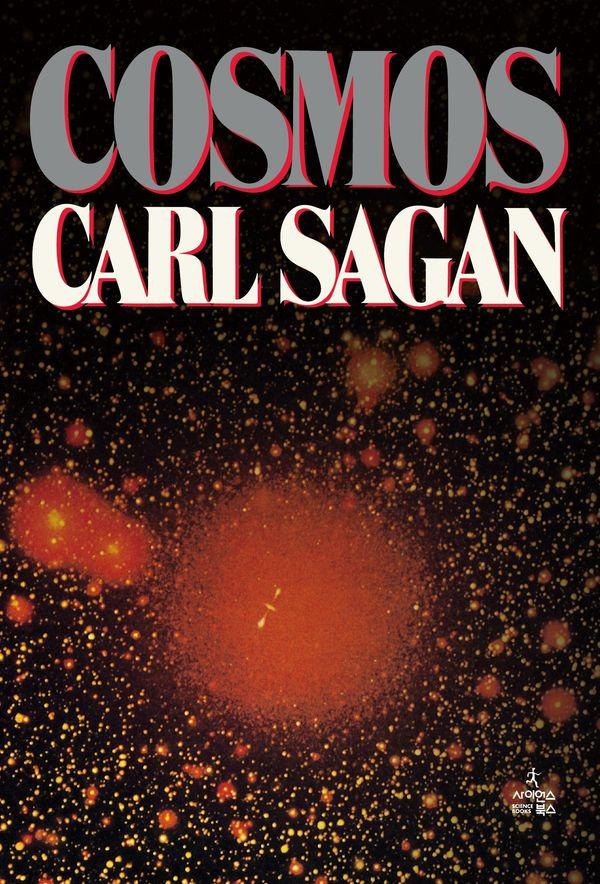
Cosmos (Millionth Copy Commemorative Edition)
Author Carl Sagan · Publisher Science Books · Published 2026-06-30 · ISBN 9791124336083 About the BookThe #1 science book recommended to young people by South Korean scientists!The #1 best-selling science book of the past 10 years!The one science book that will connect you to the universeCarl Sagan's "Cosmos" 1 million copy commemorative re-cover edition released!Carl Sagan's [Cosmos] surpassed 1 million...
See full description ↓Description
Author Carl Sagan · Publisher Science Books · Published 2026-06-30 · ISBN 9791124336083
About the Book
The #1 science book recommended to young people by South Korean scientists!
The #1 best-selling science book of the past 10 years!
The one science book that will connect you to the universe
Carl Sagan's "Cosmos" 1 million copy commemorative re-cover edition released!
Carl Sagan's [Cosmos] surpassed 1 million cumulative copies sold as of the end of April 2026. This monumental achievement comes 22 years after the complete hardcover edition, translated by the late Professor Hong Seung-soo of Seoul National University's Department of Astronomy, was published in 2004, and 20 years after the special edition was released to commemorate the 10th anniversary of Carl Sagan's passing in 2006. For a brick-sized book of over 720 pages to become a million-seller is a very rare event in the history of South Korean publishing.
The 1 million copies sold of [Cosmos] is a cumulative total across various editions. This figure includes 115,000 copies of the "Science Classics" Volume 4 hardcover complete edition, published on December 20, 2004, which fully and faithfully reproduced all illustrations from the 1980 original edition; then 876,000 copies of the semi-hardcover popular edition, released as the "Carl Sagan 10th Anniversary Special Edition" on December 20, 2006; and 38,000 e-books and 13,000 copies for military libraries. The fact that this book, published in various editions and price points, from semi-hardcover to luxury hardcover, and from e-books to books supplied to the military, has reached the million-seller mark is a monumental indicator that our society's scientific literacy and general knowledge are not limited to a specific social class or age group but have matured comprehensively.
Especially now, with the "Cosmos generation," who grew up reading Carl Sagan's books and watching his documentaries, including Elon Musk, venturing into a new era of space exploration, [Cosmos] is once again receiving attention. In 2020, Ann Druyan published [Cosmos: Possible Worlds], considered the official sequel to [Cosmos], and the documentary of the same name was broadcast in 172 countries worldwide on the National Geographic channel and Disney+ OTT service, proving that the spirit of Carl Sagan's [Cosmos] is not dead. (The Korean edition of this book has sold 53,000 cumulative copies.)
Furthermore, on new media platforms including YouTube, its value is being re-examined in numerous science popularization channels and book introduction programs. It is actively recommended by star scientists and influencer booktubers with phrases like "a gateway one must pass through to possess human dignity and intellectual refinement," or "a mountain any cultivated person must conquer before they die," or "a book that makes you realize how humble yet dignified humans are in the face of the universe." It is also being explosively rediscovered by readers in their 20s and 30s who are tired of the flood of AI-generated text since the advent of the AI era. As a result, sales have increased by over 25 percent compared to the same period in 2025.
Science Books Co., Ltd. is releasing a re-cover edition, [Cosmos: 1 Million Copy Commemorative Edition], with a changed cover to celebrate the cumulative sales of [Cosmos] surpassing 1 million copies. The cover of the existing semi-hardcover edition has been replaced with the cover of the first edition published by Random House in the U.S. when Carl Sagan's documentary was aired in 1980. The illustration on the front cover is a work by Adolf Schaller (1956-2024), a master of astronomical space illustration that adorns various parts of the [Cosmos] book and documentary, and the photo on the back cover is of Carl Sagan during his appearance in the documentary. The content of the main text is no different from the existing semi-hardcover special edition, but discerning readers who remember this original first edition cover, or scientifically literate readers who recognize that the illustration drawn by Adolf Schaller depicts a quasar in a globular cluster, one of the furthest celestial bodies humanity could imagine in 1980, will appreciate the collectible and recommendable value of this [Cosmos: 1 Million Copy Commemorative Edition].
This book will be first unveiled and sold before bookstores at the 2026 Seoul International Book Fair, which will be held from June 24, 2026. You can find this book first at the Science Books Co., Ltd. corner within the Minumsa Publishing Group booth, which celebrates its 60th anniversary this year. For readers who visit the Science Books Co., Ltd. corner, an L-holder featuring the cover of this commemorative edition will be given to the first 100 people each day. Official bookstore sales are scheduled to begin at the end of this month, along with goods events at major bookstores.
This year also marks the 30th anniversary of Carl Sagan's passing. In response, Science Books Co., Ltd. is preparing various publishing projects. Detailed information will be released later.
This book consists of 13 chapters. In this book, Carl Sagan persuasively shows what humanity has learned about the cosmos, the processes through which we learned it, and what we will continue to learn, from a vast universe containing 10 trillion galaxies, each holding 10 trillion stars, to the pale shining Earth in a corner of the Milky Way, a small yellow star, the Sun, in the outskirts of the galaxy, and that ultimately, all of this is for the purpose of knowing ourselves.
Chapter 1 "The Shores of the Cosmic Ocean"
Humanity has just begun its voyage into the vast universe from the shores of the cosmic ocean, Earth. The process of understanding the vast universe has been a journey of realizing that humanity, Earth, and the Sun are not at the center of the cosmos but in its periphery. It introduces the entities that make up the cosmos, from galaxy clusters to galaxies, star systems, and planets, and details the efforts of people to understand the universe since Eratosthenes first measured the circumference of the Earth.
Chapter 2 "A Fugue for Carbon-Based Life"
The universe may be teeming with life. By examining the history of life on Earth, which evolved from microscopic organic matter, and imagining life that could exist on other planets, using Jupiter as an example, this chapter reconfirms humanity's cosmic position.
Chapter 3 "The Harmony of Worlds"
The development of astronomy has fundamentally transformed our view of the universe. This chapter explores how astronomy, born intertwined with religion and superstition in the hands of ancient peoples who observed celestial changes to create calendars and tell fortunes, evolved into a science through Ptolemy, Copernicus, Tycho Brahe, Kepler, and Newton. It also highlights the courage of pioneering scientists who had to fight against the prejudices of their time, and even their own personal convictions, throughout this process.
Chapter 4 "Heaven and Hell"
Earth is a very small and fragile world. Earth is exposed to cosmic threats such as asteroid impacts and subtle changes in its orbit, and it suffers from humanity's self-destructive actions. Starting with the Tunguska event caused by a comet impact, Carl Sagan describes the Moon with its many craters and Venus, which suffers from hellish surface heat and pressure due to its thick carbon dioxide atmosphere, vividly demonstrating that it is up to humanity whether to make Earth a heaven or a hell like Venus.
Chapter 5 "Blues for the Red Planet"
Mars has long been an object of superstition and fantasy. This chapter discusses the passion and efforts of people intertwined with Mars and introduces current Mars exploration plans. It mentions the Martian canal controversy sparked by the forgotten Mars researchers Giovanni Schiaparelli and Percival Lowell, discussing people's dreams of Mars exploration and their longing for space exploration. It also introduces the Viking program, which landed on the Martian surface in July 1976 and sent back the first images and research data of the Martian surface to humanity, and plans for searching for life on Mars.
Chapter 6 "Travellers' Tales"
The Voyager spacecraft pioneered a new world, the solar system. It tells the story of the gifts the wanderer Voyager, never to return, gave to humanity – the stories hidden within Jupiter, Saturn, and their moons. It also introduces Christiaan Huygens, who boldly asserted the diversity of the world in the 17th century, a time entrenched in geocentrism and anthropocentrism, and greatly contributed to the advancement of astronomy by discovering Saturn's rings.
Chapter 7 "The Backbone of Night"
What was the Milky Way to people? How did people think about the universe? This chapter covers the history of humanity's worldview, cherished since humans stood on Earth. It then recounts the achievements and limitations of the Ionian scientists, such as Thales, Anaximander, Hippocrates, Empedocles, Democritus, Anaxagoras, and Pythagoras, who, 2500 years ago on the Aegean coast, nurtured the seeds of scientific thought, rejecting mythological and superstitious thinking.
Chapter 8 "Travels in Space and Time"
Can we achieve space travel? Space travel guides us into infinite cosmic space and eternal time. It introduces technologies and spacecraft that could enable interstellar space travel, such as Project Daedalus and Project Orion, and explores the theory of relativity as a guide for space travel.
Chapter 9 "The Lives of the Stars"
Stars are born, grow, age, and die. Life arose between the lives and deaths of stars. The matter that makes up us and other living things was created in the cores of red giants and blue giants where nuclear fusion reactions occur. The death of stars, which live for billions of years, became the origin of our lives, which last decades. This chapter traces the link connecting the birth of a star to its death through a supernova explosion, and the origin of life.
Chapter 10 "The Edge of Forever"
The universe is not static. It has been expanding ever since the Big Bang. So, what will be the fate of the universe? Will it keep expanding indefinitely, or will it start contracting at some point? Or is it a cyclic universe that expands and contracts repeatedly? This chapter reveals the secrets surrounding the beginning and end of the universe.
Chapter 11 "The Persistence of Memory"
For a long time, we have accumulated enormous memories in genes, brains, and libraries. This chapter explains the principles of information processing in genes and brains and introduces the possibility of communication with extraterrestrial life. It discusses our memories sent into the cosmic ocean aboard Voyager.
Chapter 12 "Encyclopedia Galactica"
Does extraterrestrial intelligent life truly exist? Are UFOs really from outer space? This chapter introduces the Drake Equation, which estimates the probability of extraterrestrial intelligent life, and explores humanity's efforts to find them.
Chapter 13 "Who Speaks for Earth?"
We live in constant conflict. We possess weapons that can destroy Earth hundreds of times over. How should we solve this problem? This chapter contemplates the threats of nuclear war, how to prevent the damage that can arise from the misuse of science and technology, and what path lies ahead for our future, our science, and the future of Earth.
A must-read book if you are interested in science
The public is far more intelligent than commonly assumed. Questions about the nature and origin of the world we live in, if they are serious inquiries posed at a deep level, will undoubtedly pique the interest of a vast number of Earthlings in science and, at the same time, ignite their passion for it. Modern civilization stands at a crucial crossroads at this moment. Perhaps the choice at this crossroads will have profound consequences for the entire human species. Whichever path is chosen at this crossroads, and no matter how much humanity tries to escape science, its destiny is intertwined with science. Whether we understand science or not will be the most crucial factor in determining our survival. Furthermore, science is inherently interesting. This is because humanity has evolved to derive joy from understanding nature. Those who better understand nature have a greater advantage in survival. In this sense, the "Cosmos" television series and this book are an experiment. - From the main text
Now, over 20 years have passed since this book was published. Numerous young readers who read [Cosmos] delved into the world of science, and through their research, the Mars exploration robot that Sagan only imagined became a reality as the Pathfinder, named Carl Sagan Memorial Station. Furthermore, space scientists landed the Huygens probe, named after Christiaan Huygens, on Titan, Saturn's moon, 1.2 billion kilometers from Earth. And Voyager 1 is currently sailing 13.5 billion kilometers from the Sun, just beginning to leave the solar system. When NASA launched Voyager, they sent a phonograph record at Carl Sagan's suggestion (see Chapter 11). It contains messages from Earthlings to extraterrestrial life.
At the starting point of all this is [Cosmos]. Sagan's "experiment" to connect science with the public was successful. If not an overly optimistic outlook, we might even succeed in communicating with extraterrestrial life. Translator Professor Hong Seung-soo evaluates this book as follows: "Though not in the near future, the existence of extraterrestrial life will someday be revealed. And humanity's persistent calls to the cosmos will someday bear fruit in communication with extraterrestrial civilizations. When that day comes, Carl Sagan's [Cosmos] will be re-evaluated as one of the classics that changed human history."
The urge to explore is part of our nature. We began as wanderers and remain wanderers. Humanity has lingered long enough on the cosmic shore, nurturing dreams. Now, at last, we are ready to set sail for the stars. - From the main text
Table of Contents
Foreword to the Korean Edition: Carl Sagan's Empty Chair
Preface
Chapter 1: The Shores of the Cosmic Ocean
Chapter 2: A Fugue for Carbon-Based Life
Chapter 3: The Harmony of Worlds
Chapter 4: Heaven and Hell
Chapter 5: Blues for the Red Planet
Chapter 6: Travellers' Tales
Chapter 7: The Backbone of Night
Chapter 8: Travels in Space and Time
Chapter 9: The Lives of the Stars
Chapter 10: The Edge of Forever
Chapter 11: The Persistence of Memory
Chapter 12: Encyclopedia Galactica
Chapter 13: Who Speaks for Earth?
Acknowledgements / Appendix 1 / Appendix 2 / Bibliography
Translator's Postscript / Publishing the Special Edition / Index
Product Details
Related products



The book is priced at its original Korean retail price (KRW 1,000 = A$1). Air freight is charged separately at checkout.
Orders close every Tuesday, are sent to Korea on Wednesday, and arrive in store one week after dispatch — 8 to 14 days from your order. Order today and pick up from Wed 4 Nov; we'll email you as soon as your books arrive.
Collect at the book corner in our Lidcombe or Eastwood store. No home delivery. Please have your order number and name ready.
First book A$15 + A$6 per extra book — 1 book $15 · 2 books $21 · 3 books $27 · 4 books $33, calculated automatically at checkout. The more books you order together, the lower the cost per book.
Titles temporarily out of stock in Korea may be delayed by about one week. If a title is out of print or unavailable, we refund that book in full and proceed with the rest of your order.
 Cosmos (Millionth Copy Commemorative Edition)
$22.00
Cosmos (Millionth Copy Commemorative Edition)
$22.00