
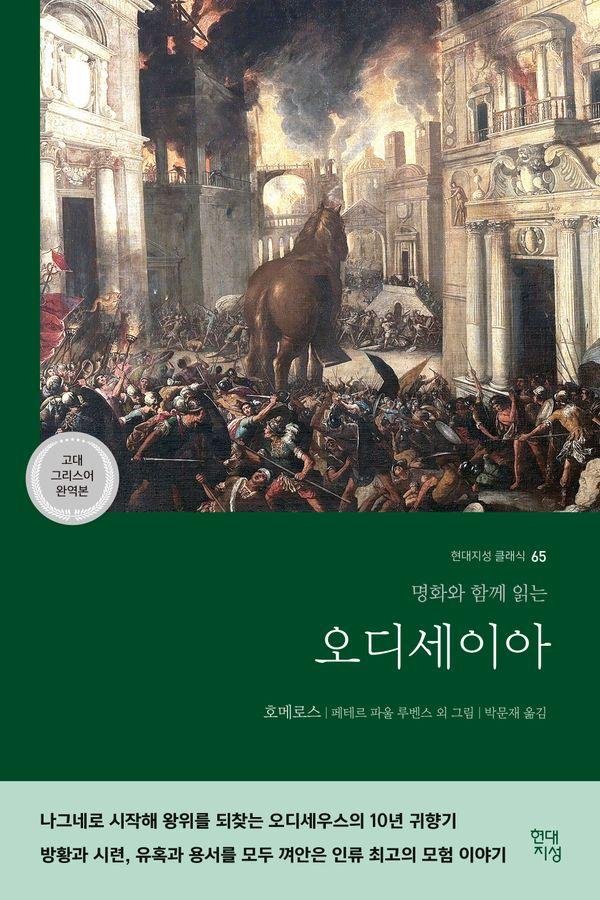
The Odyssey: Read with Masterpieces (Complete Ancient Greek Translation) - Hyeondae Jiseong Classic 65
Author Homer · Publisher Hyeondae Jisung · Published 2025-04-18 · ISBN 9791139721973 About the BookThe first story that set Western literature on its path,an epic of adventure and growth that began with OdysseusThe Odyssey is an epic heroic poem written by Homer around the 8th century BC, based on Greek mythology. Along with The Iliad, it is known as the...
See full description ↓Description
Author Homer · Publisher Hyeondae Jisung · Published 2025-04-18 · ISBN 9791139721973
About the Book
The first story that set Western literature on its path,
an epic of adventure and growth that began with Odysseus
The Odyssey is an epic heroic poem written by Homer around the 8th century BC, based on Greek mythology. Along with The Iliad, it is known as the oldest surviving Western work. 'Odyssey' means 'the story of Odysseus,' and today it has become a byword for a long and arduous journey or voyage. In this grand epic, spanning 12,110 lines across 24 books, we encounter an indomitable man who, once called "the most unfortunate of all mortals," endured countless hardships, yet in the process learned the values of courage, perseverance, and humility, and finally returned home to exact satisfying vengeance on his enemies.
While The Iliad majestically portrays the suffering and sorrow of humans destined to die in the maelstrom of war, The Odyssey thrillingly depicts how an individual survives hardships and achieves their goals.
Each book features unknown seas and islands, the people who inhabit them, gods appearing in human form, and half-human, half-beast monsters, encompassing almost all characters and narratives, both real and surreal, that ancient humanity could imagine. If the one-eyed giant Polyphemus, the sorceress Circe who turns men into beasts with her magic potion, the Sirens who lure sailors with their beautiful songs, the sea monsters Scylla and Charybdis, the nymph Calypso on a secluded island, and Athena appearing as a guardian deity form one axis of surreal imagination, then the diverse spectrum of realistic human beings forms another.
The growth of the protagonist's young son after his departure, a wife waiting for her husband who left without a promise, parents grieving the loss of their child, greedy and shameless suitors, opportunists clinging to them, and loyal servants to their masters – these characters exhibit different behaviors based on their individual values, even in the same situation.
Between gods and humans,
the questions of life posed by Odysseus
The Odyssey is not just a simple adventure story or tale of revenge. Throughout his journey across the sea and wandering from island to island, he constantly asks, "How should humans live?" The strength that enabled Odysseus to overcome countless crises and return home was not merely his cunning or valor. He always considered the will of the gods, sometimes restrained himself, and at times tested and verified those around him. This was an attitude aimed at preserving the order of 'justice' and 'piety' even amidst hardship.
To the ancient Greeks, 'justice' was a principle of the human world, and 'piety' was a fundamental attitude towards the gods. And these two were inseparable. Welcoming strangers, offering sincere sacrifices, and interpreting the omens of the gods were not just matters of etiquette, but an ethics that protected life. These repeated scenes throughout The Odyssey show that Odysseus is a character who constantly contemplates and practices 'how to survive,' not just 'to survive.'
In ancient times, revering the gods governed all aspects of human life. If strangers were treated harshly or sacrifices were poorly offered, disrespecting and scorning the gods, divine wrath would bring retribution. That is why Odysseus, after punishing the suitors, says: "Old woman, inwardly rejoice and keep your shouts of triumph within your heart. It is impious to exult over the slain. The destiny appointed by the gods and their own wicked deeds have destroyed them" (Book 22, lines 411-414). To act against the destiny and will decreed by the gods was considered to be inviting one's own ruin.
For this reason, the 'omens' sent by the gods are very important. He does not hastily accept his wife, father, or even his servants. This is because a careful and deep restoration of trust was crucial. Just as Agamemnon met his death through carelessness, Odysseus also knew that a momentary mistake could be a disaster. So he verifies everything, waits for the right moment, and finally exacts justice. And even in that moment, he restrains himself, fearing the gods.
For today's reader, The Odyssey is not just an old classic. For us, who must navigate the unpredictable seas of our era, it is the oldest and still the most effective story that asks about the direction and attitude of life.
The first epic adventure of humanity,
reborn in a complete translation that preserves the rhythm of ancient Greek
Hyeondae Jisung Classic's The Odyssey is a complete translation that directly translates Homer's original ancient Greek text, vividly reviving Odysseus' ten-year journey home. While maximally preserving the rhythm of the meter, word order, and ancient style, it has been refined into polished sentences to allow contemporary readers to immerse themselves naturally, fully conveying the essence of the original. In particular, with a translation that captures the grand scale, delicate emotions, lyricism, and dramatic scenes of the ancient epic, it enables modern readers to fully experience The Odyssey, often called the archetype of storytelling.
104 masterpieces and illustrations visually introduce the various supernatural beings and legendary scenes Odysseus encounters, such as the one-eyed giant Polyphemus, the sorceress Circe, the Sirens, Scylla and Charybdis, and Calypso, stimulating the reader's imagination and vividly bringing the ancient world to life. Explanations paired with rich color images enhance understanding of the narrative and help readers naturally envision the myths, legends, and character relationships within the flow of the story.
303 footnotes and 43 pages of commentary broadly explicate the history and culture of ancient Greece, its religious and cosmic views, names of people and places, the genealogy of the gods, and socio-political implications. In particular, since The Odyssey's temporal structure is not linear but narrates by interweaving past and present, making it difficult to read without background knowledge, this commentary and these annotations greatly aid the reader's understanding and immersion.
This book is not merely an adventure story of an ancient hero. It is a story for all those standing on the edge of life, and a text that illuminates human wisdom and restraint, and the inner strength towards justice, to avoid losing one's center amidst chaos. For readers encountering The Odyssey for the first time, it will be an introductory guide to a rich world of stories, and for those who have already read it, a classic for life that will allow them to rediscover new insights and deep reflections.
Table of Contents
Book 1 Athena Visits Telemachus
Book 2 Telemachus Sets Sail
Book 3 Nestor in Pylos
Book 4 Menelaus in Lacedaemon
Book 5 Calypso, Odysseus Shipwrecked
Book 6 Princess Nausicaa and Odysseus
Book 7 The Land of the Phaeacians
Book 8 Odysseus' Farewell Games and Feast
Book 9 The Cyclops
Book 10 Aeolus, Antiphates, Circe
Book 11 Hades, Land of the Dead
Book 12 The Sirens, Scylla and Charybdis, The Cattle of Helios
Book 13 Odysseus Returns to Ithaca
Book 14 Odysseus Meets the Swineherd
Book 15 Telemachus Heads Home
Book 16 The Meeting of Odysseus and Telemachus
Book 17 The Beggar Old Man Appears Before the Suitors
Book 18 The Beggar Old Man Among the Suitors
Book 19 Penelope and Her Guest Odysseus
Book 20 Omens
Book 21 Odysseus Strings His Bow
Book 22 The Slaying of the Suitors
Book 23 The Secret of Odysseus and Penelope's Bed
Book 24 The Souls of the Suitors Descend to Hades, and Peace
Commentary | Park Mun-jae
Main Characters
Product Details
Related products

The book is priced at its original Korean retail price (KRW 1,000 = A$1). Air freight is charged separately at checkout.
Orders close every Tuesday, are sent to Korea on Wednesday, and arrive in store one week after dispatch — 8 to 14 days from your order. Order today and pick up from Wed 28 Oct; we'll email you as soon as your books arrive.
Collect at the book corner in our Lidcombe or Eastwood store. No home delivery. Please have your order number and name ready.
First book A$15 + A$6 per extra book — 1 book $15 · 2 books $21 · 3 books $27 · 4 books $33, calculated automatically at checkout. The more books you order together, the lower the cost per book.
Titles temporarily out of stock in Korea may be delayed by about one week. If a title is out of print or unavailable, we refund that book in full and proceed with the rest of your order.
 The Odyssey: Read with Masterpieces (Complete Ancient Greek Translation) - Hyeondae Jiseong Classic 65
$27.00
The Odyssey: Read with Masterpieces (Complete Ancient Greek Translation) - Hyeondae Jiseong Classic 65
$27.00