
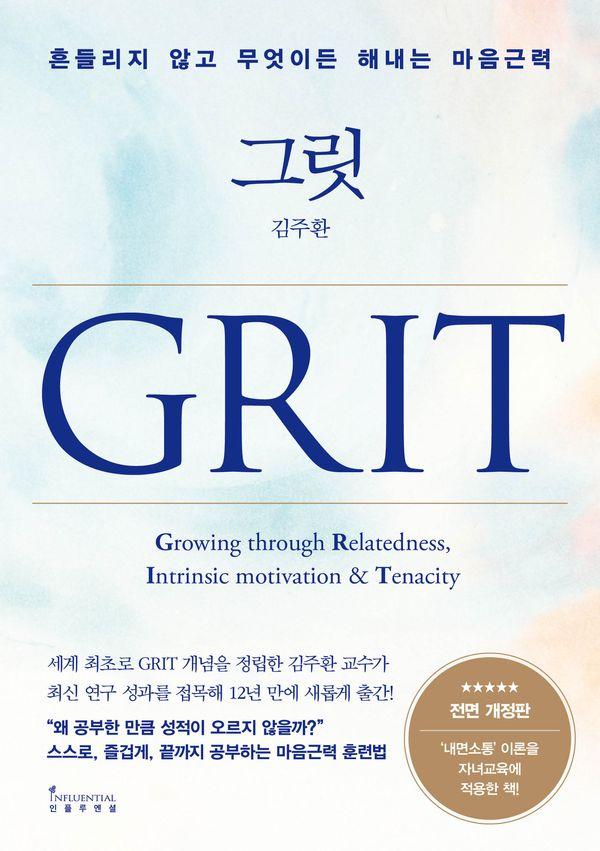
Grit: The Power of Passion and Perseverance (Revised Edition)
Author Kim Ju-hwan · Publisher Influential Co., Ltd. · Publication Date 2025-02-26 · ISBN 9791168342682 Book Introduction“Children with similar abilities put in similar effort,so why is there such a big difference in results?”The secret to achievement capabilities, revealed by Professor Kim Ju-hwan after decades of research, following his book “Inner Communication”Professor Kim Ju-hwan, who presented methods for transforming lives through...
See full description ↓Description
Author Kim Ju-hwan · Publisher Influential Co., Ltd. · Publication Date 2025-02-26 · ISBN 9791168342682
Book Introduction
“Children with similar abilities put in similar effort,
so why is there such a big difference in results?”
The secret to achievement capabilities, revealed by Professor Kim Ju-hwan after decades of research, following his book “Inner Communication”
Professor Kim Ju-hwan, who presented methods for transforming lives through mental resilience training in “Inner Communication,” has now published “Grit,” offering practical solutions for cultivating achievement capabilities for adolescents and parents who grapple with studying every day. “Grit,” first conceptualized globally by Professor Kim Ju-hwan in 2013, has been redefined after going out of print, incorporating the author's latest research to establish the concept of ‘grit’ as the source of achievement capabilities and proposing specific and realistic methods to cultivate it.
The author explains in this book that the significant differences in results among people with similar abilities who put in similar effort are due to differences in their ‘grit,’ which is an achievement capability. He states that to demonstrate high levels of achievement capability in studying or any other endeavor, mental resilience, or ‘grit,’ is essential. Professor Kim Ju-hwan introduces grit as “the power to keep trying until the end” and, through this book, presents ways to cultivate grit in daily life to excel not only in studies but in everything. In particular, it will be a more realistic help for parents with elementary, middle, or high school children to foster their child's mental resilience and raise them to be healthy in both body and mind.
The Three Mental Resiliences that Form the Foundation of All Achievement: ‘Grit’
-Self-regulation, Interpersonal Skills, Intrinsic Motivation
So, how can ‘grit,’ the foundation of all achievement, be improved? How can we raise children to excel in everything through grit? The newly defined meaning of grit in this revised edition is as follows: G stands for Growing, meaning to fully realize one's potential from their current state. When we say growth (G) means a child fully developing the abilities they already possess, this growth (G) is achieved through three mental resiliences: Tenacity, Relatedness, and Intrinsic motivation. In other words, grit is the concept of helping children grow well through these three mental resiliences (GRIT = Growing through Relatedness + Intrinsic motivation + Tenacity). The meanings of the three mental resiliences are as follows:
- Self-regulation (Tenacity): The power to control and manage oneself.
Self-regulation is the ability to drive oneself towards a set goal, and once an task is started, to see it through to the end even if it’s unpleasant or boring. It also refers to the ability to focus one's energy and attention on a goal (target) such as an exam or presentation. From a student's perspective, self-regulation can be seen as the power to make an effort and the power to perform well in exams.
- Interpersonal Skills (Relatedness): The power to build healthy relationships.
While interpersonal skills are often simply thought of as the tendency to get along with people, in neuroscientific terms, they refer to the ability to understand others' thoughts and intentions well and to empathize with their emotions. To effectively utilize interpersonal skills, one must be good at real-time information processing about oneself and others. A student's ability to accurately grasp the intent of an exam question is also only possible through the exercise of interpersonal skills.
- Intrinsic Motivation: The power to pursue things with passion and on one's own.
This is the ability to self-motivate for tasks one wishes to undertake. The most important basis for intrinsic motivation is ‘intrinsic drive,’ which involves finding joy in the task itself and gaining energy from it. This intrinsic drive stems from autonomy. Autonomy is the belief that 'I live my own life' and 'I am the master of my own life,' and only with such a belief can one decide and change one's current life.
Professor Kim Ju-hwan states, based on neuroscientific theory, that for these three mental resiliences to be activated, ‘Pyeonan Jeonhwal’ (amygdala stabilization, prefrontal cortex activation), as introduced in “Inner Communication,” must occur. He particularly emphasizes that through training to activate the prefrontal cortex, children can study independently, joyfully, and to completion.
Happy Children Also Excel in Academics
- The Secret to Improved Grades Revealed by Neuroscience
Sadly, our current education system and parents’ preconceived notions about studying are not only failing to foster children’s grit but are actually weakening it. As if to prove this, the level of amygdala activation in Korean children is alarmingly high. An activated amygdala signifies being overwhelmed by negative emotions, manifesting as constant anxiety and easily getting angry or annoyed over small matters. This is a common sight among adolescents around us.
Professor Kim Ju-hwan emphasizes that to rectify this, parents, in particular, must change their misguided prejudices. Parents must first abandon the idea that 'studying is something unpleasant and difficult, to be endured and completed.' Such thinking leads parents to pressure their children to study, push for excessive early learning, scold them, or nag them. As a result, children study 'reluctantly' to gain their parents' approval.
However, instinctively, people cannot excel at something they dislike. The same applies to studying. There is only one way to study well: activating the prefrontal cortex. An activated prefrontal cortex means, in short, a state of joyful and happy mind. That is, cultivating grit means stabilizing a child’s emotional state and consistently making their mind happy and joyful. This is why it is crucial to remember, as the author says, that “a child must be happy for their body and mind to be healthy and for them to study well.”
Although this book deals with how to excel in studies through grit, the grit the author talks about is not limited to students' academics. Competitions like entrance exams and tests continue into adulthood, and our lives are a continuous series of big and small challenges that require grit. In that sense, “Grit” can be said to offer not just a study strategy, but a way to cultivate the fundamental strength for living a successful life.
Table of Contents
Prologue Grit, the Mental Resilience to Excel in Studies and Everything Else
Chapter 1 Misconceptions and Delusions About Studying
Our Prejudices and Misconceptions About Studying
Misconceptions About Studying Are Hindering Your Child's Studies | What Should We Teach? | The True Meaning of Being Good at Studying
First Misconception: Are Intelligence and Grades Inherited?
Is It Because Parents Are Not Smart That Their Children Don't Study Well? | What the Dutch Hunger Winter Taught Us
Stress Can Also Be Inherited
Second Misconception: Does Intelligence Remain Unchanged Throughout Life?
Growth Mindset vs. Fixed Mindset | Children Who Deliberately Don't Study | Why Boys Are Better at Math Than Girls
Third Misconception: Is It Advantageous to Start Advanced Learning Early?
Children Who Play Well Also Study Well | Gifted Children Whose Grades Decline as They Get Older
Chapter 2 Grit, the Driving Force Behind All Achievement
What Leads to Success
The Secret of Non-Cognitive Skills
Effort Is Also a Skill
No Child Is Naturally Good at Everything | Items That Should Be Given Extra Points in Self-Introduction Letters
Grit, a Prerequisite for a Successful Life
Focus on ‘How’ to Teach Rather Than ‘What’ to Teach | To Study Well, Cultivate Grit First
Chapter 3 Self-Regulation: The Power to Control and Manage Oneself
The Power That Drives Me, Self-Regulation
Strengths Are Seen When You Decide to Look | The Source of Tenacity, Self-Regulation
It's Not a Matter of Willpower, But a Matter of the Prefrontal Cortex
Immediate Gratification or Delayed Reward? | Is Your Child's Prefrontal Cortex Functioning Properly?
How to Strengthen Self-Regulation
Training Method for Self-Referential Processing | The Meaning of Emotional Regulation | Methods for Stabilizing the Amygdala | Why Parents Should Cultivate Self-Regulation First
?
Chapter 4 Interpersonal Skills: The Power to Build Healthy Relationships
The Most Powerful Stress Reliever, Interpersonal Skills
Relationships, a Panacea for Stress | How to Avoid Senior Year Syndrome
Things to Remember When Dealing with Children
Two Pillars of Communication Skills: Love and Respect | Gratitude Journal, an Effective Training Method for Cultivating Interpersonal Skills
Why Children with Many Friends Also Study Well
Nature or Nurture? | The Source of All Abilities, Communication
Chapter 5 Intrinsic Motivation: The Power to Pursue Things with Passion and on One's Own
There's Another Reason Why Children Don't Study
Autonomy, the Core of Intrinsic Motivation | The Secret Education Method of Sending All Three Sons to Seoul National University | Why Korean Students Only Excel in Middle School
Cultivate Intrinsic Motivation Through Autonomy
Motivation and the Dopamine Reward System | The More Uncertain the Future, the Stronger the Motivation | The Secret of Intrinsic Motivation: Reduce the Gap Between Reality and Future
Chapter 6 The Ability to Do Well on Tests Must Also Be Developed
Grit Is Also Needed for Tests
Overcoming Test Anxiety Through Self-Regulation
Why Does Test Anxiety Occur? | Test Anxiety That Hinders Memory Retrieval | Cultivate Self-Regulation Through Regular Exercise | Change Your Perspective on Tests | How to Avoid Mistakes on Tests
Intrinsic Motivation That Improves Problem-Solving Ability
What Should You Think About Right Before an Exam? | Positive Emotion and Problem-Solving Ability
Even Tests Are Ultimately About ‘Communication’
Communication Training with Tests, Self-Feedback | Aim for the Plan Itself, Not Scores or Ranks
Product Details
Related products




The book is priced at its original Korean retail price (KRW 1,000 = A$1). Air freight is charged separately at checkout.
Orders close every Tuesday, are sent to Korea on Wednesday, and arrive in store one week after dispatch — 8 to 14 days from your order. Order today and pick up from Wed 28 Oct; we'll email you as soon as your books arrive.
Collect at the book corner in our Lidcombe or Eastwood store. No home delivery. Please have your order number and name ready.
First book A$15 + A$6 per extra book — 1 book $15 · 2 books $21 · 3 books $27 · 4 books $33, calculated automatically at checkout. The more books you order together, the lower the cost per book.
Titles temporarily out of stock in Korea may be delayed by about one week. If a title is out of print or unavailable, we refund that book in full and proceed with the rest of your order.
 Grit: The Power of Passion and Perseverance (Revised Edition)
$18.80
Grit: The Power of Passion and Perseverance (Revised Edition)
$18.80