
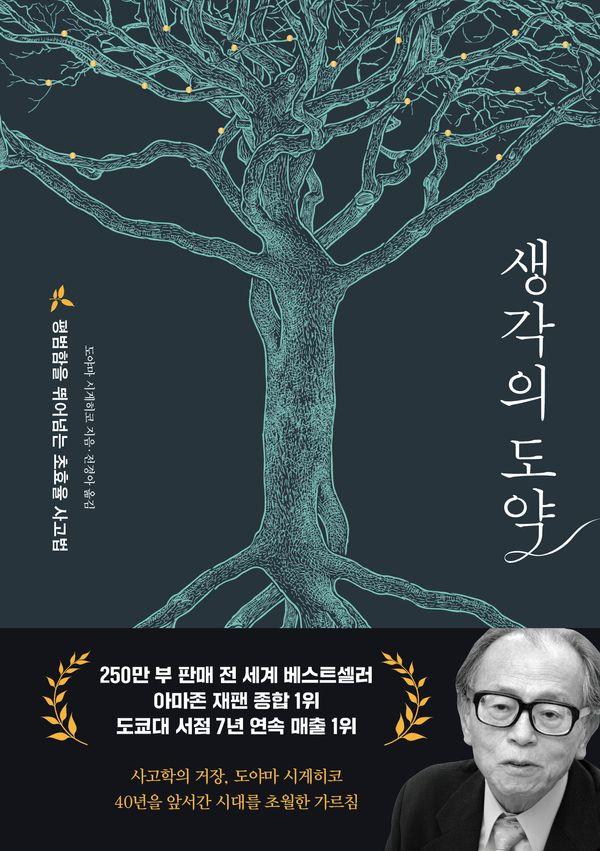
Leap of Thought: Ultra-Efficient Thinking Beyond the Ordinary
Author Shigehiko Toyama · Publisher Page2Books · Publication Date 2025-01-29 · ISBN 9791169851206 About the BookThe most perfect method for organizing thoughtsleft behind by a master of modern Japanese intellectual thoughtWhile there's growing interest in improving vocabulary and comprehension, the true essence of intellectual growth lies in developing "thoughts" to a higher level. The author points out that modern people...
See full description ↓Description
Author Shigehiko Toyama · Publisher Page2Books · Publication Date 2025-01-29 · ISBN 9791169851206
About the Book
The most perfect method for organizing thoughts
left behind by a master of modern Japanese intellectual thought
While there's growing interest in improving vocabulary and comprehension, the true essence of intellectual growth lies in developing "thoughts" to a higher level. The author points out that modern people "don't even realize they can't think for themselves" and emphasizes the need to scrutinize what thought truly is.
We acquired a vast amount of knowledge in school, but we were never truly taught 'how to think.' Especially in modern society, where new information is constantly pouring in, the ability to filter out unnecessary knowledge and systematize thoughts is crucial. Professor Toyama explains that the secret to creativity lies in thoroughly maturing selected information.
“Thoughts grow even while you dream.”
The "Super-Efficient Thinking Method" adopted even by students from prestigious universities.
As one method for elevating thoughts to a higher dimension, the author introduced the <Meta-Notebook> writing technique. It’s a very simple method that only requires three notebooks, and it's done by transferring information acquired in daily life three times: from notebook #1 to #2 to #3. While it might seem like just copying, it’s absolutely not. Amazingly, thoughts naturally mature during this process. Even while we dream, thoughts continue to grow. Unnecessary information disappears, and surprisingly novel ideas emerge that were previously unimaginable.
The third notebook is called the <Meta-Notebook>. The fact that it survived this far means it has inherent significance. It’s a valuable asset imbued with one’s personal values and interests. Having passed the gate of one's own mind, it's highly likely to pass the gate of other people's minds as well, making it truly important knowledge. The author said he created 53 notebooks over 20 years, and that they represent his entire being.
Beyond note-taking, there are various ways to enhance critical thinking. Principles introduced by the author, such as "If effort can't overcome it, forget it," "Having no individuality is the most individualistic thought," and "Make one day into two," offer a new dimension of thinking that breaks free from existing preconceptions, providing fresh inspiration found nowhere else. As you read, you will find clues to how to organize complex thoughts, where to find ideas, and the process by which great discoveries are made.
From the Book
Plants are said to be almost symmetrical, with parts visible above ground and hidden roots below ground. Flowers bloom because there is a large structure underground. Knowledge is also a flower bloomed by the human tree. If you just pick the flower because it's beautiful and put it in a vase, it will soon wither. The fact that a picked flower is not one's own can be understood from this alone. (p.20)
In schools today, the teaching side is overly proactive and kind, and it seems determined to teach no matter what. The learner merely has to sit with an open mouth and can have whatever they want put into it, which only fosters dependence. Ironically, the harder schools work, the more knowledge they provide, the more passively learners behave. It's a failure of true education. (p.25)
Current language education assigns meaning from the beginning. It teaches before one can even question or become curious. Not only meaning, but it also tries to inform in detail about the author who wrote the text. Whether that is beneficial or not is highly questionable. It is excessively kind to a fault. Children who were educated in the old days never heard that they absolutely must know the biographies of Confucius and Mencius. (p.26)
As you read, you encounter parts that impress you, parts that feel off, and parts you don't understand. Jot them all down. If a part resonates with you repeatedly, it's important. If puzzling parts keep appearing, that also requires attention. These are precisely the raw materials. (p.38)
The reason why great discoveries are sometimes said to come from inspiration is probably because an outsider marvels at the process where enzymes are obtained from unexpected places. To get interesting topics, this hint must be excellent, but it’s often difficult because it doesn't just lie around where one expects. (p.39)
Things held in the heart for a long time possess a mysterious power. A dormant theme, once awakened, becomes incredibly active. (p.47)
This is the editorship of conception. Interesting expressions with the power to intoxicate people are born this way. (p.59)
True organization is not like that. It's a qualitative change that elevates primary thinking to a higher dimension. No matter how much knowledge one has or how readily one thinks and conceives, that alone cannot sublimate it into secondary thinking. Quantity cannot substitute for quality. It takes time to organize thoughts from primary to secondary, and from secondary to tertiary. One must let those thoughts rest and wait for chemical changes to occur. Such compounded thoughts become a 'meta-thought' different from before. (p.87)
However, there are some things that remain forever no matter how hard one tries to forget them. This is because they are connected to one’s deep-seated interests and concerns. Individual intellectual personality is formed by the knowledge that one thought could be forgotten but couldn't. It is no coincidence that many intellectuals with a strong style appear to be among those who read selectively. (p.106)
Within this notebook, ideas rest for a while. They are put aside for some time and revisited after a certain period. Though one may have written about them as brilliant thoughts, with time, they sometimes appear as meager as a firefly's light in the morning sun. They lost their breath while resting. In such cases, they are mercilessly discarded. What didn't gain substance while resting simply wasn't meant to be. Ideas that still seem interesting upon re-evaluation are alive. Don't just leave them; put them to rest more thoroughly elsewhere. (p.111)
Since it has been sufficiently nurtured and held, the idea will not quickly rot and be short-lived. It has already been filtered once. Having passed the gate of one's own mind, it's safe to assume it has a high probability of passing the gate of other people's minds as well. (p.112)
Table of Contents
Introduction
What are you thinking?
Ⅰ.
True Talent - Those who cannot fly on their own
Voluntary Will - Creativity stolen by overly kind education
The Morning Brain - A miraculous time when everything becomes simple
Ⅱ.
Fermentation - Wait until it comes to you on its own
Maturing - If effort cannot overcome it
Cocktail - Both comprehensive and original
Editorship - In what order should things be grouped?
Catalyst - Having no individuality is the most individualistic
Analogy - How to solve unknown problems
Serendipity - Discovery disguised as chance
Ⅲ.
Meta-Information - Transform flat information into three-dimensional thought
Scrapbooking - An efficient way to collect information
Cards and Notebooks - Writing methods that increase value
Selective Reading - An unconscious reading method using the mind's notebook
Second Notebook - Awakening ideas and letting them breathe again
Meta-Notebook - Thoughts grow ferociously when transplanted
Ⅳ.
Organization - A skill required of creative individuals
Forgetting - How to forget well to clear your mind
The Test of Time - The power of classics that have endured countless hours
The Courage to Discard - Values that become more important with more knowledge
Just Write - The more you write, the clearer your thoughts become
Topic and Title - When thoughts are properly organized, only nouns remain
Praise - Thoughts become vibrant when praised
Ⅴ.
Articulation - When to speak freely, when to hold back
Conversation - With whom to converse
Inbreeding - Similar things have no influence
Three Senses and Three Plenties - When and where does ingenuity come from?
Wisdom - Knowledge acquired naturally
Proverbs - How to complete a thought system without reading books
Ⅵ.
Reality - Anchor your thoughts in the real world
The Known and the Unknown - And a new world
Divergence and Convergence - From perfect answers to creative answers
The Advent of Computers - Mechanical humans are pushed aside by natural selection
Special Appendix 1
Definition of 'Thinking'
Special Appendix 2
University of Tokyo Lecture: A New Way to Use Your Brain
Product Details
Related products
The book is priced at its original Korean retail price (KRW 1,000 = A$1). Air freight is charged separately at checkout.
Orders close every Tuesday, are sent to Korea on Wednesday, and arrive in store one week after dispatch — 8 to 14 days from your order. Order today and pick up from Wed 28 Oct; we'll email you as soon as your books arrive.
Collect at the book corner in our Lidcombe or Eastwood store. No home delivery. Please have your order number and name ready.
First book A$15 + A$6 per extra book — 1 book $15 · 2 books $21 · 3 books $27 · 4 books $33, calculated automatically at checkout. The more books you order together, the lower the cost per book.
Titles temporarily out of stock in Korea may be delayed by about one week. If a title is out of print or unavailable, we refund that book in full and proceed with the rest of your order.
 Leap of Thought: Ultra-Efficient Thinking Beyond the Ordinary
$18.00
Leap of Thought: Ultra-Efficient Thinking Beyond the Ordinary
$18.00