
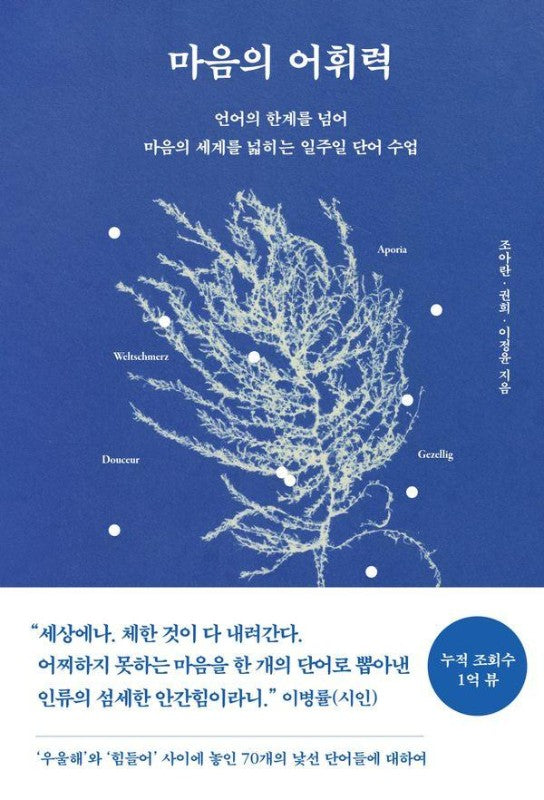
Vocabulary of the Mind: A One-Week Word Course to Expand Your Inner World Beyond the Limits of Language
Authors Jo Aran, Kwon Hee, Lee Jung-yoon · Publisher Page2Books · Publication Date 2026-08-11 · ISBN 9791169852180 Book Introduction★★★ Over 100 Million Cumulative Views ★★★★★★ Trending Content on Social Media ★★★“My goodness. My indigestion is gone.The delicate struggle of humanityto extract such uncontrollable emotions into a single word.”_Lee Byung-ryul (Poet)“What I need to understand myself is not a four-letter personality...
See full description ↓Description
Authors Jo Aran, Kwon Hee, Lee Jung-yoon · Publisher Page2Books · Publication Date 2026-08-11 · ISBN 9791169852180
Book Introduction
★★★ Over 100 Million Cumulative Views ★★★
★★★ Trending Content on Social Media ★★★
“My goodness. My indigestion is gone.
The delicate struggle of humanity
to extract such uncontrollable emotions into a single word.”
_Lee Byung-ryul (Poet)
“What I need to understand myself is not a four-letter personality type,
but my own words that can encompass my heart.”
_Oh Jin-seung (Psychiatrist, Operator of
“People who don't crumble even when shaken have a language to express their feelings.”
About 70 unfamiliar words between ‘I’m depressed’ and ‘I’m having a hard time’
Disappointment and resentment both involve feeling injustice, but their directions differ. Disappointment comes from someone you had expectations of, while resentment comes from judgment or misunderstanding. The same applies to helplessness and exhaustion. Helplessness stems from losing meaning, while exhaustion comes from using up all one's energy. Just as using the same prescription for different symptoms is ineffective, the mind also needs to be accurately named to find the right solution. However, we often lack the language or the余裕 to distinguish these subtle nuances, so we cram all these feelings into the two words, "I'm depressed" and "I'm having a hard time." Unnamed feelings don't disappear. Instead, they erupt in unexpected places and with unexpected intensity. You'll understand if you recall a day when you finally got angry over something trivial after holding it in, or a day when you couldn't do anything all day due to inexplicable lethargy. These were times that could have unfolded differently if you had known the true names of those feelings.
This book juxtaposes familiar psychological terms like learned helplessness and impostor syndrome with unfamiliar words like Weltschmerz, kreng jai, hezhelih, and ayornamat. The feeling of belittling oneself, saying "I just got lucky this time" even when a diligently prepared task goes well; sleepless nights spent worrying about things that haven't even happened yet; days when you end up writing nothing because you strive for perfection. As you read these words alongside concrete scenarios, you'll realize that the feelings you've broadly labeled as "I'm having a hard time" actually have many layers. A person who knows the precise name of their feelings is not consumed by them. Instead, they become someone who can face and manage those emotions head-on.
“How to avoid being overwhelmed by surging emotions”
A mindfulness practice that starts with a daily line and culminates in a weekly rhythm
This book doesn't just explain emotions. For example, the author says she practices 'Sati' daily by feeling the temperature of the water when washing dishes and noticing the sensation of her feet touching the ground when walking. "Ah, I'm worrying about tomorrow now; I'm clinging to yesterday now." The moment one becomes aware, the thought is no longer one's entire being but an event happening within oneself. Each of the 70 words contains a practical application that can be immediately applied to life that day. It doesn't require grand resolutions or special time. Instead, at the end of each page, three "Questions for Today" are left, bringing the recently read word directly into one's day. What was the last thing I gave up on most quickly? Where did that standard of perfection come from? What small reason kept me going today? The short time spent answering these questions becomes a practice in managing the day's emotions.
This book was completed by three individuals who, from different places, recorded their emotions in their own ways: a 13-year content marketer who collected words of the heart every night after work, an SNS operator who shares psychological and philosophical stories with over a million readers every month, and a freelance writer who has been learning how to understand the mind through psychological counseling for seven years. Perhaps that's why this book is less a single person's insight and more a record of multiple lives striving not to crumble in the face of emotion. Following it day by day, from Monday to Sunday, you'll eventually find yourself not being overwhelmed by surging emotions.
From the Book
I practice Sati with very small daily actions. I feel the water temperature when washing dishes and notice the sensation of my feet touching the ground when walking. When drinking coffee, I slowly feel the warmth and bitterness on my tongue. And above all, I become aware of my thoughts. Ah, I am worrying about tomorrow right now; I am holding onto yesterday right now. The moment I become aware like this, the thought is no longer my entire self but an event happening within me. Anxiety mostly arises from the future, and regret repeats from the past. In this present moment, many things do not actually exist as much as we think.
_Monday, from Sati (p.16~17)
While dwelling on those words doesn't make impostor syndrome disappear instantly, it does subtly change one's mental attitude. I try never to forget that the anxiety and fear I feel now are baseless, but the trust and praise from those who believed in me were real truths. Then, the mind that doubted and belittled itself gains the strength to ask back, "Are you really such an incompetent person? Are you sure?" Most of the time, there's no reason to be that certain. Let's not use our minds to doubt ourselves, but to trust the journey we've walked so far.
_Monday, from Impostor Syndrome (p.26)
Respecting their choice if they choose not to change, and not forcing correction if they wish to remain in a misunderstanding. The "Let Them" theory was not about neglecting others, but about returning their lives to them. Most importantly, I also had to leave myself as I was. It's okay not to fully explain myself when I didn't explain perfectly, when I was misunderstood, or when I couldn't be a good person in every relationship.
_Tuesday, from Let Them Theory (p.56)
Just as the same painting looks completely different depending on its frame, life's scenes can become tragedies or processes for a better future, depending on the frame we impose. 'Reframing' is not simply about affirming everything. It's not about laughing off things as if nothing happened or hastily overlaying meaning onto painful emotions. It's about breaking the negative flow of thought by finding possibilities and opportunities even in the worst moments. It's the choice not to add harsh interpretations like 'I'm no good after all' to things that have already happened.
_Wednesday, from Reframing (p.87)
The Inuit people of the Canadian Arctic use the word 'Ayornamat' in such moments. It means 'it is what it is' or 'it cannot be helped.' Living in harsh nature, they must have instinctively learned from a very young age the difference between what can and cannot be helped by human power. Knowing clearly that anger or regret won't change the situation, when a hunt failed or plans went awry due to sudden weather changes, they likely didn't lament but instead said, "Ayornamat, it cannot be helped. Let's accept it and think about what's next." "Bad things happen, and you can't do anything about it. Right? When the world gets you down, the best thing to do is ignore it!" This is a line from the movie The Lion King. In the face of things that have already happened, things that cannot be changed, the courage to let go is more necessary than the power to hold on. Is 'Ayornamat' not another name for that wise courage?
_Wednesday, from Ayornamat (p.107)
That's where 'Kintsugi' begins. It's a method of not denying the irrecoverable, but accepting the broken form as a new appearance. This isn't a 'technique for restoring to its original state.' It doesn't erase the cracks but instead leaves them as the most prominent lines. Breaking becomes not a failure but a process, and flaws become the unique history of this object. From a psychological perspective, it might be akin to 'post-traumatic growth,' where after experiencing significant physical or mental damage, an individual reaches a higher level of personal capacity and life satisfaction than before.
_Thursday, from Kintsugi (p.116)
Then I learned the word 'philautia.' The self-love this word describes wasn't a vague command to simply like myself. Philautia neither unconditionally favors me nor pushes me without reason. It acknowledges what's done well and what's done wrong, but doesn't punish me more than necessary. Applying the standards I allow for others to myself—that simple attitude, I realized then, was unfamiliar to me. These days, I no longer strive to love myself. Instead, at the end of the day, I ask myself: Was I fair to myself today? Just that one question changed how I treat myself.
_Friday, from Philautia (p.148)
The phrase "Even if it's hard now, it will surely have meaning" contains positive reappraisal. It's a way of interpreting a painful experience not as a simple failure, but as a process of growth. The same event can be read as 'frustration' or 'learning' depending on the perspective from which it is viewed. The phrase "Once this is over, things will be fine" hides a positive reframing strategy. It's about temporarily shifting one's gaze, fixed on present suffering, to the future. Just remembering that current difficulties are not eternal can loosen the pressure of emotions a little. The phrase "Still, it's a good thing it's only this bad" is a shift in perspective. It's about finding room for gratitude by comparing the current situation with how much worse it could have been. It's a way of shifting one's gaze from what has been lost to what still remains.
_Saturday, from Cognitive Reappraisal (p.197)
There are times when we experience the overview effect in everyday life. It's that moment when, looking at the cityscape from a high vantage point or surveying the whole from an open vista, the worries and thoughts that have plagued us suddenly feel insignificant. I sometimes recall the overview effect when I'm deep in thought. "Is this a worry for a few days?" "Will this concern still be valid a year from now?" When the answer to these questions is no, I decide to let it go. After all, from a cosmic perspective, it's just one of many dust-like concerns.
_Sunday, from Overview Effect (p.215)
Table of Contents
Prologue - Cultivating your emotional vocabulary makes life a little lighter
Monday: Words that name anxious feelings
Sati | Learned Helplessness | Weltschmerz | Impostor Syndrome | Completionism |
Kreng Jai | Ressentiment | Aporia | Attachment Anxiety | Dichotomy of Control
Tuesday: Words that protect you in relationships
Epoché | Reciprocity of Liking | Let Them Theory | Hwinan | Schadenfreude |
Empathy Fatigue | Hezhelih | Seasonal Ties | Philia | Deep Trust
Wednesday: Words for nights when thoughts won't stop
Decentering | Reframing | FOMO Syndrome | Hygge | Rumination |
Confirmation Bias | Anticipatory Anxiety | L'appel du Vide | Ayornamat | Saudade
Thursday: Words that heal wounds
Kintsugi | Hesychia | Komorebi | Citadel | Oshikatsu |
Samatha | Self-Compassion | Self-Care | Social Comparison | Comfort Zone
Friday: Words that help you rise again when your spirit is broken
Philautia | Antifragile | Fictional Independence | Katabasis | Sabr |
Emotional Contagion | Wabi-sabi | HSP | High-Functioning Depression | Grounding
Saturday: Words that find joy by gently caring for yourself
Self-Efficacy | Self-Determination | Catharsis | Kalsarikänni | Petits Bonheurs |
Aloneness | Cognitive Reappraisal | Douceur | Lagom | Cute Aggression
Sunday: Words that give courage to live again
Sunday Blues | Overview Effect | Psychological Safety | Psychological Security | Wanchān |
Strikhedonia | Mono no aware | Guilty Pleasure | Ikigai | Anticipated Nostalgia
Product Details
Related products


The book is priced at its original Korean retail price (KRW 1,000 = A$1). Air freight is charged separately at checkout.
Orders close every Tuesday, are sent to Korea on Wednesday, and arrive in store one week after dispatch — 8 to 14 days from your order. Order today and pick up from Wed 30 Sep; we'll email you as soon as your books arrive.
Collect at the book corner in our Lidcombe or Eastwood store. No home delivery. Please have your order number and name ready.
First book A$15 + A$6 per extra book — 1 book $15 · 2 books $21 · 3 books $27 · 4 books $33, calculated automatically at checkout. The more books you order together, the lower the cost per book.
Titles temporarily out of stock in Korea may be delayed by about one week. If a title is out of print or unavailable, we refund that book in full and proceed with the rest of your order.
 Vocabulary of the Mind: A One-Week Word Course to Expand Your Inner World Beyond the Limits of Language
$16.80
Vocabulary of the Mind: A One-Week Word Course to Expand Your Inner World Beyond the Limits of Language
$16.80