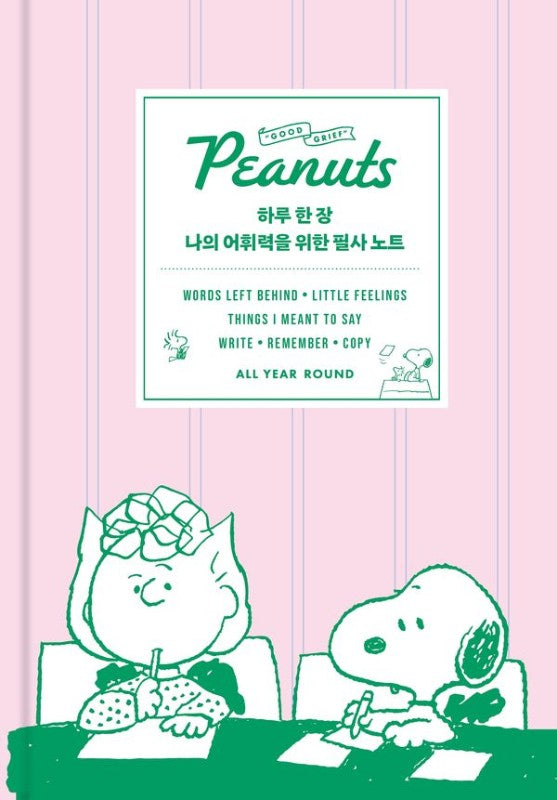
A Daily Copying Notebook for My Vocabulary (Peanuts Edition): Discovering Hidden Vocabulary for Adults Who Have Much to Say But Few Words to Use (Hardcover)
Author Yoo Sun-kyung · Publisher Wisdom House · Published 2026-08-26 · ISBN 9791171711673 About the Book"Transcription, isn't it just copying?""Does transcription really improve vocabulary?"★The only book you need to read if you're just starting transcription to boost your vocabulary!★With the recent surge in interest in artificial intelligence, the range of ChatGPT's applications is expanding. Many users, expecting a mechanical response...
See full description ↓Description
Author Yoo Sun-kyung · Publisher Wisdom House · Published 2026-08-26 · ISBN 9791171711673
About the Book
"Transcription, isn't it just copying?"
"Does transcription really improve vocabulary?"
★The only book you need to read if you're just starting transcription to boost your vocabulary!★
With the recent surge in interest in artificial intelligence, the range of ChatGPT's applications is expanding. Many users, expecting a mechanical response from a mobile chatbot, are surprised by its surprisingly plausible rhetoric and unexpected logic. Although there are no particularly difficult words or pointed messages, one cannot shake the feeling that it has accurately read the words and thoughts one wanted to express. Seeing ChatGPT effortlessly articulate thoughts and arguments that one knew but didn't know how to phrase, one begins to reflect on their own vocabulary and writing skills. Realizing that there is much to say but no adequate words, an unprecedented interest in extensive reading or transcription arises.
《My Daily Vocabulary Transcription Notebook》 begins by addressing questions that anyone starting or currently engaged in transcription might have asked. It goes beyond the simple concept of transcribing an entire book, offering concrete, step-by-step methods to extract greater utility from the process. It provides opportunities to encounter a variety of works—novels, poetry, essays, plays—that are not commonly read in everyday life. The selections, carefully curated by the author, are enjoyable to read but hold a more special 'resonance' when slowly and carefully transcribed by hand. It presents specific methods to improve vocabulary, such as 'how to get familiar with words,' 'secrets to building vocabulary,' and 'the power of words,' while also helping readers deepen their transcription practices to align with their own goals. Furthermore, there are dedicated pages for personal writing, using vocabulary discovered in newly read and transcribed passages as material, and by substituting synonyms provided in footnotes into the main text, one can subtly appreciate the 'flavor of language' that might have been overlooked.
'Words not used are ultimately words that cannot be used.'
- 134 practical writing and transcription exercises to unlock your hidden vocabulary
It's true that for basic communication, having enough vocabulary to read and express oneself is sufficient. However, upon closer inspection, everyday conversations and writings are not as diverse as one might think. Similar words and formulaic content are repeatedly exchanged. This leads to a lack of opportunities to hear and learn new things to enrich one's language. A limited vocabulary prevents effective expression of thoughts and emotions and contributes to a lagging ability to interpret information and knowledge.
This book, 《My Daily Vocabulary Transcription Notebook》, is the first vocabulary transcription book created by author Yoo Sun-kyung, combining her reading experiences and transcription know-how for those who thirst for rich language skills and quick comprehension. Through just one page and about 10 minutes of writing each day, it helps users retrieve words they haven't used before. It helps them internalize expressions and vocabulary that they knew but rarely had the opportunity to use, rather than not knowing them at all.
We can only know what we have experienced; everything else remains in the realm of the unknown. The same applies to language. Ultimately, words that we don't use are words that we cannot use. As the realm of unused words shrinks and the number of usable words grows, one will realize a significant expansion in their vocabulary and sentence structure, not only in formal writing but also in everyday conversations. Moreover, starting transcription to familiarize oneself with unfamiliar literary works or new vocabulary can also bring the benefits of mental exercise and meditation, making it an excellent study for 'adult education.'
Through this book, if one continues to write, and consistently enjoys the simple pleasure of reading and writing even just one page a day, they will experience the joy of transcription and the benefits of self-study. At that point, they will find themselves sitting at their desk with a notebook and pen, eagerly anticipating this time, without even having to force themselves. That is the power of routine.
Table of Contents
Foreword Transcription, for Living
First Step, Getting Familiar with Vocabulary
1. Writing with Feeling Using Onomatopoeia and Mimetic Words
Michael Ende's novel 《Momo》
Park Kyung-ni's novel 《Toji 5》
Hwang Ji-woo's poem 〈While Waiting for You〉
Françoise Sagan's novel 《A Certain Smile》
[My Writing] Thump! Thump!
Kim Yu-jeong's novel 《Bom Bom》
Shin Hyung-geon's poem 〈Spring Day〉
Kwon Dae-woong's essay 〈Fluttering Heart〉
[My Writing] The Sound of Your Heartbeat
Park Mok-wol's poem 〈Market Day〉
Moon Soon-tae's poem 〈Anchovy〉
Kim Seung-hee's poem 〈Breakfast at Dawn〉
Christian Bobin's novel 《A Slight Heartbeat》
Kwon Yeo-sun's short story 〈Three People〉
Sándor Márai's novel 《The Change of Marriage (Part 1)》
Yoo Sun-kyung's essay 〈Pain Perception Emotional Vocabulary〉
[My Writing] What vocabulary enters you?
2. Experiencing the Flavor of Words: Acquiring Linguistic Intuition
Yoon Dong-ju's poem 〈Boy〉
Federico García Lorca's poem 〈It's True〉
Daniel Glattauer's novel 《Love Virtually》
William Shakespeare's play 《Romeo and Juliet》
Kawabata Yasunari's novel 《Snow Country》
Han Kang's novel 《Greek Lessons》
Jeong Ji-yong's poem 〈Shooting Star〉
Chusa Kim Jeong-hui's poem 〈Spring Light Deep, Dew Heavy〉
Maxim Gorky's novel 《Mother》
Dongpo So Shik's poem 〈Poem of the Geomungo〉
Ryūnosuke Akutagawa's short story 〈Kappa〉
Victor Hugo's novel 《Les Misérables》
Yoo Sun-kyung's essay 〈Accept the Fact That You Don't Understand Each Other's Words〉
3. Replacing Zero-sum Vocabulary
Various words that can replace zero-sum vocabulary
Oscar Wilde's novel 《The Picture of Dorian Gray》
Park Wan-suh's novel 《Who Ate All That Singa?》
Jeon Hye-rin's essay 〈Long Wandering〉
Amélie Nothomb's novel 《The Life of Hunger》
Émile Ajar's novel 《The Life Before Us》
Jang Yeong-hee's essay 〈A 'Special' Ordinary Year〉
Kahlil Gibran's poem 〈On Marriage〉
Kim Ae-ran's essay 〈Adverb and Greeting〉
Miyashita Natsu's novel 《The Forest of Wool and Steel》
Yoo Sun-kyung's essay 〈Shifting Perspective Broadens the Mind〉
Second Step, Secrets to Building Vocabulary
1. The Beginning of Connection, Interest
Lee Hyo-seok's short story 〈When the Buckwheat Flowers Bloom〉
Dazai Osamu's essay 〈Laziness Trump Card〉
Kim Ae-ran's short story 〈Bugs〉
Words that helped form new connections
Kim Nam-geuk's poem 〈Ginkgo Flower〉
Lee Tae-jun's essay 〈Autumn Flowers〉
Jeong Ji-yong's essay 〈Oriole and Chrysanthemum〉
Lee Moon-jae's poem 〈Green Onion Flower〉
Choi Yun's novel 〈Whispers, Whispers〉
Park Wan-suh's essay 〈Unshaken Whole〉
Patrick Modiano's novel 《Missing Person》
Hans Christian Andersen's short story 〈The Little Mermaid〉
Charles Baudelaire's poem 〈Windows〉 (excerpt)
Michel Tournier's essay 〈The Back is the Truth〉
Francis Jammes' poem 〈Restaurant〉
Saihate Tahi's essay 〈I like it〉
2. The Beginning of Proper Seeing, Observation
David Le Breton's essay 〈Silence〉
Alain de Botton's essay 〈On the Country and the City〉
Hope Jahren's essay 〈Lab Girl〉
Hwang Jung-eun's novel 〈Myeongsil〉
Hyun Ki-young's novel 〈My Wife and the Catalpa Tree〉
Olga Tokarczuk's novel 《Primeval and Other Times》
3. Turning Point Leading to a Change in Perspective, Description
Kim Hwa-young's essay 〈Morning Market in Provence and the Scent of Cavaillon Melons〉
Lulu Miller's essay 〈Dandelion〉
Delia Owens' novel 《Where the Crawdads Sing》
Park Mok-wol's poem 〈Spring Rain〉
Woo Sook-young's essay 〈Fallen Leaves and Autumn Foliage〉
Kim Hoon's essay 〈In Jeju〉
Federico García Lorca's essay 〈Monastery of San Pedro de Cardeña〉
Jang Seok-nam's essay 〈Sound of Drawing Water〉
Han Seung-won's novel 〈But Not All Are Like That〉
Gustave Flaubert's novel 《Madame Bovary》
Karen Blixen's novel 《Out of Africa》 204
Park Kyung-ni's novel 《Toji 9》 206
F. Scott Fitzgerald's novel 《The Great Gatsby》 208
Baek Seok's poem 〈Midnight〉 212
Jacques Prévert's poem 〈Breakfast〉 214
Third Step, The Power of Vocabulary
1. Empathy: Responding to and Entering Another's World
Peter Bischel's short story 〈A Table is a Table〉
Natsume Sōseki's novel 《Kokoro》
Eun Hee-kyung's novel 《The Gift of a Bird》
Haitani Kenjiro's novel 〈Lonely Zoo - Preface〉
Baek Seok's poem 〈Mountain Dwelling〉
Cheon Myeong-kwan's novel 《My Uncle Bruce Lee 1》
Ryūnosuke Akutagawa's short story 〈Mikan〉
Moon Tae-jun's essay 〈Stroking is Passion〉
Kim Sa-in's poem 〈A Quiet Matter〉
Mary Shelley's novel 《Frankenstein》
Viktor Frankl's essay 〈Bitterness and Disillusionment〉
Jeong Kkeut-byeol's poem 〈Tide〉
[My Writing] A Story of Empathy
2. Comprehension: Escaping Dichotomous Thinking and Interpreting in Multiple Dimensions
Kim Hyeon's essay 〈1987.7.1.〉
Margaret Atwood's essay 〈How Do We Change the World?〉
Nikos Kazantzakis' novel 《Zorba the Greek》
Shin Young-bok's essay 〈Language of Hope, Unyielding Fruit〉
Étienne de La Boétie's essay 〈Habit, The First Reason for Voluntary Servitude〉
Park Hong-soon's essay 〈In a Third-Class Train〉
Kakuta Mitsuyo's novel 《Paper Moon》
Paul Auster's novel 《The Locked Room》
Luise Rinser's novel 《Middle of Life》
Karel Čapek's play 〈R.U.R.〉
Lee Byung-ryul's essay 〈My Heart Commanded〉
Bill Bryson's essay 〈A Short History of Nearly Everything - Preface〉
[My Writing] Discovering a New Perspective
3. Insight: Piercing Through Objects or Phenomena with Keen Observation to Know the Best
Pascal Mercier (Peter Bieri)'s novel 《Night Train to Lisbon》
Martin Schleske's essay 〈You Are Loved〉
Lee Cheong-jun's novel 《Ieodo》
Bertrand Russell's essay 〈The Conquest of Happiness〉
Kim Dae-hyun's essay 〈Water Mirror〉
Mahatma Gandhi's essay 〈Thoughts 2〉
Lucius Annaeus Seneca's essay 〈On Providence〉
Zhuangzi 〈Discussion on the Equality of Things (Qi Wu Lun) Part 2〉
Jeong Min's essay 〈Monk! What Do You See?〉
Oscar Wilde's essay 〈The Soul of Man Under Socialism〉
William Shakespeare's play 《Macbeth》
Sándor Márai's novel 《Embers》
[My Writing] Imagining My Insightful Self
4. Self-Regulation: Holding the Reins of Emotions and Thoughts to Maintain Balance
John Fowles' novel 《The French Lieutenant's Woman》
Willy Ronis' essay 〈Bohemians of Montreuil, 1945〉
Park Noh-hae's poem 〈How to Catch a Tiger〉
Vadim Zeland's essay 〈Reality Transurfing〉
Yoo Sun-kyung's essay 〈You Can Live Well Even with Holes〉
Epictetus' essay 〈Enchiridion〉
Kahlil Gibran's poem 〈On Joy and Sorrow〉
Hermann Hesse's novel 《Demian》
Lee Ja-hyun's essay 〈Second Memorial〉
Henry David Thoreau's essay 〈Walden - Conclusion〉
Rachel Naomi Remen's essay 〈Kitchen Table Wisdom〉
Miguel de Cervantes' novel 《Don Quixote》
Vincent van Gogh's essay 〈Letters of Vincent van Gogh〉
Jang Geon's poem 〈Trembling Compass〉
[My Writing] Questions and Answers about Self-Regulation
5. Expressiveness: Materializing Abstract Thoughts or Feelings into Words and Writing
Ogawa Ito's novel 《Tsubaki Stationery Store》
Robert Frost's poem 〈Tree at My Window〉 (excerpt)
Cheongheo Hyujeong's poem 〈Hearing a Geomungo While Passing an Inn〉
Henning Mankell's novel 《The Man from Beijing》
Johann Wolfgang von Goethe's novel 《The Sorrows of Young Werther》
Jeong Ji-yong's poem 〈Apcheon〉
Bertolt Brecht's poem 〈My Mother〉
Lee Seong-bok's poem 〈Feeling〉
Jeong Hyeon-jong's poem 〈Every Moment Is a Flower Bud〉
Choi Seung-ja's essay 〈Life Ripened Round〉
Friedrich Wilhelm Nietzsche's prose poem 〈On the Isles of the Blessed〉
[My Writing] Expressing
Product Details
Related products
The book is priced at its original Korean retail price (KRW 1,000 = A$1). Air freight is charged separately at checkout.
Orders close every Tuesday, are sent to Korea on Wednesday, and arrive in store one week after dispatch — 8 to 14 days from your order. Order today and pick up from Wed 4 Nov; we'll email you as soon as your books arrive.
Collect at the book corner in our Lidcombe or Eastwood store. No home delivery. Please have your order number and name ready.
First book A$15 + A$6 per extra book — 1 book $15 · 2 books $21 · 3 books $27 · 4 books $33, calculated automatically at checkout. The more books you order together, the lower the cost per book.
Titles temporarily out of stock in Korea may be delayed by about one week. If a title is out of print or unavailable, we refund that book in full and proceed with the rest of your order.
 A Daily Copying Notebook for My Vocabulary (Peanuts Edition): Discovering Hidden Vocabulary for Adults Who Have Much to Say But Few Words to Use (Hardcover)
$23.80
A Daily Copying Notebook for My Vocabulary (Peanuts Edition): Discovering Hidden Vocabulary for Adults Who Have Much to Say But Few Words to Use (Hardcover)
$23.80