
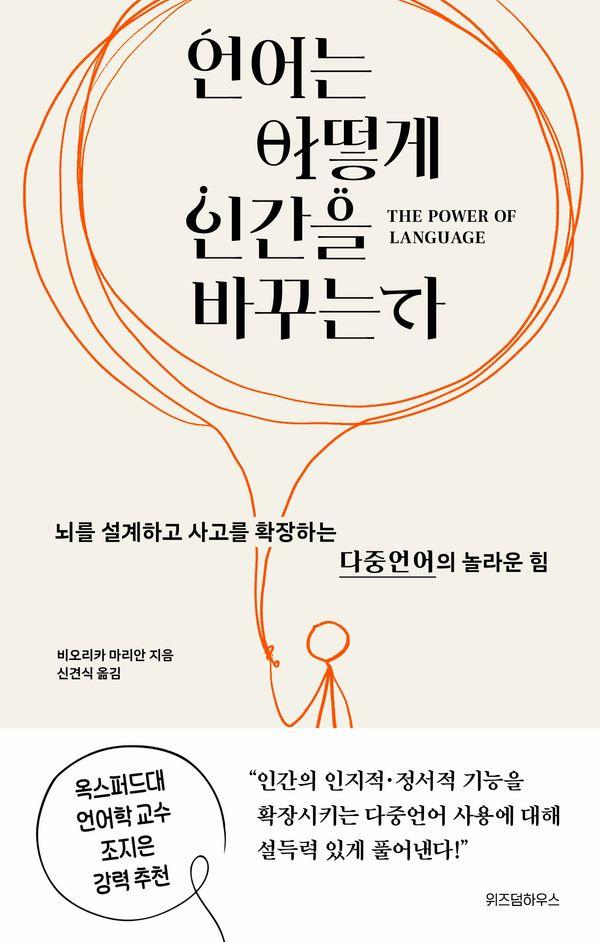
How Language Transforms Humans: The Astonishing Power of Multilingualism to Design the Brain and Expand Thought
Author Viorica Marian · Publisher Wisdom House · Published 2026-03-04 · ISBN 9791175910379 About the Book“We become another self every time we speak a different language.”The secret of multilingualism is finally revealed.Imagine a die. Give it to a multilingual person and ask them to roll it alone and report the result. Only they know the outcome, and a larger number...
See full description ↓Description
Author Viorica Marian · Publisher Wisdom House · Published 2026-03-04 · ISBN 9791175910379
About the Book
“We become another self every time we speak a different language.”
The secret of multilingualism is finally revealed.
Imagine a die. Give it to a multilingual person and ask them to roll it alone and report the result. Only they know the outcome, and a larger number yields a greater reward. If we were all honest, the probability for each number as an answer would be one-sixth. However, experiments surprisingly show that when asked in their native language, people are more likely to report a higher number than when asked in another language. Even in the ‘trolley dilemma,’ where one must choose between killing five people or one, responding in a language other than one's native tongue resulted in a more utilitarian choice. This is true for the same person.
In "The Multilingual Mind," the author, who studies the interaction between language and mind, presents various examples of how language can transform individuals. Ultimately, when we use a language other than our mother tongue, we perceive and react to people, events, and objects differently, expanding our framework of thought. This is because brain activity varies with language, leading to different emotional decisions. We become more honest, more logical, and make decisions that yield greater social benefits. Multilingual individuals can also connect things in ways that monolinguals cannot. This enables them to score higher on creativity tasks and easily distinguish between relevant and irrelevant information, thereby improving concentration.
We "speak" every day, but we do not fully understand the "power of words." One could say that as the language we use changes, different aspects of ourselves come to the forefront, and different identities that were dormant are activated. We can become a "different person" depending on the language we speak. While there is skepticism about learning foreign languages during childhood when one has not fully mastered their native language, the author argues that the earlier one starts, the better. This is because infant cognition is sophisticated even before speech, allowing for the early establishment of diverse personal facets according to language.
“Just as exercise changes the body, language changes the brain.”
The power of multilingualism, affecting the physical structure of the brain.
For a long time, scientists thought about the use of multiple languages in this way: "When switching from one language to another, the brain operates by turning off one language and turning on the other." However, experiments on multilingual individuals have confirmed that when they hear a word, they simultaneously recall similar-sounding words in other languages. This proved "parallel activation," meaning the brain remains constantly active and processes information automatically and simultaneously, even when not actively using other languages. From then on, the perception of the potential and possibilities of the multilingual brain changed.
Research into the brains of multilingual individuals intensified, revealing that they have a higher density of gray matter, which houses neuron cell bodies and processes information in the frontal lobe. This implies that even as people age and gray matter volume decreases, knowing multiple languages can help slow that decline. Through this, science has proven that speaking two or more languages can protect the brain from age-related cognitive decline and that multilingualism delays the onset of Alzheimer's disease and other forms of dementia by an average of 4 to 6 years. Considering that nothing else, besides exercise and diet, has such a significant effect on dementia onset, this figure is highly significant. Furthermore, studies continue to show that "cognitive reserve," which enables better resilience to brain diseases and better performance in cognitive tasks, is higher in multilingual individuals, literally indicating that speaking multiple languages leads to a healthier brain.
Isn't the ultimate goal in an individual's life to fully enjoy and live independently for as long as possible? From this perspective, "learning a foreign language" may now have to be accepted as an essential element, not just for understanding others but also for one's own healthy life. The author of this book emphasizes that it is never too late to learn a language.
“Language is the key to unlocking the mysteries of the universe.”
The value of infinite multilingual thinking.
The Rosetta Stone is a prime example of an artifact that shows the origins of ancient languages. However, the Rosetta Stone also proves the history of multilingualism. The Rosetta Stone records the same content in three different scripts: Ancient Greek, Demotic Egyptian, and Egyptian hieroglyphs. More than 2,200 years ago, some Egyptians were already multilingual.
For thousands of years, humanity has created "codes" with specific rules and has learned various "codes" for communication with others. Currently, there are over 7,000 languages in the world. Many languages are rapidly disappearing, but new ones are also being born. This is because artificial languages, once unimaginable, are now widely used in society. There are computer languages like JavaScript and C#, and languages created in fictional works, like Klingon, which are registered on online language learning apps. There are also languages like Esperanto, created for research and international communication.
In "The Multilingual Mind," the author expands the scope of language to discuss various forms of language. They examine the development and utility of the artificial languages we use and also explore "mathematics," the most powerful symbol developed by humans, from the perspective of language. Furthermore, they argue that our bodies are made of a code, DNA, which is a language. For humans, who are made of language and live in a world of language, multilingualism is no longer an option but a necessity. This is because as more people understand the codes that make up the world, our society gains the power to transform in subtle and multi-layered ways.
We live in an age where AI instantly translates languages. Many dismiss learning a new language with time and effort as inefficient. However, research has proven that the brains of simultaneous interpreters show changes not only in areas governing attention, inhibitory control, and working memory but also in areas related to learning and motor skills. Language can change us more than we can imagine. In the final part of the book, the author suggests language learning methods for those who wish to overcome comfort and learn another language. Now is the time to unleash the treasure-like ability we already possess, which has long been neglected.
Contents
Foreword
PART 1 Language That Changes Me
Chapter 1 The Amazing World of Language
Chapter 2 Parallel Activation of Language
Chapter 3 The Power of Language to Foster Creativity
Chapter 4 The Word Became Flesh
Chapter 5 The Lifelong Effects of Multilingualism
Chapter 6 Does Language Change the Person?
PART 2 Language That Changes Society
Chapter 7 The Influence of Language
Chapter 8 The Changes Language Brings
Chapter 9 The Importance of Translation
Chapter 10 The Code of Our Minds
Chapter 11 The Future of Science and Technology
Conclusion _ Suggestions for Language Learning
Product Details
Related products


The book is priced at its original Korean retail price (KRW 1,000 = A$1). Air freight is charged separately at checkout.
Orders close every Tuesday, are sent to Korea on Wednesday, and arrive in store one week after dispatch — 8 to 14 days from your order. Order today and pick up from Wed 4 Nov; we'll email you as soon as your books arrive.
Collect at the book corner in our Lidcombe or Eastwood store. No home delivery. Please have your order number and name ready.
First book A$15 + A$6 per extra book — 1 book $15 · 2 books $21 · 3 books $27 · 4 books $33, calculated automatically at checkout. The more books you order together, the lower the cost per book.
Titles temporarily out of stock in Korea may be delayed by about one week. If a title is out of print or unavailable, we refund that book in full and proceed with the rest of your order.
 How Language Transforms Humans: The Astonishing Power of Multilingualism to Design the Brain and Expand Thought
$20.00
How Language Transforms Humans: The Astonishing Power of Multilingualism to Design the Brain and Expand Thought
$20.00