
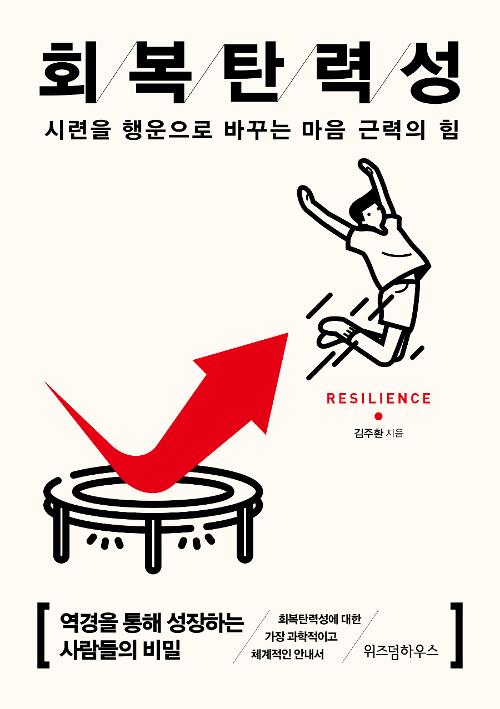
Resilience (150,000 Copies Sold Commemorative Recover Edition) - Recommended by National Library of Korea Librarians in 2011
Author Kim Joo-hwan · Publisher Wisdom House · Publication Date 2019-03-29 · ISBN 9791189938772About the BookThe Secret of People Who Grow Through Adversity: 『RESILIENCE』150,000-copy commemorative re-cover!“Resilience” was a concept first introduced to Korea by Professor Kim Joo-hwan in 2011. However, it has now become a common everyday term, as if it had always been a part of the Korean language....
See full description ↓Description
Author Kim Joo-hwan · Publisher Wisdom House · Publication Date 2019-03-29 · ISBN 9791189938772
About the Book
The Secret of People Who Grow Through Adversity: 『RESILIENCE』
150,000-copy commemorative re-cover!
“Resilience” was a concept first introduced to Korea by Professor Kim Joo-hwan in 2011. However, it has now become a common everyday term, as if it had always been a part of the Korean language. Since the publication of 『Resilience』, dozens of books have been released with “resilience” in their titles.
In 2015, the JoongAng Ilbo reported that 『Resilience』 ranked 2nd in the 'Most Cited Works by Academic Field' in the social sciences category. This means that scholars frequently cited this book when writing academic papers within a short period of four years. It signifies that this book has been recognized by scholars as a valuable academic work, and it has also received much love from readers. This is also evidence that our society desperately needs resilience. Therefore, we have added and refined the text to present a 150,000-copy commemorative re-cover edition.
Resilience is one of the most timely concepts among the research topics in positive psychology. This is because it is the mysterious inner strength that allows humans to overcome misfortune and adversity and rise again like a tumble doll. Positive psychology began with a reflection that psychology had previously focused only on treating pathological psychological states. Professor Martin Seligman, considered the founder of positive psychology, proposed positive psychology, asserting that attention should now also be paid to further elevating and developing normal people.
Interpersonal conflict, mistakes, illness, accidents, divorce, bankruptcy, death…
“What's different about people who overcome despair?”
Professor Kim Joo-hwan, who had long focused on resilience, participated as a key researcher in SBS’s “Unanswered Questions – Seven Secrets of People Who Overcame Despair,” where he met individuals who had faced great trials in life due to unexpected accidents or business failures.
There was Professor Lee Sang-muk of Seoul National University's School of Earth and Environmental Sciences, who became a quadriplegic due to a car accident; Woo Jung-hoon, a top street dancer who became paralyzed from the waist down due to a car accident; and Ryu Chun-min, who ran a successful BBQ restaurant with annual sales exceeding 5 billion won but accumulated 10 billion won in debt due to the IMF crisis and mad cow disease scare… Yet, surprisingly, these individuals did not despair in the face of great life trials but overcame adversity and successfully recovered. How did they overcome such immense challenges in life? What kind of strength did they possess?
Through this broadcast, Professor Kim Joo-hwan introduced the new and astonishing concept of ‘resilience,’ and empirically demonstrated, through brainwave experiments, that people who overcome adversity possess significantly higher and more robust resilience than ordinary people.
After the broadcast, public interest in 'resilience' exploded. The resilience index measurement questions introduced through the broadcast and newspaper articles rapidly spread online, and inquiries about how to increase resilience were constant. However, the 'resilience index questions' introduced at the time were not developed for Koreans. Professor Kim Joo-hwan directly conducted repeated surveys of over 2,000 samples, including middle school students, high school students, university students, and adults over 60, and used rigorous statistical analysis techniques to develop the 53-item 'Korean Resilience Quotient (KRQ-53),' which is included in 『Resilience』.
The main text identifies six elements of resilience and presents concrete methods to cultivate it. Questions to identify 'your unique signature strengths' have also been added. Let's check your personal resilience through the test, plan concrete action steps, and consistently work on them. Professor Kim Joo-hwan’s clear-cut solutions, presented to help ordinary people find positive senses and move towards happiness, will guide you to enhance your resilience.
The most scientific and systematic guide to resilience
“Just as you build muscles through exercise, you can build mental strength through training.”
It’s a well-known saying that when there’s a glass of water half-full, a negative person thinks, ‘There’s only half a glass left,’ while a positive person thinks, ‘There’s still half a glass left.’ However, simply deciding to 'think positively from now on, that there's still half a glass left,' doesn't immediately make one a positive person. It's like seeing a muscular body and deciding you want to have strong abs; it doesn't happen instantly.
To have a muscular body, you need to lose body fat and build muscle. To become a positive person, you need to weaken negative neural pathways in the brain and form habits that strengthen positive ones. Positivity, like a muscle, varies in quantity from person to person, and the amount of load it can withstand for a certain period is also set. Therefore, to build this 'muscle,' you must 'train' with appropriate load, but be careful not to overdo it to avoid 'mental muscle fatigue or injury.'
The human brain is plastic, so it can change with repetitive training, no matter how old one gets. People with habitual positive emotions have a higher baseline level of happiness and increased resilience.
“People with high resilience are lenient towards their own mistakes, and are bold and adventurous. A positive brain is characterized by being sensitive to one's mistakes, yet not fearing them.” (Page 82)
“With this training, anyone can become a happy person!”
A Sure Way to Increase Your Resilience Quotient
Everyone inevitably experiences adversity and difficulties in life. Especially for modern people living fiercely, the power of resilience is desperately needed. Therefore, it is necessary to examine the factors that constitute resilience, and furthermore, to make efforts to learn and implement concrete ways to cultivate resilience.
Just as a person who is physically weak by nature can become healthy through consistent exercise, and a tone-deaf person can learn to sing well through training, resilience can also be improved considerably through consistent effort. Some of the specific training methods introduced in the main text are as follows:
√ Flash a Duchenne smile. The human brain can detect pleasure from its own facial expressions. In other words, smiling really does make you happy. Make a habit of smiling positively. (The Secret of the Duchenne Smile_Page 88)
√ Develop a habit of positive storytelling. Depending on how we interpret adversity and what meaning we give it through storytelling, we can become unhappy or happy. (The Secret of Storytelling_Page 139)
√ Strive to improve your empathy. Empathy can be enhanced through training such as active listening and mirroring facial expressions. (Mirror Neuron System of the Brain_Page 178)
√ Maintain deep and broad human relationships. Strive to enhance positive emotions, as positive emotions are the driving force that strongly makes us feel one with others. (Positive Emotion and Self-Expansion Theory_Page 192)
√ Discover your signature strengths. A truly happy life is one where you find joy, accomplishment, and fulfillment through doing what you excel at. (Why Focus on Strengths_Page 235)
√ ‘Gratitude’ is a good habit for the mind, and ‘exercise’ is a good habit for the body. If you combine gratitude with regular exercise, even the most negative and pessimistic person will definitely experience a positive change in their brain after three months, and their resilience will also increase. (A Sure and Direct Way to Boost Brain Positivity_Page 245)
By checking your resilience with the 53 KRQ questions included in this book, and by planning concrete action steps and consistently working on them, you will undoubtedly feel yourself changing.
Table of Contents
| Prologue | Resilience Comes from Communication Skills and Genuine Happiness
PART 01 Mental Strength, Resilience
What is Resilience?
-The Power to Overcome Adversity
People Who Cope with Adversity
-The Case of Professor Lee Sang-muk of Seoul National University
-SBS Unanswered Questions
-The Case of Aimee Mullins
-The Cases of Patricia Hwei, J.K. Rowling, and Andersen
-The Case of Being Diagnosed with a Terminal Illness
Discovering Resilience
-Professor Daniel Kahneman’s Colonoscopy Experiment
-What Happened on Kauai Island, Hawaii
PART 02 What is My Resilience Quotient?
Development of the Korean Resilience Quotient
-Interest in Resilience
My Resilience Quotient
-
How Do the Brains of People with High and Low Resilience Differ?
-A Positive Attitude Towards Mistakes
How Can I Increase My Brain's Resilience?
-Practicing Imprinting Happiness in the Brain
-The Secret of the Duchenne Smile
PART 03 The First Element of Resilience: Self-Regulation Ability
The Power to Understand Oneself, Self-Regulation Ability
-How to Understand Others Through Oneself
-Howard Gardner’s Experience
-Discovery of the Theory of Multiple Intelligences
-Importance of Intrapersonal Intelligence
Habits That Evoke Positive Emotions
-Candle Problem and Candy
-Effects of Enhancing Positive Emotions
Don't Endure, Enjoy
-Don't Play, Study?
-Autonomy Brings Happiness
Accurately Identify the Causes of Events
-The ABCs of Storytelling
-Humans Are Story-Living Animals
PART 04 The Second Element of Resilience: Interpersonal Skills
A Happier Life Together, Interpersonal Skills
-When You Need a Mental Supporter
Conversation Techniques That Attract Others' Favor
-Communication is a Skill
-Two Dimensions of Communication
-Overcoming Communication Anxiety
-Two Ways to Express Yourself
Understand the Principles of Empathy and Practice Listening
-Mirror Neuron System of the Brain
-Theory of Mind, The Ability to Put Oneself in Others' Shoes
-Gender Differences in Empathy
Maintain Deep and Broad Human Relationships
-Positive Emotion and Self-Expansion Theory
-The Fundamental Nature of Social Relationships
-Professor Gottman’s Divorce Equation and Soap Operas
-The Core of Enhancing Self-Expansion
PART 05 What We Need to Do to Increase Resilience
Transform into a Positive Brain
-Is South Korea Happy?
The Baseline Level of Happiness Must Be Increased
-The Automatic Thermostat of Happiness
-Can the Baseline Level of Happiness Be Improved?
Discover Your Signature Strengths
-Why Focus on Strengths
-Enhancing Resilience Through Performing Signature Strengths
Two Habits for Improving Resilience
-A Sure and Direct Way to Boost Brain Positivity
-The Amazing Power of Gratitude
-Regular Exercise Changes Life
| References |
Product Details
Related products
The book is priced at its original Korean retail price (KRW 1,000 = A$1). Air freight is charged separately at checkout.
Orders close every Tuesday, are sent to Korea on Wednesday, and arrive in store one week after dispatch — 8 to 14 days from your order. Order today and pick up from Wed 28 Oct; we'll email you as soon as your books arrive.
Collect at the book corner in our Lidcombe or Eastwood store. No home delivery. Please have your order number and name ready.
First book A$15 + A$6 per extra book — 1 book $15 · 2 books $21 · 3 books $27 · 4 books $33, calculated automatically at checkout. The more books you order together, the lower the cost per book.
Titles temporarily out of stock in Korea may be delayed by about one week. If a title is out of print or unavailable, we refund that book in full and proceed with the rest of your order.
 Resilience (150,000 Copies Sold Commemorative Recover Edition) - Recommended by National Library of Korea Librarians in 2011
$14.80
Resilience (150,000 Copies Sold Commemorative Recover Edition) - Recommended by National Library of Korea Librarians in 2011
$14.80