
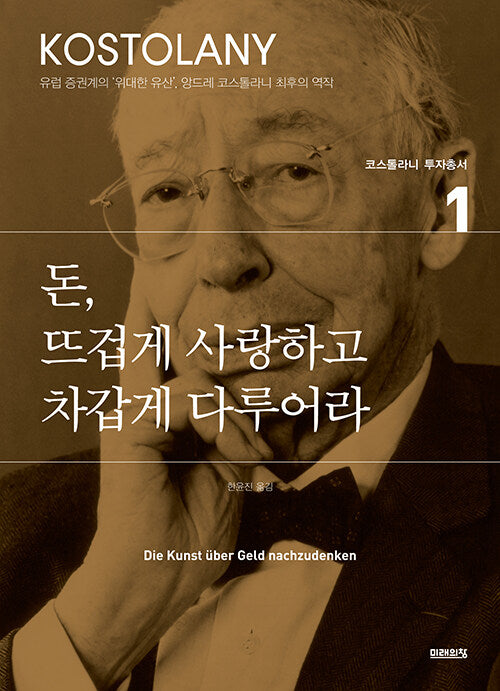
Money, Hot Love and Cold Rationality - Kostolany's Investment Lectures 1
Author André Kostolany · Publisher Mirae N · Published 2023-09-21 · ISBN 9791192519883 About the BookReaders expecting to find secrets to quickly making a lot of money in this book—the culmination of André Kostolany's 80 years in investment, a man who always called himself a "purebred investor" and enjoyed investing as an "intellectual adventure"—might be disappointed. That's because no such...
See full description ↓Description
Author André Kostolany · Publisher Mirae N · Published 2023-09-21 · ISBN 9791192519883
About the Book
Readers expecting to find secrets to quickly making a lot of money in this book—the culmination of André Kostolany's 80 years in investment, a man who always called himself a "purebred investor" and enjoyed investing as an "intellectual adventure"—might be disappointed. That's because no such secrets are revealed anywhere in the book. For such people, Kostolany simply says, "Invest your money in blue-chip stocks. Then take a sleeping pill and sleep soundly for a few years." If everyone followed his advice, what good would a book like this be? Kostolany says that no one heeds such advice because humans are inherently "playing animals." He, too, enjoyed this "game."
However, he never forgot the four virtues of an investor he spoke of: money, ideas, patience, and luck. His principles can be summarized as never investing with borrowed money, taking time to think, and having the patience to believe in and stick to one's decisions. And finally, luck must follow.
The original title of this book is 'The Art of Thinking About Money (Die Kunst ueber Geld nachzudenken).' As the title suggests, this book illuminates money from various angles. World historical events related to money, people who pursued wealth and acquired it or failed, and above all, his numerous experiences throughout his investment life are depicted in Kostolany's unique humorous style.
Amusing anecdotes about investment, the nature of the stock market, and basic investment principles are written in easy-to-understand language and style, making it accessible even to those who have never invested before. As proof, high school students in Germany enjoy reading this book to understand economics, finance, and investment. Kostolany's wit and humor, his rich life experiences, his leisurely demeanor, wisdom, and above all, his fluent writing style, make it feel less like an investment guide and more like a collection of exquisite essays.
From the Book
In my experience, there are three ways to become a millionaire in a short period: 1. Marrying rich. 2. A promising business item and idea. 3. Investment. While inheriting an estate or winning the lottery can quickly make one a millionaire, I exclude them because they are beyond one's control, unlike the three methods mentioned earlier. Countless women and men become millionaires through marriage. I have witnessed countless such cases. Bill Gates, more than anyone, comes to mind as someone who became wealthy with a promising business idea that brought luck. With a single business idea and accurate intuition, he became the richest man in America in his 30s. Or consider Sam Walton of Walmart or the founder of McDonald's. Ernő Rubik, a brilliant Hungarian engineer, became the first millionaire in the Eastern Bloc with the magic cube he invented 20 years ago. But a brilliant idea alone is not enough. That inventive spirit must be combined with business acumen. For example, the pharmacist who developed the Coca-Cola formula sold the secret recipe for a pittance of a few dollars to the brand that is now world-famous. I have nothing more to say about how to build wealth with witty and clever business ideas. Because my expertise has always been the third and final method: investment.
--- p.32~33, from "The Allure of Money"
People unfamiliar with stocks often describe the stock market as an economic thermometer, but that's not actually true. The stock market doesn't show the current situation nor the future economic trends. To prove this, one doesn't even need to delve into ancient history; looking at the past five years is enough. When Germany's unemployment rate was high despite enormous economic growth, the German stock market grew by as much as three times. And this is precisely what Oskar Lafontaine loudly criticized during the last federal election campaign. However, he understands neither economics nor the stock market at all. In contrast, in the United States, the economy grew during full employment, and the stock market also boomed. But there were also cases where the economy was at its peak, but the stock market was stagnant. The economy and the stock market do not always grow in parallel. That doesn't mean there's no interaction between them. I'll explain it more easily with an example from a story I thought of years ago. A man walks his dog. As dogs usually do, his dog runs ahead of its owner and then returns to him. Then it runs ahead again, realizes it has strayed too far from its owner, and returns again. This behavior repeats throughout the walk, and finally, they both reach the same destination. But while the owner slowly walked one kilometer, the dog, running around, walked four kilometers. Here, the owner is the economy, and the dog is the stock market. Looking at the development process of the US economy during the severe Great Depression from 1930 to 1933, one can see how accurate this example is. The economy develops continuously but also stops one or two steps, and sometimes even retreats. But the stock market fluctuates up and down more than 100 times during the same period.
--- p.110~111, from "The Stock Exchange - The Nervous System of the Market Economy"
No matter which restaurant I go to, I never order the menu recommended by the waiter. That's because such dishes are usually ones the restaurant wants to sell quickly. The same goes for 90 percent of the stock recommendations and investment advice given by brokerage firms. Truly good advice that's worth considering is extremely rare. In most cases, it's just a scheme or promotion by banks or syndicates to offload their shares onto people. They dress this up as rosy analysis and spread it by word of mouth through the media. And they subtly manipulate the news in their desired direction, controlling stock prices. Then, even stocks that have already risen significantly are easy to sell to the public. Driven by this kind of buying spree, stock prices soar. After the herd investors buy all the stocks, at some point, it will become clear that the rosy analysis was nothing more than hot air, and they will be unable to avoid bankruptcy.
--- p.252, from "The Information Jungle"
Table of Contents
Foreword 4
The Allure of Money
Money and Morality 19 | Money: The Measure of Value in the Free World 22 | How Much Money Does It Take to Become a Millionaire? 26 | The Right Attitude Towards Money 28 | Becoming a Millionaire Quickly 32 | Investing is an Art, Not a Science 33 | I am a Stock Investor and Always Will Be 34
The Stock Zoo
Speculation: As Old as Humanity! 39 | To Invest or Not to Invest? 44 | Brokers: Those Who Only Care About Transactions 47 | Money Managers: Masters of a Million Dollars 48 | Financiers: The Big Hands of the Market 49 | Arbitrage: An Already Extinct Trade 50 | Short-Term Investors: Gamblers of the Stock Market 52 | Long-Term Investors: Marathoners of the Stock Market 57 | Purebred Investors: Long-Term Strategists 60
What to Invest In?
Questions of Opportunity and Risk 67 | Bonds: A Much More Important Investment Than Commonly Thought 68 | Foreign Exchange: Much More Interesting in the Past Than Now 74 | Commodities: Speculators vs. Speculators 84 | Valuables: Collector or Investor? 89 | Real Estate: For Investors with Abundant Capital 91 | Stocks: The True Object of Investment Itself 94
The Stock Exchange – The Nervous System of the Market Economy
Birth Time 96 | The Nervous System of Capitalism 104 | A Meeting Place for Securities Professionals 107 | A Mirror of World History 109 | Economic Thermometer? 110
What Moves Stock Prices
The Logic of the Stock Market 112 | The Principle of Supply and Demand 114
Long-Term Influencing Factors
Minor or Major? 116 | Peace is Most Important in the World 117 | Economic Development from a Long-Term Perspective 119
Medium-Term Influencing Factors
Money + Psychology = Trend 130 | Business Cycles: Not So Important in the Medium Term 134 | Inflation: Fighting Against It Is Only Harmful 137 | Deflation: The Biggest Disaster for the Stock Market 140 | Central Banks: Dictators of Interest Rates 141 | Bonds: Competitors to Stocks 148 | Foreign Currency: What Can Be Done With Dollars? 151 | Mass Psychology 153
Stock Market Psychology
Are You a Herd Follower or an Independent Thinker? 156 | Money 157 | Thought 160 | Patience 165 | Luck 167 | Kostolany's Egg 169 | Booms and Crashes: An Inseparable Pair 190 | The 17th Century Tulip Mania 191 | The Math Genius Who Broke France's Neck 196 | The Nature of the 1929 Stock Market Crash 200 | The Successful Strategy Is to Do the "Opposite of the Current Economic Cycle" 211 | It's a Matter of Clear Conviction 217 | Are You a Bull or a Bear Investor? 220
The Information Jungle
Information: The Investor's Tool 238 | The Fait Accompli Phenomenon 240 | Information Society 250 | Investment Advice, Recommendations, and Rumors 252 | Stock Market Giants: From Jewish Rabbis to Mathematicians 254 | Inside Information 263
How to Choose Stocks
From the Stock Market to Stock Trading! 267 | Growth Industries: Opportunity to Get Rich 268 | Fair Stock Price 271 | Turnaround Stocks: Phoenix Rising from the Ashes 272 | Meaningless Expressions Used by Stock Analysts 274 | Charts: Profits Can Be Gained, Losses Cannot Be Avoided 276
Money Managers
Investing Others' Money 282 | Investment Funds: Buses for Many Long-Term Investors 284 | Hedge Funds: A Scam by Name Alone 286 | Investment Consultants: Their Joy Is the Client's Pain 290 | Asset Managers: The Tailors Among Money Managers 292
For Those Willing to Take Risks
Losses Are Part of the Risk 293 | Not a Matter of Time 295 | Fame Comes at a Price 296 | Stocks and Love, and Love for Stocks 299 | 10 Recommendations 310 | 10 Prohibitions 311
Product Details
Related products



The book is priced at its original Korean retail price (KRW 1,000 = A$1). Air freight is charged separately at checkout.
Orders close every Tuesday, are sent to Korea on Wednesday, and arrive in store one week after dispatch — 8 to 14 days from your order. Order today and pick up from Wed 28 Oct; we'll email you as soon as your books arrive.
Collect at the book corner in our Lidcombe or Eastwood store. No home delivery. Please have your order number and name ready.
First book A$15 + A$6 per extra book — 1 book $15 · 2 books $21 · 3 books $27 · 4 books $33, calculated automatically at checkout. The more books you order together, the lower the cost per book.
Titles temporarily out of stock in Korea may be delayed by about one week. If a title is out of print or unavailable, we refund that book in full and proceed with the rest of your order.
 Money, Hot Love and Cold Rationality - Kostolany's Investment Lectures 1
$16.20
Money, Hot Love and Cold Rationality - Kostolany's Investment Lectures 1
$16.20