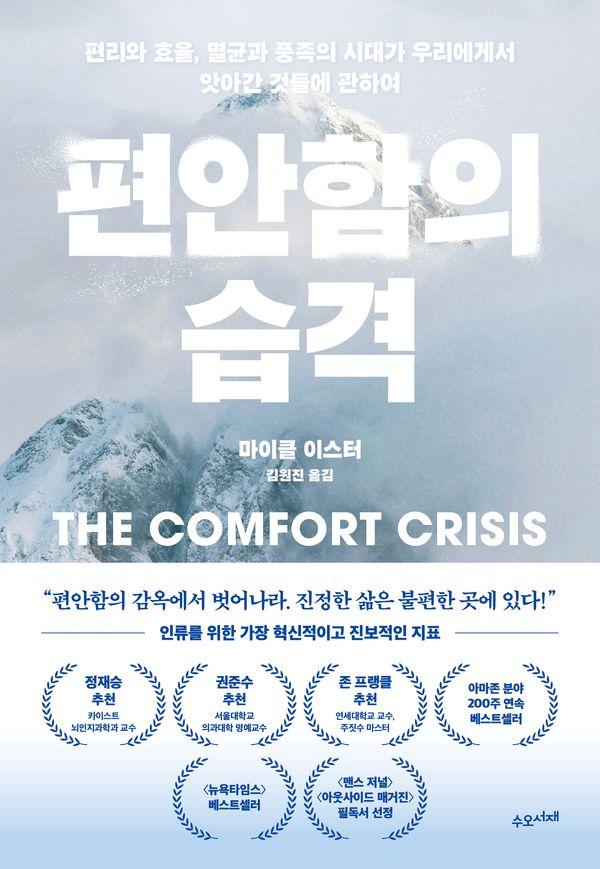
The Onslaught of Comfort: What the Era of Convenience, Efficiency, Sterility, and Abundance Has Taken From Us
Author Michael Easter · Publisher Suo Books · Publication Date 2025-06-24 · ISBN 9791193238691 About the Book"What have you lost for the sake of comfort?"Unveiling the true nature of the comfort that engulfs humanity!★ Strongly recommended by Jae-seung Jeong (KAIST Professor), Jun-soo Kwon (Seoul National University Emeritus Professor), and John Frankl (Yonsei University Professor)!★ A New York Times Bestseller, selected...
See full description ↓Description
Author Michael Easter · Publisher Suo Books · Publication Date 2025-06-24 · ISBN 9791193238691
About the Book
"What have you lost for the sake of comfort?"
Unveiling the true nature of the comfort that engulfs humanity!
★ Strongly recommended by Jae-seung Jeong (KAIST Professor), Jun-soo Kwon (Seoul National University Emeritus Professor), and John Frankl (Yonsei University Professor)!
★ A New York Times Bestseller, selected as a must-read by Men's Journal and Outside Magazine
★ An Amazon bestseller in its category for 200 consecutive weeks, published in 13 countries worldwide!
Today, we live in a more comfortable environment than ever before. All indoor spaces have perfect temperature control, there's an abundance of food readily available, advances in modern medicine have extended life expectancy, and there are no significant challenges that threaten survival. But has comfort truly brought health and a happy life?
Michael Easter, a behavioral change expert and health journalist, has explored the modern human's health, happiness, and meaningful life by adventuring through places like the Alaskan Arctic, Bhutan, war zones, and the Bolivian jungle. He has also interviewed thousands of experts, including leading scholars in various fields, professional athletes, and religious and environmental leaders. Seeking scientific strategies that are practically helpful for optimizing life, he found the answer in "discomfort," a sense that humanity has lost.
This book boldly challenges the prevailing modern narrative that "comfort leads to happiness and fulfillment." It explores the evolutionary utility of discomfort, a sense lost by humanity, and deeply analyzes how contemporary issues such as addiction, depression, anxiety, suicide, obesity, loneliness syndrome, burnout, and loss of meaning in life are connected to comfort.
Our Brain's Evolutionary Mechanism
How Comfort Consumes Life
Here are stairs and an escalator. Which would you use? Experimental results show that only 2 percent of people use the stairs. There was a time when stairs boasted marvelous efficiency. But why bother taking the stairs when escalators exist?
Humans have evolved to seek comfort because it aids survival. Relative comparison is also an evolutionary mechanism of the brain. Instead of remembering every situation, relative comparison conserves brain energy, allowing for quicker and safer decisions and solutions.
Let's apply this to comfort. When a new comfort emerges, people no longer tolerate previous comforts. In other words, the goalpost of comfort shifts backward, making today's comfort tomorrow's discomfort. David Revere, a professor of psychology at Harvard University, warns that all of this happens unconsciously. Comfort, creeping in like a thief, endlessly consumes our lives.
Smartphones, cars, computers, junk food, TVs, drugs, air conditioning, and heating—the epitome of a comfortable and affluent life—seem to eliminate boredom, pain, stress, and inconvenience, but in reality, they plunge us deeper into the swamp of comfort. Who would have ever guessed that a comfortable life could be a problem? Comfort now threatens not only health but also vitality and the meaning of life.
"How did we become humans with the
most pathetic health in history?"
Humanity's Lost Movement and Stolen Time
We hardly move anymore. Only about 20 percent of Americans follow the government's recommended exercise guidelines. 27 percent of adults do not engage in any physical activity that could be called exercise. As a result, a staggering 70 percent of adults are overweight. In Korea, according to the Korean Society for the Study of Obesity, the prevalence of obesity is 46.2 percent for men and 27.3 percent for women, and these figures are rapidly increasing every year.
Today, humans spend an average of 11 hours and 6 minutes per day on digital devices. With the advent of smartphones, boredom has been declared completely dead. In a society overflowing with stimuli, smartphone addiction and stress levels are intimately intertwined and increasing. By having our time for leisurely mind-wandering stolen, humanity is not just losing creativity and mental health. We also miss out on the 'beauty of life' whose existence is only revealed when we perceive quietude. If we do not consciously embrace discomfort—that is, if we do not actively push back against comfort increasingly infiltrating our lives—we will become progressively weaker, pickier, and sicker.
"Reviving the Value of Ancient Discomfort"
A Record of Change Finally Freed from Addiction and
A Journey to Recover a Humane Life
"The journey proposed in this book lies at the 'extreme end' of the 'prescriptions' that researchers in various fields recommend we incorporate into our lives. It is a return to the wild, and partly a re-framing of mindset. And its benefits are immeasurable and all-encompassing." _ From the text
Michael Easter was a health journalist struggling with alcoholism. To break free from his self-destructive and contradictory life patterns, he embarked on a grand journey to understand why "uncomfortable challenges" are evolutionarily necessary for humans.
He learned the secrets of training methods for tackling physically demanding tasks from the NBA's top exercise physiologist, and gained insights into the impermanence of life, death, and happiness by meeting a religious leader in Bhutan. In a young neuroscientist's lab, he confirmed how nature expands human creativity and heals overload and anxiety. Spending actual time in nature away from urban environments, he deeply contemplated the importance of connecting with nature, the health problems caused by lack of physical activity, research findings that hunger is not merely a state of deprivation but rather a survival mechanism that makes the body function healthier and stronger, the benefits of exercise and what kind of exercise is most suitable, and the modern human's life where digital connectivity has increased but meaningful connections have decreased.
Furthermore, to personally experience extreme discomfort, the author embarked on a 33-day caribou hunt in the Alaskan wilderness. In a place where land has never been trodden by humans, in the last remaining wild place on Earth, he personally experienced the "return to the wild" through bone-chilling cold, hardship, hunger, dirt, quietude, and boredom. Based on this experience, he vividly conveys the utility of discomfort to his readers. Along with exciting and exotic hunting stories, a vast amount of data and research accumulated by experts worldwide unfolds at a rapid pace across the pages.
The author confesses that his journey was "a process of exploring the factors that make humans live longer, and paradoxically, I was learning how to live an easier life," calling "The Comfort Crisis" a record of change.
"Facing discomfort, choosing discomfort, and sometimes even intentionally finding ways to be a little more uncomfortable. That is the essential wisdom we need to live without losing our innate human energy and vitality amidst the onslaught of all kinds of comforts." _ From John Frankl's recommendation
Throughout this journey, Easter asks fundamental questions about health and happiness, and encourages embracing a bit of discomfort and challenge in daily life to re-understand the essence of human existence. Rather than complete comfort, appropriate stress and challenges actually make us stronger, happier, and healthier. This book reminds us that true fulfillment in life lies outside the fences of comfort, strongly urging us to stimulate dulled thinking, motivate ourselves, and discover the wildness hidden within.
If you feel the need for change in a fleeting life, or if you are startled by yourself escaping to your smartphone every time boredom strikes, or if you are tired of a modern society saturated with technology, and therefore, if you are someone who wants to challenge yourself and find a deeper purpose, this book will open up new perspectives on life and bring about amazing transformations in your life.
Table of Contents
Part 1. It Has to Be Very Hard, But Not Deadly
33 Days | The Start of an Alaskan Caribou Hunt
35, 55, or 75 | Leaving the World of Comfort
0.004 Percent | Instinctive and Evolutionary Laziness
800 Faces | Humanity Consumed by Comfort
18 Meters | Returning to a Part of Nature
50-50 | Hardship That Doesn't Kill Makes Humans Stronger
50, 70, or 90 | Preparing to Come Back Alive
150 People | An Interesting Study on the Misfortune of City Dwellers
163 Kilometers | The Correlation Between Solitude and Health
110 Kilometers Per Hour | First Day in the Arctic
Part 2. Enjoy Boredom
11 Hours 6 Minutes | Time Lost to Digital Devices
20 Minutes, 5 Hours, 3 Days | Nature is a Natural Tranquilizer
Twelve Places | The Stress-Relieving Effect of Quietude
Part 3. Feel Hunger
-4,000 Calories | The Rediscovery of Hunger
12-16 Hours | Hunger Makes Us Healthier
Part 4. Think of Death Daily
Three Intact Legs | Caribou Hunt
December 31st, 23:59:33 | Bhutan's Culture of Death Contemplation
20 Minutes 11 Seconds | Facing Death
Part 5. Carry the Load
45 Kilograms | The Weakest Humanity in History
23 Kilograms | Awaken the Carrying Instinct
80 Percent | Imprisoned Humans
Epilogue
81.2 Years | Severe Discomfort Extends Life Expectancy
Acknowledgements
Product Details
Related products
The book is priced at its original Korean retail price (KRW 1,000 = A$1). Air freight is charged separately at checkout.
Orders close every Tuesday, are sent to Korea on Wednesday, and arrive in store one week after dispatch — 8 to 14 days from your order. Order today and pick up from Wed 28 Oct; we'll email you as soon as your books arrive.
Collect at the book corner in our Lidcombe or Eastwood store. No home delivery. Please have your order number and name ready.
First book A$15 + A$6 per extra book — 1 book $15 · 2 books $21 · 3 books $27 · 4 books $33, calculated automatically at checkout. The more books you order together, the lower the cost per book.
Titles temporarily out of stock in Korea may be delayed by about one week. If a title is out of print or unavailable, we refund that book in full and proceed with the rest of your order.
 The Onslaught of Comfort: What the Era of Convenience, Efficiency, Sterility, and Abundance Has Taken From Us
$22.00
The Onslaught of Comfort: What the Era of Convenience, Efficiency, Sterility, and Abundance Has Taken From Us
$22.00