
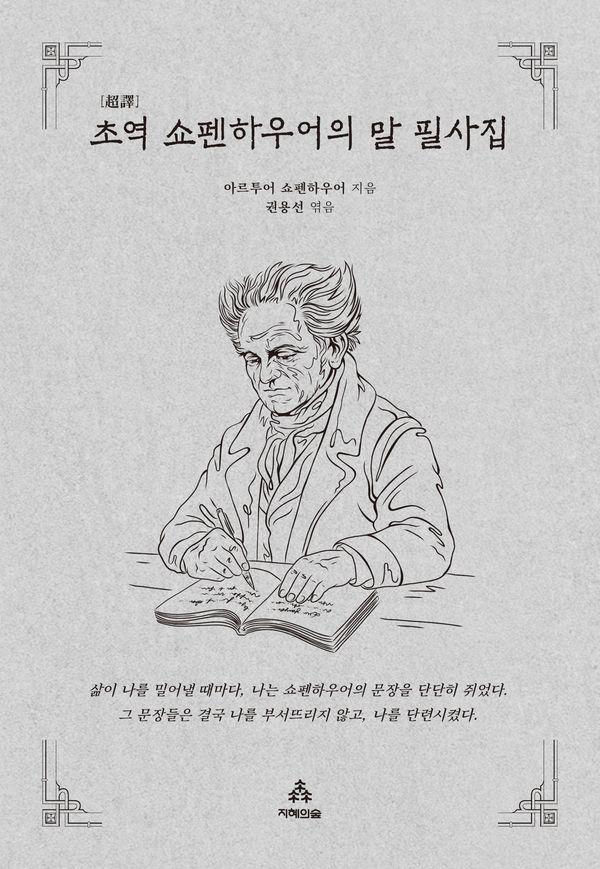
Schopenhauer's Words: A Transcription Collection, Translated
Author Arthur Schopenhauer · Publisher Forest of Wisdom · Publication Date 2025-08-21 · ISBN 9791193282359 About the BookIf you don't write Schopenhauer yourself,don't claim to know Schopenhauer.『Cho-yeok Schopenhauer's Words』, which received fervent attention from readers upon its publication, has been re-released with a revised format as 『Cho-yeok Schopenhauer's Words: A Collection for Transcription』. It is designed to allow readers of...
See full description ↓Description
Author Arthur Schopenhauer · Publisher Forest of Wisdom · Publication Date 2025-08-21 · ISBN 9791193282359
About the Book
If you don't write Schopenhauer yourself,
don't claim to know Schopenhauer.
『Cho-yeok Schopenhauer's Words』, which received fervent attention from readers upon its publication, has been re-released with a revised format as 『Cho-yeok Schopenhauer's Words: A Collection for Transcription』. It is designed to allow readers of 『Cho-yeok Schopenhauer's Words』 to think and feel more deeply by directly transcribing his sentences, thus enabling them to traverse and penetrate Schopenhauer's philosophy.
Sentences that might be lightly skimmed when read take on a completely different weight when written by hand. Schopenhauer does not shy away from the pain of life. He does not sugarcoat reality with superficial hope. His sentences, which confront the essence of human existence in its raw form, fully embody the philosopher's character and attitude. They are brief yet sharp, cynical yet profound.
As readers directly transcribe Schopenhauer's sentences, they gradually delve deep into his thoughts. Words and sentences that might have seemed merely cynical and sharp now hit them with full force. Within these lies an unspeakable great pain, and Schopenhauer's attitude of never turning away from that pain. Transcribing his sentences is not mere repetition; it is a way to endure the pain of my own life that I, like Schopenhauer, will face, and a process of realizing my own life.
The experience of directly inscribing Schopenhauer's words,
which were truer than anyone else's, into one's heart.
This book selects key sentences from his major works, including 『The World as Will and Representation』, 『Parerga and Paralipomena』, 『On the Will in Nature』, and 『On the Basis of Morality』, and compiles them into a single volume.
The condensed content is reorganized into 180 passages across seven themes for all of us who must live life at least once: 'Pain and Pleasure,' 'Aging and Death,' 'Self and Others,' 'Habit and Success,' 'Selfishness and Morality,' 'Truth and Art,' and 'Debate and Rhetoric.'
His philosophical insight that life is suffering is placed first, allowing for an expansion from this realization into other areas of life. It encourages reflection on all aspects of life—aging, relationships, success, morality, truth—to ponder 'how one should live' and 'what constitutes a good life.' Schopenhauer's sentences are placed exactly where they are needed, in the most appropriate spots.
To hear the philosopher's voice directly, transcribe it, and engrave it in one's heart. After confronting the essence of what Schopenhauer speaks, no prior comfort or advice will be needed.
Schopenhauer: blunt and sharp,
yet precisely because of his sharpness, surprisingly warm.
We often pretend not to know. We say things will get better when they won't, and that things are okay when they aren't. We pretend to be fooled even when we know it's a lie and a pretense, and we pretend not to see wrongdoings even when we know them.
'Turning a blind eye' isn't necessarily bad, because the truth is almost always painful. Humans live by clinging to sweet lies to avoid suffering. Emotional essays and even self-help books preaching positivity ultimately stem from such psychology.
However, Schopenhauer is different. Called the 'philosopher of pain,' he does not lie and does not turn away from suffering. He offers not a single line of comfort. He asserts that humans are bound to suffer as long as they live, even stating, "Life is mercifully short." Thus, his sentences are firm, direct, and at times, harsh.
Yet, precisely because of such sentences, they are all the more truthful. His perception of pain, which spared not even himself, is vividly conveyed beyond the words. In its presence, we ironically feel a deeper comfort.
Transforming Schopenhauer's thoughts into my own.
The editor of this book says:
"If you can willingly endure the discomfort that Schopenhauer's honesty brings, I believe you will gain true solace and courage to affirm life within it."
As you write each sentence, Schopenhauer's philosophy becomes your own thought. 『Cho-yeok Schopenhauer's Words: A Collection for Transcription』 is the one philosophy book recommended for readers seeking true contemplation and reflection. It will be the first step to embracing 'life as it is,' beyond the fatigue of overflowing emotional essays and self-help books.
Contents
Introduction
Chapter 1: Pain and Pleasure
001 Don't waste the present
002 Don't buy pleasure with pain
003 A life without pain is a happy life
004 Giving up is an act of denying the world order
005 Trapped in the past means no tomorrow
006 Pain diminishes with time
007 Everything changes
008 Face misfortune calmly
009 When it's hard, go outside and get some light
010 When life shakes, stand before grand nature
011 Don't ignore my subtle signals
012 There is no end to suffering
013 Everyone is a slave to time
014 Humans are merely components of this world
015 Everyone is a tragic hero and a comedic clown
016 An empty life leads to superstition
017 Life is mercifully short
018 The end of vanity is only despair
019 This world uses and discards you
020 The reason you can never be eternally happy
021 Fear good fortune
022 Lose it in advance
023 A person without desires is free
Chapter 2: Aging and Death
024 Life is a continuous escape from death
025 What is seen in childhood lasts a lifetime
026 Misfortune does not specially love only you
027 Boredom is the privilege of youth
028 How to waste youth
029 Youth does not know itself
030 Don't complain
031 No life blooms by chance
032 Youth is fervent, middle age ripens, old age is serene
033 No expectations, no worries
034 There is no special happiness
035 Let the body age, but not the mind
036 Sparkle fades but changes form
037 Don't flaunt your age
038 What is gained only at the end of life
039 Death is not an end, but a return
040 Life begins with love and is completed by death
041 Death is another way of life
042 No eternal stage, no eternal mask
Chapter 3: Self and Others
043 Don't waste your life on others
044 The moment you lower your standards, you fall
045 Kindness turns into weakness
046 Friendship with a dog is real friendship
047 Humans await others' misfortunes
048 Intellectual superiority creates enemies
049 Misfortune exchanges friends for enemies
050 'Good character' is the worst insult
051 Respond to rude questions with lies
052 Information is a weakness
053 Talking to oneself reveals everything
054 Think of it as a comedy
055 Don't forget others' flaws
056 Don't miss the moment the mask comes off
057 A person who cannot cry is dangerous
058 How one treats animals reveals one's true nature
059 Look again at those who turn away from people in need
060 Habits show a person's caliber
061 You can tell character by body type
062 Children have no obligations to parents
063 Humans can never be reformed
Chapter 4: Habit and Success
064 Act right now
065 A diary is a teacher
066 One who cannot look in a mirror is ugly
067 Be yourself, not someone else
068 Daily exercise leads to early death
069 Muscles thrive under pressure, but nerves die
070 Less sleep means a shorter life
071 Effort cannot conquer fate
072 Sometimes, waiting is better
073 Life is war
074 Once you have money, don't let go
075 Don't mock your past self
076 What is proper regret?
077 Tap into desire
078 Seize everyday warnings
079 Character is innate
080 Humans live two lives
081 If you don't know yourself, life is futile
082 Don't imitate
Chapter 5: Selfishness and Morality
083 One person can destroy the whole world
084 Selfishness comes with a price
085 Wrongful intrusion on others is like murder
086 Possession is effort
087 Exaggeration is also a lie
088 Lying is worse than violence
089 Lies destroy society
090 Self-defense
091 Lies for lies
092 The law is cold
093 The misconception that law is morality
094 Law cannot change humans
095 Law is the minimum standard
096 Punishment protects the future
097 Public opinion is cruel but accurate
098 The revenge of the righteous is humanity's last conscience
099 The wicked look different
100 The path to wickedness is easy
101 Lectures or sermons cannot change people
102 Do not do good deeds expecting anything in return
103 Don't differentiate between yourself and others
104 If you inherit wealth, don't forget society
105 Consideration for others and true morality
106 A selfish person is anxious every moment
107 Love that cannot sacrifice is merely selfishness
108 True ethics can be known without learning
109 Etiquette is hypocrisy, but necessary
110 Jealousy sickens society
111 Egoists erode morality
112 The wicked are pure
113 Right and wrong cannot be measured
114 Traitors should not be forgiven
115 Good deeds can sometimes be a sword
116 Don't confuse good deeds with transactions
117 Things to remember when pessimism beckons
118 Religion is weak
119 Happiness tips for the naturally wealthy
120 People who appear when others suffer
121 False conscience
Chapter 6: Truth and Art
122 Truth prevails
123 Knowledge does not disappear
124 Jokes are the most intellectual sword revealing human flaws
125 Plagiarism is more malicious than simple theft
126 The hypocrisy and opportunism of a philosopher are the most disgusting betrayal
127 Be judged by essence, not illusion
128 Logic and reason are not everything
129 Don't pretend to be the lord of all creation
130 Nature cannot be defeated
131 Not even a single day of life is mine
132 Reason obstructs intuition
133 Reason analyzes life, but art makes one feel life
134 Without knowing art, one is not qualified as human
135 Great works are always uncomfortable
136 Geniuses are not engrossed in themselves
137 True freedom is found only in nature
138 Geniuses know no satisfaction
139 Without understanding metaphors, you cannot understand the world
140 Ordinary people and geniuses have different eyes
141 Truth is a weapon, error is a trap
Chapter 7: Debate and Rhetoric
142 The more important the words, the colder they should be delivered
143 Artfully inflate the point
144 Changing just one word wins the debate
145 Extend the opponent's argument to all situations
146 Hide the conclusion and scatter only the premises
147 Build truth upon the opponent's lies
148 Don't prove the conclusion, hide it in the premise
149 If you want to win, ask questions
150 If you want to win, make the opponent angry
151 The more confusing the questions, the better
152 If the opponent only opposes, ask the opposite
153 Package specific cases as general truths
154 Whoever controls the language dominates the debate
155 Corner the opponent with extreme choices
156 The loudest voice wins the debate
157 Confuse the opponent with unfamiliar and bizarre propositions
158 If losing in logic, attack the opponent
159 Win by interpretation, not meaning
160 If defeat is imminent, collapse the entire framework
161 If losing on the point, escape with a larger question
162 Don't ask for the conclusion, announce it
163 When countering sophistry, abandon dignity
164 Demand proof
165 Pour oil on a raging debate
166 Twist the argument
167 A mad dog has no enemies
168 One strong counter-example is enough
169 Give back as received
170 Pierce the emotional weak point
171 The audience's laughter is cruel
172 Buy time
173 Authority is the greatest deception
174 Admit my foolishness
175 Cast the shadow of disgust
176 Hold reality hostage
177 Never miss the opponent's silence
178 Stimulate the audience's vested interests
179 Overwhelm the opponent with abstruseness
180 If one piece of evidence crumbles, the whole collapses
Product Details
Related products
The book is priced at its original Korean retail price (KRW 1,000 = A$1). Air freight is charged separately at checkout.
Orders close every Tuesday, are sent to Korea on Wednesday, and arrive in store one week after dispatch — 8 to 14 days from your order. Order today and pick up from Wed 4 Nov; we'll email you as soon as your books arrive.
Collect at the book corner in our Lidcombe or Eastwood store. No home delivery. Please have your order number and name ready.
First book A$15 + A$6 per extra book — 1 book $15 · 2 books $21 · 3 books $27 · 4 books $33, calculated automatically at checkout. The more books you order together, the lower the cost per book.
Titles temporarily out of stock in Korea may be delayed by about one week. If a title is out of print or unavailable, we refund that book in full and proceed with the rest of your order.
 Schopenhauer's Words: A Transcription Collection, Translated
$22.00
Schopenhauer's Words: A Transcription Collection, Translated
$22.00