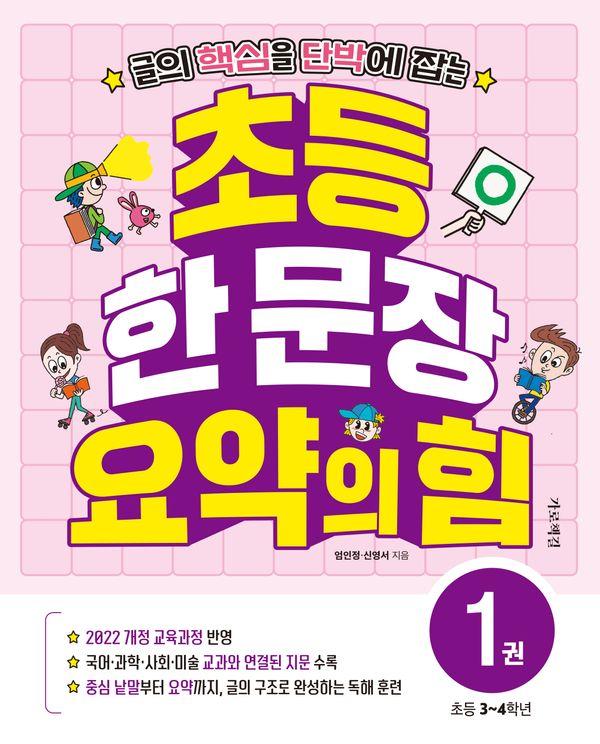
The Power of One-Sentence Summaries for Elementary Schoolers to Immediately Grasp the Core of a Text 1 For Grades 3-4
Authors Eom In-jeong, Shin Young-seo · Publisher Garochekgil · Published 2026-07-30 · ISBN 9791193419106About the BookSummarization is the foundation of all learning.To read Korean, social studies, and science texts well, one must first understand what the text is about. Then, one needs to select the essential information from each paragraph, reduce detailed examples, and retain only the core points. This...
See full description ↓Description
Authors Eom In-jeong, Shin Young-seo · Publisher Garochekgil · Published 2026-07-30 · ISBN 9791193419106
About the Book
Summarization is the foundation of all learning.
To read Korean, social studies, and science texts well, one must first understand what the text is about. Then, one needs to select the essential information from each paragraph, reduce detailed examples, and retain only the core points. This book is structured to teach the basic principles of summarization through a 5-step summarization training method in "Building Basic Concepts": finding the central word → finding the central idea → finding the central sentence → finding the main point → summarizing. Unfamiliar concepts are explained with easy explanations and example texts, making it easy for children to learn the principles of summarization without feeling overwhelmed. This helps them move away from the habit of superficial reading and develop a reading attitude that involves observing the flow of the text and identifying important information.
Reflecting the 2022 revised curriculum, read and organize textbook texts in 5 stages.
In "Practicing Concepts," students read texts linked to elementary school subjects, reflecting the 2022 revised curriculum, and repeat a 5-step learning process: finding the central idea → confirming content → condensing content → summarizing in one sentence → structuring and organizing. The book is based on topics children encounter in school, such as natural and human environments, migratory birds, water scarcity, democracy, artificial intelligence, cultural heritage, earthquakes, presentations, and letter writing, thereby enhancing their comprehension of these subjects. Using tables and blanks, students organize central words and main points by paragraph, and finally summarize the entire text in one sentence. Following this process, children will not be afraid to read long texts and will gain the ability to explain what they have read in their own words.
Literacy ultimately grows from the power of organization.
Children with good literacy do not just read a lot. They differentiate between important and less important information, grasp the flow of the text, and express the core ideas in their own language. "The Power of One-Sentence Summarization for Elementary School" is a book that fosters precisely this ability. It is designed to build children's reading confidence by starting with short texts, expanding to curriculum-linked texts aligned with the 2022 revised curriculum, and progressing from summarizing main points by paragraph to one-sentence summarization. It is a reliable literacy training book that helps children who merely follow words grow into children who can find the core, organize their thoughts, and express them in their own words.
* Certification Type: Supplier Conformity Confirmation
Table of Contents
· Author's Note
· Structure and Utilization
[Building Basic Concepts]
· Finding the Central Word - Our Traditional Clothing, Hanbok (Elementary Social Studies 3-2_Life in the Past and Present)
· Finding the Central Idea - Precious Things the Little Prince Taught Us (Elementary Korean 4-1_Reading While Asking Questions)
· Finding the Central Sentence - Protecting the Environment Through Recycling (Elementary Korean 3-1_Finding Important Content/Elementary Science 4-2_Organisms and Environment)
· Finding the Main Point - The Earth's Breath, Amazon (Elementary Science 4-2_Organisms and Environment/Elementary Science 4-2_Climate Change and Our Lives)
· Summarizing - Crisp and Healthy Vegetable, Paprika (Elementary Korean 3-1_Finding Important Content)
[Practicing Concepts]
[Week 1]
Day 1: 01 Preventing Diseases by Washing Hands (Elementary Science 3-2_Infectious Diseases and Healthy Living)
Day 2: 02 Shall We Learn About How Kimchi is Made? (Elementary Korean 3-1_Finding Important Content)
Day 3: 03 Shall We Learn About How Bees Make Honey? (Elementary Korean 3-1_Finding Important Content)
Day 4: 04 Shall We Learn About Food and Food Poisoning? (Elementary Science 3-2_Infectious Diseases and Healthy Living)
Day 5: 05 What Are the Similarities and Differences Between Turtles and Snapping Turtles? (Elementary Science 3-1_Animal Life)
Day 6: 06 Why Do Migratory Birds Move Seasonally? (Elementary Science 3-1_Animal Life)
Day 7: 07 Development of Transportation and Changes in Lifestyle (Elementary Social Studies 3-2_Life in the Past and Present)
[Week 2]
Day 1: 08 Transportation in the Past and Present, What Has Changed? (Elementary Social Studies 3-2_Life in the Past and Present)
Day 2: 09 How to Write a Book Review? (Elementary Korean 3-1_Introducing Books I've Read/Elementary Korean 4-2_Reading While Sharing Thoughts)
Day 3: 10 King Sejong, the King Who Loved His People (Elementary Korean 3-1_Introducing Books I've Read/Elementary Korean 4-2_Reading While Sharing Thoughts)
Day 4: 11 Why Should We Preserve Mudflats? (Elementary Science 3-2_Earth and Sea/Elementary Science 4-2_Organisms and Environment)
Day 5: 12 Why Do Tides Occur? (Elementary Science 3-2_Earth and Sea/Elementary Science 4-2_Organisms and Environment)
Day 6: 13 How Can We Prevent Noise Between Floors? (Elementary Science 3-2_Properties of Sound)
Day 7: 14 How Are Pianos and Violins Different? (Elementary Science 3-2_Properties of Sound)
[Week 3]
Day 1: 15 How to Write a Letter? (Elementary Korean 3-1_Communicating with Mutual Consideration)
Day 2: 16 How Should We Speak When Our Opinions Differ from a Friend's? (Elementary Korean 3-1_Communicating with Mutual Consideration)
Day 3: 17 Types and Characteristics of Animals According to Habitat (Elementary Science 3-1_Animal Life)
Day 4: 18 Types and Characteristics of Plants According to Habitat (Elementary Science 3-1_Plant Life)
Day 5: 19 How Are Ants and Spiders Different? (Elementary Science 3-1_Animal Life)
Day 6: 20 Low Birth Rate and Aging Population Problems (Elementary Social Studies 3-2_Social Change and Diverse Cultures)
Day 7: 21 Informatization and Information Society (Elementary Social Studies 3-2_Social Change and Diverse Cultures)
[Week 4]
Day 1: 22 How is AI Changing Our Lives? (Elementary Social Studies 3-2_Social Change and Diverse Cultures)
Day 2: 23 Shall We Learn About Ink Wash Painting? (Elementary Art 3-2_Painting with Ink)
Day 3: 24 Shall We Learn About Chuseok, Thanksgiving, and Mid-Autumn Festival? (Elementary Social Studies 3-2_Social Change and Diverse Cultures)
Day 4: 25 Why Should Personal Information Be Carefully Protected? (Elementary Social Studies 3-2_Social Change and Diverse Cultures)
Day 5: 26 What Are the Types of Texts? (Elementary Korean 3-2_Writing in Online Situations/Elementary Korean 4-1_Finding Information Online)
Day 6: 27 Smart Internet Usage for Finding Accurate Information (Elementary Korean 3-2_Writing in Online Situations/Elementary Korean 4-1_Finding Information Online)
Day 7: 28 Types and Characteristics of Fungi (Elementary Science 4-1_Diverse Organisms and Our Lives)
[Week 5]
Day 1: 29 How Are Kimchi and Yogurt Made? (Elementary Science 4-1_Diverse Organisms and Our Lives)
Day 2: 30 Is Korea a Water-Scarce Country? (Elementary Science 4-1_Changes in the State of Water)
Day 3: 31 Where Does Water Go When It Boils? (Elementary Science 4-1_Changes in the State of Water)
Day 4: 32 Democracy and the Principles of Democracy (Elementary Social Studies 4-2_Democracy and Autonomy)
Day 5: 33 How Can Local Problems Be Solved? (Elementary Social Studies 4-2_Solving Local Problems and Promoting the Region)
Day 6: 34 Objects That Stick to Magnets and Objects That Don't (Elementary Science 4-1_Uses of Magnets)
Day 7: 35 The Land Changes as It Erodes and Accumulates (Elementary Science 4-1_Changes in Land)
[Week 6]
Day 1: 36 Differentiating Between Needs and Wants (Elementary Science 4-1_Economic Activities and Inter-Regional Exchange)
Day 2: 37 Why Do Seasonal Customs Continue? (Elementary Social Studies 3-2_Life in the Past and Present)
Day 3: 38 From Egg to Butterfly (Elementary Science 3-1_Life Cycle of Organisms)
Day 4: 39 Natural and Human Environments (Elementary Social Studies 4-2_Diverse Environments and Lifestyles)
Day 5: 40 Protecting Our History and Cultural Heritage (Elementary Social Studies 4-1_National Heritage in Our Region)
Day 6: 41 Impact of Earthquakes and How to Respond (Elementary Science 4-1_Changes in Land)
Day 7: 42 How is Basalt Formed? (Elementary Science 4-1_Changes in Land)
[Week 7]
Day 1: 43 Why is Inter-Regional Exchange Necessary? (Elementary Social Studies 4-1_Economic Activities and Inter-Regional Exchange)
Day 2: 44 Skimming and Close Reading (Elementary Korean 4-1_Reading While Creating Questions/4-2_Reading While Sharing Thoughts)
Day 3: 45 What Are the Similarities and Differences Between Bell Peppers and Paprikas? (Elementary Science 3-1_Plant Life/Elementary Korean 4-2_Reading While Sharing Thoughts - Reading by Comparing)
Day 4: 46 Stories Told by Dinosaur Footprints (Elementary Social Studies 4-2_Diverse Environments and Lifestyles)
Day 5: 47 What Are the Similarities and Differences Between Azaleas and Rhododendrons? (Elementary Science 3-1_Plant Life/Elementary Korean 4-2_Reading While Sharing Thoughts - Reading by Comparing)
Day 6: 48 What Celestial Bodies are in the Solar System? (Elementary Science 4-2_Observing the Night Sky)
Day 7: 49 Life and Changes in Rural Villages (Elementary Social Studies 4-2_Diverse Environments and Lifestyles)
[Week 8]
Day 1: 50 Meaning and Lifestyle of Cities (Elementary Social Studies 4-2_Diverse Environments and Lifestyles)
Day 2: 51 How Can We Give a Good Presentation? (Elementary Korean 4-2_Presenting Using Materials)
Day 3: 52 Managing Our Classroom Library Together (Elementary Korean 4-2_Collecting Opinions)
Day 4: 53 What Natural and Human Environments are Shown on Maps? (Elementary Korean 4-1_Our Region Through Maps)
Day 5: 54 How Do Signs and Posters Convey Information? (Elementary Art 3-2_Finding Art in Our Daily Lives)
Day 6: 55 How Are Crayons and Paints Different? (Elementary Art 3-1_Creating with Various Materials)
Day 7: 56 How Are Celadon and White Porcelain Different? (Elementary Art 4-2_Experiencing the Beauty of Traditional Art)
Answers and Explanations
Product Details
Related products


The book is priced at its original Korean retail price (KRW 1,000 = A$1). Air freight is charged separately at checkout.
Orders close every Tuesday, are sent to Korea on Wednesday, and arrive in store one week after dispatch — 8 to 14 days from your order. Order today and pick up from Wed 7 Oct; we'll email you as soon as your books arrive.
Collect at the book corner in our Lidcombe or Eastwood store. No home delivery. Please have your order number and name ready.
First book A$15 + A$6 per extra book — 1 book $15 · 2 books $21 · 3 books $27 · 4 books $33, calculated automatically at checkout. The more books you order together, the lower the cost per book.
Titles temporarily out of stock in Korea may be delayed by about one week. If a title is out of print or unavailable, we refund that book in full and proceed with the rest of your order.
 The Power of One-Sentence Summaries for Elementary Schoolers to Immediately Grasp the Core of a Text 1 For Grades 3-4
$19.80
The Power of One-Sentence Summaries for Elementary Schoolers to Immediately Grasp the Core of a Text 1 For Grades 3-4
$19.80