
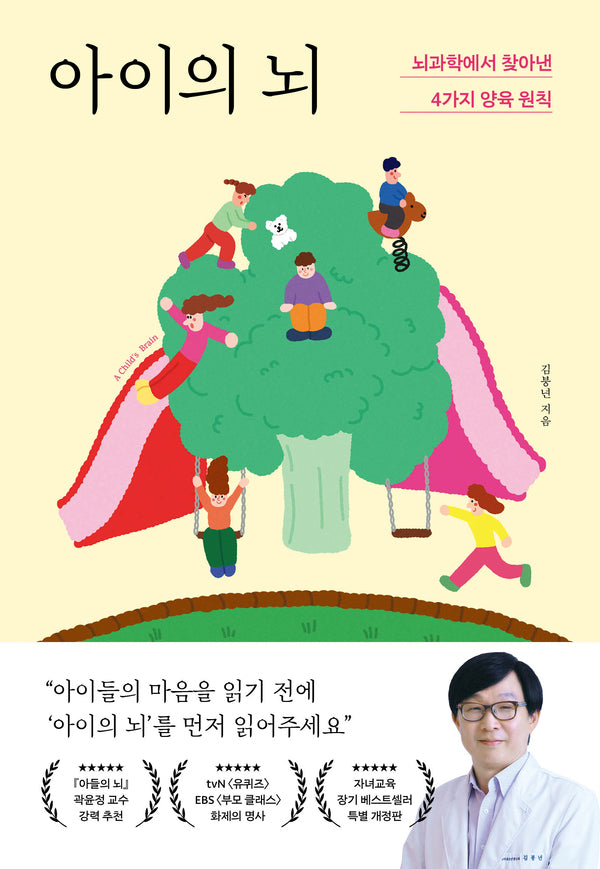
The Child's Brain: 4 Parenting Principles from Neuroscience
Author Kim Bung-nyeon · Publisher Forest Books · Publication Date 2024-12-11 · ISBN 9791193506981 Book Introduction“What on earth are you thinking?” vs“Why are you always like this to me, Mom?”The power of neuroscience that reduces misunderstanding and conflict, and fosters understanding and respect.When raising children, there are times when you might think, "I have no idea what's going on in...
See full description ↓Description
Author Kim Bung-nyeon · Publisher Forest Books · Publication Date 2024-12-11 · ISBN 9791193506981
Book Introduction
“What on earth are you thinking?”
vs
“Why are you always like this to me, Mom?”
The power of neuroscience that reduces misunderstanding and conflict, and fosters understanding and respect.
When raising children, there are times when you might think, "I have no idea what's going on in my child's head." You might feel anxious that your child is falling behind when other children seem to be doing everything perfectly, and even worried that there might be a problem somewhere.
Children feel the same way. They constantly say, "Why are you always like this to me, Mom?" or "What did I do wrong?" They feel unjustly treated and upset because their parents don't seem to understand them.
At the center of all this conflict is the 'brain.' This is because essential human abilities such as thought, empathy, and behavior are not formed at birth but develop in accordance with the brain's developmental process. Therefore, a proper understanding of the brain's growth process and principles becomes a core value in parenting, more important than simply loving your child.
Professor Kim Bung-nyeon, a professor of pediatric and adolescent psychiatry at Seoul National University, who is recognized as a leading parenting mentor in Korea through TV programs like tvN's <You Quiz on the Block> and EBS's <Parent Class>, as well as YouTube and lectures, unequivocally states, "There is a specific way of nurturing and educating that children's brains desire." This is because if parents do not properly understand the brain, which is the core center of thought and behavior, their love and attention for their child can inadvertently turn into excessive demands and hurt. Good parenting is not about giving what parents want to give, but about accurately and consistently providing what the child needs.
“Before you read your children’s minds,
read your children’s brains.”
A book that moves beyond unconditional love and sacrifice
to present clear parenting principles!
After their children are hurt by incorrect parenting methods, parents often say things like, "I did it because I loved my child so much," or "It was all because I wanted my child to do well." However, parenting driven only by emotions and enthusiasm, without clear principles and standards, only leaves scars on both parents and children. So, what exactly is proper parenting?
Professor Kim Bung-nyeon, a leading expert in pediatric and adolescent psychiatry in Korea and a father of two children, answers the question of how to be a good parent by saying, "Treat your child like an honored guest." This short sentence holds a lot of meaning.
First, consideration. If someone is an honored guest, the standard of judgment is naturally placed on the guest, not oneself. This means not imposing what you like or want, but thinking primarily about what the guest wants. Next is respect. It means acknowledging that they are not someone you can control and seeing them for who they are. He emphasizes that to adopt this parenting attitude, one must study 'the child's brain.'
“Children’s brain development has critical periods that differ by area. For a child to grow up with a smart brain and warm emotions, it is very important how appropriately parents provide a nurturing environment for the child’s brain development during these periods.”
If you want your child to be smarter, to think more freely, and to act more confidently, you need to establish clear parenting principles based on scientifically proven brain development, rather than just unconditional love and sacrifice. What parents should read is not the heart, but the child's brain.
Table of Contents
Introduction
How to raise a child with a strong and warm inner self
Part 1 Why brain science is needed in parenting
01 The ever-changing child's brain
02 Nature or nurture?
03 Are smart children happier?
04 Dopamine, the brain's vitality booster
05 Serotonin, the brain's resting place
06 Adrenaline, the brain's alarm system
07 What happens when you don't sleep
08 I don't usually eat breakfast
09 Unexpected habits that strengthen the brain
Part 2. Thought Intelligence that broadens perspectives on the world
10 The secret of children who eventually succeed
11 The brain doesn't work under duress
12 Is my distracted child ADHD?
13 The joy of immersion
14 Imagination changes the brain map
15 A magician who boosts self-esteem
16 The effects of reading that stimulates the prefrontal cortex
Part 3 Emotional Intelligence that helps us see others with warm eyes
17 Getting along is also a skill
18 Empathy grows with love
19 The reason we are drawn to kindness
20 Children whose happiness is held hostage
21 I feel like I've been bitten by a black bulldog
22 Skinship that strengthens happiness muscles
23 School as a safe fence
Part 4 Executive Intelligence that enables us to act as we intend
24 A society that encourages competition
25 Children who can wait lead the world
26 A child who dreams VS a child who achieves dreams
27 The art of praise
28 For children with too much worry and anxiety
29 The willpower circuit that expels negative memories
Product Details
Related products


The book is priced at its original Korean retail price (KRW 1,000 = A$1). Air freight is charged separately at checkout.
Orders close every Tuesday, are sent to Korea on Wednesday, and arrive in store one week after dispatch — 8 to 14 days from your order. Order today and pick up from Wed 28 Oct; we'll email you as soon as your books arrive.
Collect at the book corner in our Lidcombe or Eastwood store. No home delivery. Please have your order number and name ready.
First book A$15 + A$6 per extra book — 1 book $15 · 2 books $21 · 3 books $27 · 4 books $33, calculated automatically at checkout. The more books you order together, the lower the cost per book.
Titles temporarily out of stock in Korea may be delayed by about one week. If a title is out of print or unavailable, we refund that book in full and proceed with the rest of your order.
 The Child's Brain: 4 Parenting Principles from Neuroscience
$17.80
The Child's Brain: 4 Parenting Principles from Neuroscience
$17.80