
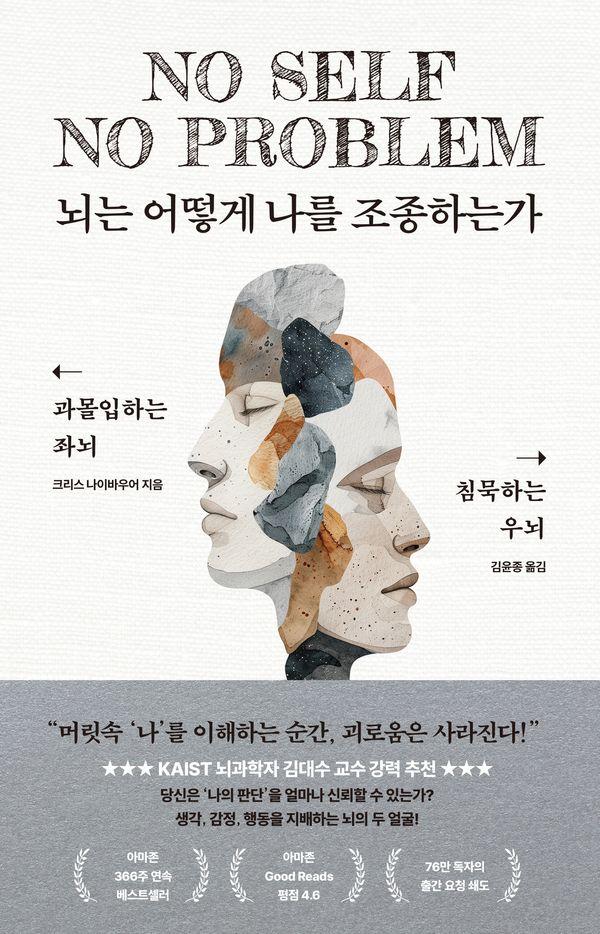
How the Brain Controls Me: The Obsessed Left Brain, The Silent Right Brain
Author Chris Niebauer · Publisher Clabbooks · Publication Date 2026-01-21 · ISBN 9791193941577 About the Book"There's a lie detector in your head!": Modern people trapped in the left brain's snare“If you stop thinking, suffering will stop.” While researching how the left and right brains work, Dr. Chris Niebauer, the author of the book, noticed many commonalities between Buddhist teachings and...
See full description ↓Description
Author Chris Niebauer · Publisher Clabbooks · Publication Date 2026-01-21 · ISBN 9791193941577
About the Book
"There's a lie detector in your head!"
: Modern people trapped in the left brain's snare
“If you stop thinking, suffering will stop.” While researching how the left and right brains work, Dr. Chris Niebauer, the author of the book, noticed many commonalities between Buddhist teachings and neuroscience. From the 'delusion' that someone dislikes him, to the 'judgment' that no matter how hard he tries, he's still far from good enough, to 'beliefs' that are biased, all thoughts that create the trap of prejudice were one-sided interpretations of the left brain, and the moment he believed them to be true reality, mental suffering began. To resolve this situation, the left and right brains needed to be balanced.
The 1990s were a golden age for brain research, known as the 'Decade of the Brain'. Thanks to split-brain patients, whose left and right brain connections were severed to alleviate epileptic seizures, it became possible to study the left and right brains independently, and shocking facts were subsequently revealed. That is, the human brain lies more often than imagined. Dr. Gazzaniga showed the words "Walk." only to the right brain (left eye) of a split-brain patient. The patient immediately got up and started walking. When asked why he got up, he replied, "To get a Coke." This is a lie from the left brain. The right brain received the command to walk, but the right brain does not have language function. Therefore, the left brain, which can communicate, invents a plausible reason. Through this, humanity learned that the left brain is a brain that constantly interprets, regardless of whether it's true or not.
Dr. Niebauer likened the left brain to a 'mind's interpretation device'. The mind's interpretation dominates our emotions and actions. For example, when it suddenly rains, we think, 'The weather is terrible' or 'It's nice and atmospheric.' Depending on what we think when looking at the same rain, the emotions we feel afterward differ greatly. The author explains that the mind that first thinks of complaints is also a result created in the interpretation process of the left brain, which is responsible for language. What if we consider that when we feel like complaining, the left brain gives us biased interpretations to maintain its role? 'My left brain is complaining too much again.' In this way, the author says that merely separating oneself from the left brain's interpretation can reduce mental suffering.
"What if Buddha was a neuroscientist?"
: A masterpiece that scientifically explains the Buddhist concept of Anatta (non-self)
But what if this 'self' is also just an interpretation of the left brain? Dr. Niebauer hypothesizes that the ego, a concept opposite to the Buddhist anatta (non-self), is actually closer to an illusion created by the left brain to control the body and mind. Anatta in Buddhism perceives the self not as a fixed entity but as a constantly changing flow. In contrast, the left brain classifies, defines, and perceives objects as fixed entities. Just as humanity draws lines on a map and names it 'Korea' to claim ownership of territory, the left brain categorizes information entering the brain and gives it various names to assert that it is the master of this body and mind. When there is a comprehensive feeling of 'I am a man, a father, a husband, a professor, and a writer,' the ego is born. However, the ego exists only when it believes itself to be so. If there were no one to remember Korea, could Korea be said to exist? In this way, the ego is a mirage that exists only when one thinks.
What would happen if the left brain shut down and only the right brain functioned? Neuroscientist Dr. Jill Bolte Taylor recounted that when a tumor suddenly appeared in her left brain, right-brain consciousness came to the forefront of her life for the first time, and she heard no voices in her head, only being filled with a feeling of gratitude. This experience was similar to the state experienced by Eastern masters, including in Buddhism and Taoism. The state of anatta, which many people try to reach through meditation and mindfulness practice, was deeply connected to the right brain.
From the perspective of the left brain, which dominates language, the silent right brain is difficult to understand. Therefore, sometimes the term 'unconscious' is attached to the actions of the right brain, but the author emphasizes that "the right brain is another form of consciousness that does not rely on language." American psychologist William James defined the vague feeling of knowing, such as when one instantly likes a new place, when one knows a person but can't recall their name, or when one knows the answer to a problem but can't remember it during an exam, as 'fringe consciousness' and confirmed that the right brain lights up when experiencing this. Similarly, it is difficult for the left brain to verbalize the right brain's ability to process information simultaneously and holistically. One page is enough for a watch assembly manual, but a whole book is needed to explain the watch's purpose and history. Understanding diverse background knowledge broadly is impossible without the right brain's flexible and broad perspective.
"Do I use my brain, or does my brain use me?"
: Balancing life with neuroscience
Researchers are now moving towards a more integrated view of the brain rather than separating it into left and right. Of course, split-brain experiments were by no means meaningless. Without the 1990s, when the left and right brains were studied independently, 21st-century neuroscience would not have made so much progress. However, it is also not desirable to divide the left and right brains antagonistically and adopt an attitude of 'which brain should be preferred?' This is already a left-brain biased idea. Dr. Niebauer stated that the reason for distinguishing between the left and right brains was "to explain it simply so that many people can understand and enjoy neuroscience."
Thanks to the developed left brain, humanity has rapidly advanced technology. Society began to seek left-brained individuals who could produce immediate results. However, in any field, being too skewed to one side inevitably leads to side effects. Excessive performance orientation instrumentalized humans, leading to numerous industrial accidents, and unchecked technological advancement created horrific weapons of war that cannot be undone. In such cases, when the logical and efficient left brain runs wild, the right brain acts as a brake. The 'gut feeling'—that something feels wrong, a hunch, a mood—is difficult to explain in words but suggests that one should stop, which is the action of the right brain. However, if one focuses only on the actions of the right brain, rules and order would be difficult to find in society. The author states that only by understanding the complementary nature of the brain can one use the brain in a balanced way and alleviate life's suffering. "The mind is a tool. The question is, do you use the tool, or does the tool use you?" Through a Zen Buddhist koan, the book poses the question: "Do we use our brain, or does our brain use us?"
《How the Brain Manipulates Me》 examines how emotional suffering such as depression, anxiety, self-loathing, inferiority, and victim mentality grow through the brain, then helps readers move toward a semantic reflection of "Who am I?" However, if one realizes that the fundamental 'self' cannot be easily defined, all questions will converge into one: "Then how will I live going forward?" This is the true theme of this book. Dr. Niebauer became a neuropsychologist to understand the numerous mental sufferings humans experience after his father's death. And just as he did, he completed this book for those who, like him, suddenly found themselves struggling with grief and suffering. The suffering of life is unavoidable. Nevertheless, life goes on, and how we live is up to us.
"I hope your life changes for the better by learning to use your brain in a different way than before." - Chris Niebauer
Table of Contents
Foreword
Introduction: For those whose lives are suffering
Chapter 1 There's a Lie Detector in My Head: The World of Rationalization Created by the Brain
The emergence of split-brain patients
What the left brain did while the right brain slept
The mind creates interpretations
[Experience] The world your brain expresses
Chapter 2 Who are you?: The constructed self
Why do we laugh and cry at words? - Language
Why do we constantly classify? - Categorization
Stories that constantly emerge - Judgment
What saves and kills humans - Belief
[Experience] How strong is my ego?
Chapter 3 Thoughts don't stop: The over-engaged left brain
The left brain likes patterns
The left brain's struggle to maintain the self
The birth of the mirage-like self
[Experience] How many 'me's are inside me?
Chapter 4 What I thought was unconscious: The silent right brain
A neuroscientist with a turned-off left brain
The right brain is not deceived by illusions
How to access right-brain consciousness
Thoughts are another dream world
[Experience] The right brain's attitude towards life
Chapter 5 How the Brain Gives Meaning to Life: Parts and Wholes
The impact of meaning
Interpretive understanding vs. meaningful understanding
The function of metaphor
The meaning of negative space
[Experience] Practicing emptying a full life
Chapter 6 Can I trust my intuition?: Wisdom beyond language
Feelings difficult to explain
Definition of intuition
How to manage emotions?
A grateful brain
Creativity
[Experience] Right-brain intelligence test
Chapter 7 Where is consciousness?: The relationship between brain and consciousness
What is consciousness?
Form field hypothesis
[Experience] Feeling consciousness
Chapter 8 The World After Understanding the Brain: Three Life Strategies
The Hide-and-Seek Folk Tale
Three life strategies
[Experience] New questions about "Who am I?"
Translator's Note
Notes and References
Recommendations
Product Details
Related products

The book is priced at its original Korean retail price (KRW 1,000 = A$1). Air freight is charged separately at checkout.
Orders close every Tuesday, are sent to Korea on Wednesday, and arrive in store one week after dispatch — 8 to 14 days from your order. Order today and pick up from Wed 30 Sep; we'll email you as soon as your books arrive.
Collect at the book corner in our Lidcombe or Eastwood store. No home delivery. Please have your order number and name ready.
First book A$15 + A$6 per extra book — 1 book $15 · 2 books $21 · 3 books $27 · 4 books $33, calculated automatically at checkout. The more books you order together, the lower the cost per book.
Titles temporarily out of stock in Korea may be delayed by about one week. If a title is out of print or unavailable, we refund that book in full and proceed with the rest of your order.
 How the Brain Controls Me: The Obsessed Left Brain, The Silent Right Brain
$18.80
How the Brain Controls Me: The Obsessed Left Brain, The Silent Right Brain
$18.80