
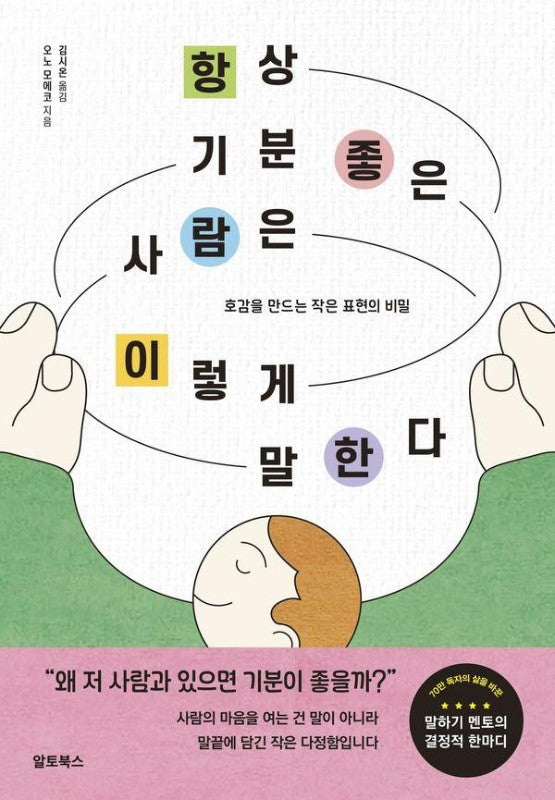
People who are always in a good mood say this: The secret to small expressions that create favor
Author Moeko Ono · Publisher Alto Books · Publication Date 2026-08-20 · ISBN 9791194655404 About the BookThe power of small expressions that make relationships comfortableYou too can become a pleasant personThis book begins with the premise that a single, thoughtlessly uttered word can either smooth or strain a relationship. “That’s usually how it is, isn’t it?” We use this phrase...
See full description ↓Description
Author Moeko Ono · Publisher Alto Books · Publication Date 2026-08-20 · ISBN 9791194655404
About the Book
The power of small expressions that make relationships comfortable
You too can become a pleasant person
This book begins with the premise that a single, thoughtlessly uttered word can either smooth or strain a relationship. “That’s usually how it is, isn’t it?” We use this phrase without much thought. There’s no intention to blame the other person; we simply believe we’re adding our own thoughts. Yet, from that moment, the conversation begins to subtly diverge. The other person feels their opinion has been negated and quietly closes off.
Many people also unconsciously use “but” frequently in conversation. “However” and “but” are expressions that negate what was said previously. If used habitually, they can leave a negative impression on the other person, contrary to intent.
The author suggests that strained relationships don't stem from major conflicts. A short conjunction like “but…” can interrupt someone, and a well-intentioned phrase like “Can I help you?” can sometimes sound like a doubt about the other person’s abilities, making the relationship awkward. Even a considerate expression like “Anything is fine with me” can shift the burden of choice onto the other person. It’s surprising that well-intentioned words can yield completely different results than expected, but upon reflection, it’s an experience most people have had at least once.
The author doesn't attribute these issues to a lack of eloquence or communication skills. Through numerous consultations and corporate training, she confirmed that people react more sensitively to the attitude and heart behind words than to their content. Thus, this book teaches the principles of comfortable conversation for the other person, rather than expressions aimed at persuasion.
Expressive habits that attract people
stem from self-affirmation
This book first reviews conversational habits that make human relationships difficult, then explains the attitude of respectful listening and empathy, and further proposes standards for conversations that maintain comfortable relationships while valuing oneself. Ultimately, it demonstrates through various examples that 'good conversation' is neither sacrificing oneself to accommodate others nor pouring out everything one wants to say. So, without trying too hard to change, as you turn the pages, the speaking habits of pleasant people naturally become ingrained. The moment you realize that a joke like “Are you leaving already?” can be a burden to someone, or that the phrase “Coming to work exactly at 9 AM shows a lack of dedication” might actually just be a personal value, ordinary daily conversations begin to appear completely different. Making you see familiar scenes from a new perspective – that is the biggest change this book offers.
The author compares conversation to a game of catch. A person skilled in conversation isn't just someone who throws well, but someone who throws a ball that the other person can easily catch. And surprisingly, the starting point for this is not speaking technique, but self-affirmation. The more a person accepts themselves as they are, the more comfortably they can treat others, and this attitude naturally permeates their words and expressions, leading to a good impression. This book also presents specific methods for fostering self-affirmation and building comfortable relationships.
It helps readers naturally understand various examples, from listening to others until the end, to responding without negation, to healthy ways of refusing, and maintaining an attitude that respects others while protecting oneself. So, after reading it, you’ll be left with a lingering feeling of having understood people's hearts a little better, rather than just having learned communication techniques.
What transforms human relationships is not the content of words, but 'how they are spoken.' The way pleasant people speak will be a quiet yet powerful weapon that allows you to shine most authentically.
From the Book
One day, while talking with a client, I suddenly felt a sense of incongruity. In her everyday stories, a certain word kept appearing repeatedly. It was the word 'usually.'
“Well, that’s usually how it is, isn't it? Everyone just doesn’t understand.”
“Usually, everyone does it this way.”
Of course, 'usually' is a word everyone uses daily. But its frequency felt a bit high. As I delved deeper into her story, conversations at her workplace gradually became clearer. What she had said to those around her was something like this. -23p
A person whose habitual phrase is “Don’t do it” will naturally blurt out the same words even in urgent situations. However, this can be changed with conscious training. The method is very simple: change “Don’t do it” to “Let’s do it.” All you have to do is flip the negative word into a positive one.
For example, changing “Don’t run” to “Please walk.” This doesn’t mean you have to suppress what you want to say. It merely means changing the way you say it. If you keep using positive expressions like this, they will naturally become ingrained in your speech. Try asking someone using a positive expression today. Especially when requesting something from someone, approach it with the mindset of ‘asking’ rather than ‘commanding.’ -36p
So, what do we discern from the other person's expressions and gestures? It is emotion. In the experiment introduced earlier, people worried, "Isn't he angry?" "Isn't he bored?" The manager's case was similar. It wasn't that he was actually angry, but a misunderstanding arose because his emotions weren't conveyed. Expressing one's emotions to some extent is the first condition for becoming a pleasant person.
Lack of reaction and minimal facial changes are typical factors that create a bad impression. If you, too, are worried, "I try to speak as kindly as possible, but I don't know why I'm perceived as cold," the problem might not be your words, but your non-verbal expressions. -52p
Talking about favorite foods is something anyone can easily do and is a great topic for building rapport.
For example, something like this:
“Actually, I prefer Lotte chocolate over Godiva.”
“Do you dip your tangsuyuk or pour the sauce over it? I always dip.”
“Do you like iced Americano or hot Americano? I drink iced Americano even in the middle of winter.”
Just bringing up everyday stories that anyone can relate to is enough. If you honestly share your preferences like this, you might find common ground. Conversely, if opinions differ, you can further expand the conversation by asking, “What do you like about that option?” -65p
Humans are inherently inclined to talk about themselves, so even when the other person has started speaking, the listener unconsciously changes the subject. However, in active listening, maintaining the state where 'the other person is the subject' is fundamental. True active listening means reflecting back, "So that's what you did," or "So that's how you felt," rather than inserting one's own opinion. This is typically how it's done in counseling.
"I fought with my husband yesterday."
"I see. You had a disagreement with your husband."
"I have a boss I dislike at work."
"I understand. You have a boss you dislike."
Let me emphasize again, saying 'NO' is not the same as rejecting or ostracizing someone. It merely conveys that one does not agree with the other person's proposal or opinion; it does not negate the other person's character itself. In fact, if you hold different opinions or thoughts but endure and tolerate without refusing, you might eventually avoid interpersonal relationships or fall into a state of depression and frustration.
Remember, it's okay to say 'NO.' No, you must say it. However, if you don't properly understand the fundamental difference between 'negation' and 'NO,' depending on which words you choose for the same refusal, you might not only fail to make a good impression but actually become someone with a bad impression. -104p
We've all had the experience where, if a painful event is stuck in the back of our minds and we consciously try not to think about it, it comes to mind even more. This phenomenon is called the 'white bear effect' by psychologist Daniel Wegner. It refers to a state where the more you try not to think about something, the more you become dominated by that thought, and it repeatedly comes to mind whenever something happens. People who lack confidence, in particular, often cling to self-blaming thoughts for a long time in interpersonal relationships, such as, 'Did what I said really mean that?' or 'I didn't express myself properly earlier; did I cause a misunderstanding?' And the longer such time continues, the more severe the lack of confidence becomes. In such cases, a 'forced reset'—deliberately creating time to stop thinking—is also effective for self-compassion. -131p
Even in close relationships, you should not assume that you perfectly understand the other person’s thoughts. Whether between parents and children or spouses, there are often more aspects of each other that they don't know than they realize. Regardless of how close or not close you are, it's important to clearly recognize the boundary between yourself and the other person in your mind. When boundaries are clear, the tendency to arbitrarily make assumptions about others decreases. Also, even if you have a definitive opinion, you can consciously control yourself from bringing it up in conversation. -156p
Communication is like a game of catch. A perfect chemistry is formed when one person throws a ball and the other person catches it. Therefore, a person who can throw a ball that the other person can catch, or even better, a ball that the other person can easily catch, can be said to be a pleasant person.
So, what is an easy-to-catch ball? It's "easy-to-understand language" for anyone who hears it. It means choosing expressions that are not just understandable, but also conveyed accurately without room for misunderstanding. -170p
Everything has multiple facets. Nothing can be viewed from only one direction. Consider that even aspects you’ve believed to be flaws can be seen from a different perspective. You will surely discover something new. Then, finding strengths will become much easier. There’s no need to force yourself to change. You just need to change your perspective. That’s why I believe reframing is the easiest way to discover strengths in the world. Also, if you want to be a pleasant person, actively use this reframing in your conversations. Your attitude towards others will become much softer and warmer. -194p
Table of Contents
Introduction
Chapter 1. The Power of an Unswayed Attitude
· Why "That's usually how it is, isn't it?" ruins relationships
· The dangerous psychology hidden behind the habit of saying "but"
· The mind also has 'immunity'
· 'Not negating' is enough
· The 6-second control that distinguishes likeability from dislike
· The secret 93% that determines your impression
· The 1cm gesture technique that wins favor
· Non-verbal communication that brings a sense of relief
· Confession of tastes that invites favor
Chapter 2. Four Listening Techniques that Unlock the Heart
· When listening, start with emotions; when speaking, start with facts
· The subtle difference between someone who gets angry first and someone who asks for facts first
· The mirror conversation technique of reflecting the other person's words as they are
· Don't steal the other person's story in the name of 'sympathy'
Chapter 3. The Trap of Forced Empathy
· The paradox of the 'nice person to everyone'
· A polite refusal contains a 'specific number'
· The desire to rest is also a legitimate reason
· Don't sympathize, flow with empathy
· The art of expressing honest impressions without stepping on landmines
· True relationships begin only when you stop pretending to be nice
· The inner child still remembers that scolding
· 'Self-compassion' that embraces the wounded self first
· For you who froze your emotions to avoid getting hurt
· A superior's evaluation is merely their own concern
· The art of conversation that doesn't flinch at "Are you leaving already?"
Chapter 4. The Subtle Difference Between Consideration and Interference
· Shallow stereotypes embedded in a single word
· The art of consideration that doesn't cross the line, between 'dipping and pouring sauce'
· Is arriving exactly at 9 AM an unreasonable act?
· Kindness that hides its purpose evokes an ominous feeling
· The ace of communication throws a ball that even a middle schooler can catch
· Words that provide relief are not conversation but 'excretion'
Chapter 5. Habits Practiced Daily by Pleasant People
· In an era of 'no need for greetings,' greetings are still everything
· There is always 'one person' who watches you consistently greet others
· The easiest way to turn weaknesses into strengths
· How to collect pieces of joy from a casually flowing day
· My heart lives in the path I choose for my commute today
· Time to awaken the 'fond feelings' you sealed away after being hurt
· The reason why you, who kept enduring, suddenly became a 'picky person'
· What you need when you're speechless is the 'quantity of experience'
Conclusion
Product Details
Related products



The book is priced at its original Korean retail price (KRW 1,000 = A$1). Air freight is charged separately at checkout.
Orders close every Tuesday, are sent to Korea on Wednesday, and arrive in store one week after dispatch — 8 to 14 days from your order. Order today and pick up from Wed 21 Oct; we'll email you as soon as your books arrive.
Collect at the book corner in our Lidcombe or Eastwood store. No home delivery. Please have your order number and name ready.
First book A$15 + A$6 per extra book — 1 book $15 · 2 books $21 · 3 books $27 · 4 books $33, calculated automatically at checkout. The more books you order together, the lower the cost per book.
Titles temporarily out of stock in Korea may be delayed by about one week. If a title is out of print or unavailable, we refund that book in full and proceed with the rest of your order.
 People who are always in a good mood say this: The secret to small expressions that create favor
$17.80
People who are always in a good mood say this: The secret to small expressions that create favor
$17.80