
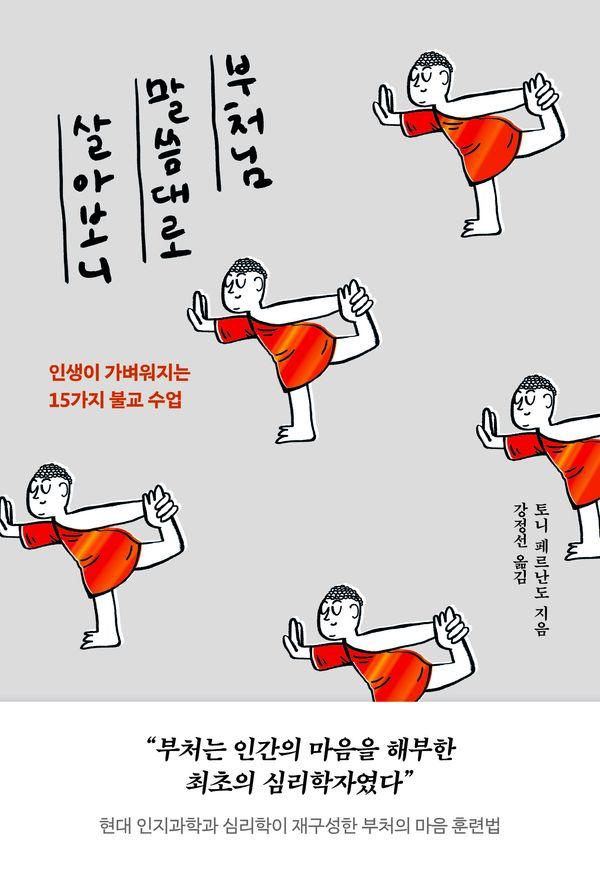
Living According to the Buddha's Teachings - 15 Buddhist Lessons to Lighten Your Life
Author Tony Fernando · Publisher Wilma · Published 2026-02-20 · ISBN 9791199496651 About the BookWhat a world-renowned mental health expert learned from applying the Buddha's teachings to his lifeThe author, who gave up everything to become a monk to delve deeply into the Buddha's teachings, says, "The Buddha's enlightenment was not a mysterious revelation. The Buddha precisely observed how the...
See full description ↓Description
Author Tony Fernando · Publisher Wilma · Published 2026-02-20 · ISBN 9791199496651
About the Book
What a world-renowned mental health expert learned from applying the Buddha's teachings to his life
The author, who gave up everything to become a monk to delve deeply into the Buddha's teachings, says, "The Buddha's enlightenment was not a mysterious revelation. The Buddha precisely observed how the human mind creates suffering and systematically explained how anger, anxiety, attachment, and addiction arise and why they repeat."
Surprisingly, the Buddha's approach is not vastly different from the core questions addressed by modern mental health psychiatry. In fact, the Buddha diagnosed the human mind like an illness, identified its causes, and then proposed concrete methods to reduce suffering. He named the cause of suffering "dukkha" and described the state where thoughts amplify uncontrollably as "papancha." In modern psychiatry, dukkha aligns with "stress," and papancha with "overthinking."
This book is a user manual for the mind in this era, combining the author's experience of practicing the Buddha's teachings as a monk and 20 years of psychological knowledge applied in clinical settings. It shows how desires, thoughts, emotions, and relationships intertwine to amplify suffering, and how to loosen those knots. By following how insights from 2,600 years ago connect with current mental health knowledge, the Buddha's words begin to read like the most realistic guide for living today.
For those who have consistently read psychology books for mind management but still find their minds fluctuating, those seeking concrete methods to reduce suffering rather than vague consolation, those who find religion burdensome but are looking for phrases to sustain their lives, and those seeking new attempts for inner peace like meditation—this book will be the most realistic guide.
From the book
I consider the Buddha to be the most brilliant psychologist in history. He deeply understood why we experience suffering and stress. The Buddha advised us not to blame others but to look within ourselves and observe how our overthinking complicates situations. As a mental health expert, I deeply resonated with his teachings. That's why I temporarily ordained in Myanmar to fully experience Buddhism.
- p.12 From the Preface, "Life Has Deeper Meaning"
2600 years ago, the Buddha's approach to stress was similar to how doctors diagnose and treat illnesses today. First, the Buddha diagnosed the stress and suffering he experienced. Then, he concluded that everyone experiences stress and suffering. The Buddha clearly explains why we experience stress, suffering, and dissatisfaction: it's because we cling, hold onto, and grasp things. I personally think the word "grasp" intuitively expresses attachment well.
- p.31 From Chapter 1, "The Journey to Happiness"
My teacher, Ajahn Chah, always reminded his disciples of the wisdom of "Mai nae (impermanence)." Mai nae means it could be, or it might not be. Everything is inherently uncertain. Truly, everything is. Weather, health, relationships, thoughts, emotions, even matter at the subatomic level—everything in the world is constantly changing. While it might seem pessimistic at first glance, this is the true reality.
Look closely at the phrase "it could be, or it might not be" rationally, without emotion. Then you will realize that countless variables are intertwined in the process of achieving desired outcomes. We cannot control all these countless variables—perhaps thousands, even millions. That is impossible in any situation.
- p.61 From Chapter 2, "We Are All Mad"
The process where the mind gets engrossed in thoughts, narratives, or ideas, spiraling and expanding, was called "papancha." When caught in papancha, the mind summons past memories and creates all sorts of complex stories. Scenarios that are highly unlikely to happen in reality are created. The mind weaves together memories, thoughts, conversations, opinions, fears, and frustrations into a fabric of emotions and feelings that are almost unrelated to the current situation. It makes us mistakenly believe it to be a solid and eternal truth.
The Buddha said, "Recognize papancha, treat it like an illness, and break free from it." He said that being caught in papancha is suffering itself. The Buddha believed that we could awaken from a state of ignorance.
- p.72 From Chapter 2, "We Are All Mad"
People often mistakenly believe that having many commonalities leads to good conversation. Instead of looking for common ground during a conversation, if you have a slight curiosity about the other person, questions will naturally arise. In fact, if you and the other person have different recent experiences, the conversation can flow more easily. Everyone has the skill to spark an interesting conversation.
- p.88 From "Questions That Make Conversation Natural Even with Strangers"
People tend to resemble those they associate closely with. Life is ultimately completed through people, so one should not form relationships lightly. Paper that wrapped incense retains the scent of incense, and string that strung fish retains the smell of fish. Similarly, one's mind is colored by the relationships one forms.
- p.82 From Chapter 3, "Living Harmlessly"
I have temporarily ordained as a monk four times so far. Twice in Myanmar and twice at a temple in Auckland, New Zealand. Temporary ordination lasts from a few days to several months and is a common tradition in Theravada Buddhist countries like Myanmar, Thailand, Sri Lanka, and Laos. My brief experience as a temporary monk was the best experience of my life, one I will cherish until I die. In particular, the ordination experience in Myanmar was so impressive that it overshadowed all other memories.
- p.140 From Chapter 7, "Generosity"
Mindfulness is being aware of what is happening in the mind and body moment by moment. When heard for the first time, it can feel quite abstract. "What exactly is this experience happening in my body and mind?" This definition is much closer to being experienced directly than understood intellectually. In Buddhism, experience has always been valued more than knowledge.
- p.184 From Chapter 9, "Mindfulness"
Among Thich Nhat Hanh's meditation practices, I particularly like dishwashing meditation. Dishwashing meditation contains a simple but profound message.
The thought that washing dishes is unpleasant only comes when you're not washing dishes. When you stand at the sink, roll up your sleeves, and put your hands in warm water, it's surprisingly quite enjoyable. I like to wash each dish slowly. I wash dishes by fully being aware of the feel of the dishes, the warm water, and the movements of my hands.
- p.215 From Chapter 10, "How to Bring Mindfulness into Daily Life"
Just as one can be addicted to material things, one can also be addicted to beliefs. The Buddha, in transmitting the "Mettā Sutta (Discourse on Loving-kindness)," said that one can attain supreme happiness only by not being addicted to fixed views. He also compared his teachings to a raft, teaching us to mercilessly discard the raft when we reach the shore of true happiness. He even taught us to let go of his own teachings. The Buddha was a perfect example of a person who did not hold fixed views.
The alternative to breaking free from afflictions, ultimately, means becoming "lighter" by letting go of attachments. The views we hold now are limited to the present. We must remember that the mind can change at any time, and it is bound to change someday. Furthermore, a day may come when more advanced knowledge proves us wrong.
- p.266 From Chapter 13, "Breaking Free from Addiction"
The way to cultivate kindness and compassion is simple: see others as exactly the same as yourself. It's easy to find differences. So, let's focus on what's the same. It's realizing that we are all the same beings. Regardless of race, nationality, religion, economic background, or political beliefs, we all want the same things.
- p.286 From Chapter 14, "Kindness and Compassion"
You too would want to treat everyone with a heart of loving-kindness and compassion. However, if you are stressed or sleep-deprived, a heart of loving-kindness and compassion will not arise. It is normal for parents not to always treat their children cheerfully when they are busy.
The first step of compassion is to acknowledge that you are tired, depleted, and need rest. Cultivating compassion also includes getting appropriate help from those around you. Your environment is also important.
- p.304 From Chapter 15, "The Four Abodes of the Mind"
Table of Contents
Preface: Life Has Deeper Meaning …12
Part 1: Right View
Change how you see: Why we misunderstand happiness
Chapter 1: The Journey to Happiness
Why pleasure abounds but the mind feels empty …23
Like a wild dog ceaselessly moving …30
The Buddha's diagnosis of stress …31
Will having what you want truly make you happy? …34
Freeing yourself from the thought of "having to" …37
Attributing meaning to oneself …40
Bad thoughts multiply the more you dwell on them …43
Chapter 2: We Are All Mad
The illusion of rationality …48
Desire created by the mind …50
Ice cream melts, desires swell …54
How to live healthily with desires …56
It could be, or it might not be …60
Beings unable to see things as they are …63
The whirlwind of the mind, papancha …69
Part 2: Precepts
Aligning your life first: How to stand on your own two feet
Chapter 3: Living Harmlessly
Practice without harmlessness is empty …77
What is harmlessness? …80
Why uphold the Buddha's precepts …87
Thich Nhat Hanh's mindfulness practice …90
Chapter 4: The First Precept: Speak Kindly and Honestly
Arrows flying first to close ones …93
Five questions for choosing "good words" …95
Sacred silence …109
Chapter 5: The Second Precept: Do Not Harm
The blind turtle and the yoke …110
Even just imagining harming …112
The true meaning of non-killing realized by oneself …114
What can be achieved through non-killing …118
Chapter 6: The Remaining Precepts
The Third Precept: Non-stealing: Be wary of the urge to possess …119
The Fourth Precept: Non-sexual misconduct: Avoid sexual impropriety …123
The Fifth Precept: Abstain from intoxicants: Avoid alcohol …131
Desires are not suppressed but managed …134
Part 3: Giving (Dāna)
Loosening attachment: Training to weaken the "grasping power"
Chapter 7: Generosity
Heart-warming alms round in Myanmar …139
What is generosity? …142
Expect neither reward nor thanks …144
Generosity taught by other beings …146
How generosity works in the brain …147
Giving is about the heart, not the size …149
What comes to mind when facing death …150
Chapter 8: What We Gain from Giving
Does spending money on others truly make you happy? …155
Giving makes people beautiful …157
Giving returns as giving …158
The pit of scarcity amplified by greed …162
When a single candle illuminates the world …166
Part 4: Concentration (Samādhi)
Cultivating the power to observe the mind: The path of my mind
Chapter 9: Mindfulness
The true meaning of mindfulness …173
What we think of as mindfulness …176
Why mindfulness? …177
Efforts to maintain life's tranquility …179
The power to see my mind from the outside …183
Six instruments on the stage of consciousness …184
The three pillars of mindfulness …188
Mindfulness is not a religion …192
Don't try to stop thinking …194
Does it really work? …195
Chapter 10: How to Bring Mindfulness into Daily Life
Closing your eyes and looking at yourself …198
Mindfulness breath meditation …199
Walking meditation …205
Eating meditation …210
Dishwashing meditation …214
Mindfulness in daily life …216
Emotions that torment oneself …218
Chapter 11: Returning When Shaken
Practice is not a lonely path …221
Finding an experienced meditation teacher …222
Setting aside time for meditation …223
Letting go of expectations …224
Smartphone = mindlessness …225
The age of mindlessness is coming …227
Is the ultimate goal of Buddhist practice mindfulness? …229
Part 5: Wisdom (Paññā)
Wisdom revealed in daily life: Living simply
Chapter 12: The Wisdom of Looseness
Not clinging to possessions …233
The感動 (deep impression/emotion) of a simple life …234
Not fearing suffering through restraint …237
We are all addicts …240
Relationship addiction …241
I could be wrong …244
Achievement addicts …247
Addiction is never satisfied …248
Chapter 13: Breaking Free from Addiction
The path from desire to addiction …250
The power of gratitude and contentment …256
Even belief can become an addiction …261
Why do we dislike changing our minds? …263
Time always refutes …264
Practicing listening to different views …266
What is more important than fixed views …269
Part 6: Loving-kindness and Compassion (Mettā-Karuṇā)
A heart that empathizes: The final step to peace
Chapter 14: Kindness and Compassion
The seeds of compassion …273
The core teaching of all religions …274
What is true kindness and compassion? …276
Why kindness and compassion are difficult ①: Stress …277
Why kindness and compassion are difficult ②: In-group bias …278
The satisfaction bestowed by compassion …279
Treat everyone you meet like a friend …283
Chapter 15: The Four Abodes of the Mind
Embodying kindness and compassion …287
The abodes of the mind, Brahmavihārās …289
Practical guidelines for loving-kindness …290
Meditation on loving-kindness and compassion …293
Tonglen meditation …299
Random loving-kindness wishes …302
Obstacles hindering compassion …304
A word from the great monk …305
"Know suffering"—what does it mean? …307
Conclusion: The Mind Has a Place to Return To …312
References …314
Product Details
Related products



The book is priced at its original Korean retail price (KRW 1,000 = A$1). Air freight is charged separately at checkout.
Orders close every Tuesday, are sent to Korea on Wednesday, and arrive in store one week after dispatch — 8 to 14 days from your order. Order today and pick up from Wed 21 Oct; we'll email you as soon as your books arrive.
Collect at the book corner in our Lidcombe or Eastwood store. No home delivery. Please have your order number and name ready.
First book A$15 + A$6 per extra book — 1 book $15 · 2 books $21 · 3 books $27 · 4 books $33, calculated automatically at checkout. The more books you order together, the lower the cost per book.
Titles temporarily out of stock in Korea may be delayed by about one week. If a title is out of print or unavailable, we refund that book in full and proceed with the rest of your order.
 Living According to the Buddha's Teachings - 15 Buddhist Lessons to Lighten Your Life
$18.90
Living According to the Buddha's Teachings - 15 Buddhist Lessons to Lighten Your Life
$18.90